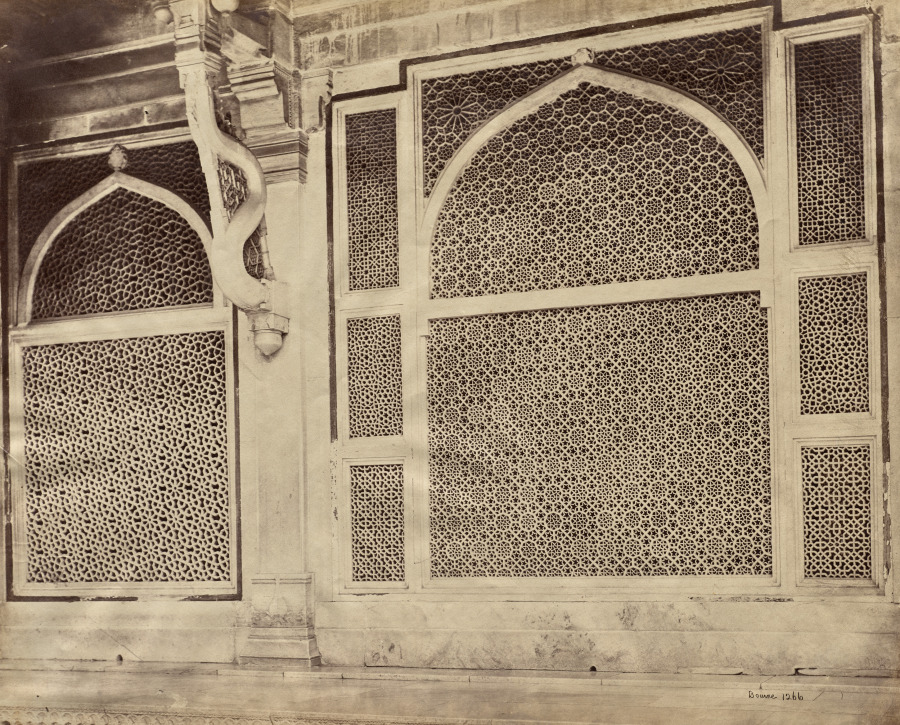
Urban Form: Futtypore Sikri—Two of the Marbled Screens in the Tomb of Sheik Selim Chisti
Technical Analysis: Geometric Integrity & The 2026 Executive Silhouette
The architectural marvel of Fatehpur Sikri, specifically the twin marble jali screens from the Tomb of Sheik Salim Chishti, presents a masterclass in structured void, rhythmic density, and sacred geometry. For the Addison Fashion 2026 executive silhouette, this is not merely an aesthetic reference but a foundational treatise on urban materiality. The artwork’s DNA—its interplay of absolute order and permeable light—provides the precise architectural blueprint for a wardrobe that negotiates between corporate citadel and fluid urbanity. The analysis must proceed with surgical precision, dissecting the geometric integrity of the jali to extract its core principles for sartorial construction.
Structural Poetics: The Grammar of the Void
The primary poetic act of the marble screen is its subversion of mass. It transforms a solid, imposing material—white marble—into a lightweight, breathable membrane through a relentless, mathematically ordered negative space. This is the essence of the 2026 minimalist executive silhouette: the strategic removal of superfluity to reveal an armature of purpose. The silhouette will no longer be defined by the additive layering of past seasons, but by a precise calculus of absence.
The jali’s geometric patterns—likely complex iterations of hexagons, stars, and floral motifs within an overarching grid—establish a non-hierarchical field. There is no single focal point, only a continuous, rhythmic repetition that creates a holistic integrity. Translated, this dictates a move away from the singular "statement piece" and towards a complete and coherent uniform system. Each garment becomes a modular panel within a larger personal architecture. A tailored jacket, for instance, may feature laser-cut micro-perforations in a geometric pattern that echoes at the cuff of a sleeve or the placket of a companion blouse, creating a unified field of design language across the body, not merely upon it.
Urban Materiality: The Paradox of Marble & Membrane
The material genius of the screens lies in their paradoxical nature: they are simultaneously barrier and conduit, providing privacy while permitting light and air to permeate. This is the exact functional metaphor for the contemporary executive’s public-facing role. The required materiality for 2026, therefore, must embody this duality.
Textile development will focus on technical fabrics that mimic this marble-membrane paradox. Expect heavyweight, matte-finish wools and precision-engineered cottons that hold a razor-sharp crease (the solid marble), juxtaposed with or integrated into sections of engineered mesh, ultra-fine gauge knits, or laminated sheer panels (the permeable jali). Seaming will become a primary design feature, acting as the "leading" that defines the geometric panels of the silhouette. Seams will be exaggerated, top-stitched with a contrasting ivory thread, or recessed to create clean, uninterrupted lines that map the body’s architecture with cartographic accuracy.
The 2026 Silhouette Definition: Architectural Modesty & Controlled Revelation
From this analysis, the definitive 2026 executive silhouette emerges as one of architectural modesty with controlled revelation. The geometric integrity of the jali forbids frivolous asymmetry or deconstructed disorder. Silhouettes will be columnar or slightly A-line, echoing the verticality and stability of the architectural source. However, within this strict framework, the "voids" are strategically placed.
This manifests in several key forms:
The Pierced Tailoring: A single-breasted overcoat in a dense, ivory wool-cashmere blend, featuring a symmetrical pattern of laser-cut geometric openings across the shoulders and upper back, revealing a subtle underlayer of silver-backed mesh. The integrity of the outer shell remains uncompromised, but it becomes a filtering screen.
The Layered Monochrome System: A dress constructed from three layers: a foundational slip in silver technical silk, a mid-layer of rigid, honeycomb-structured cotton organdy forming the bodice, and an outer layer of minimalist ivory wool crepe that acts as a moving screen, with strategic openings that frame the structured layer beneath. The body is glimpsed only through the geometric apertures of the intermediate layer.
The Modular Pant Suit: Trousers and a sleeveless tunic-top, both in the same ivory textile, where the geometric pattern is not printed but woven into the fabric structure itself. The pattern is continuous across the separate garments, creating the illusion of a single, seamless architectural form when worn together.
The color, Ivory, is non-negotiable. It references the marble’s purity, its ability to both absorb and reflect the changing urban light (from dawn’s gold to office fluorescence to twilight’s blue), and provides the perfect neutral field upon which the shadows cast by the silhouette’s own three-dimensional geometry become the primary ornamentation. This is clothing as a calibrated environment—a portable, personal Fatehpur Sikri for the executive body, offering sanctuary, defining presence, and filtering the urban gaze through the precise, poetic grammar of the cut.