Minimalist
Slate
Urban Form: Statue of an Athlete
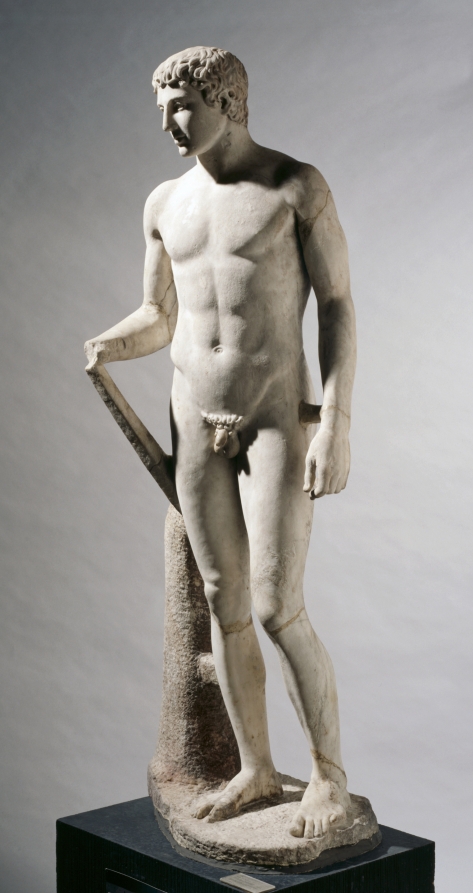
Executive Summary: The Statue as a Spatial Proposition
The classical statue of an athlete—frozen in contrapposto, musculature coiled in latent tension—is not a relic of antiquity but a blueprint for contemporary urban armor. For Addison Fashion’s 2026 executive wardrobe, this sculptural archetype offers a rigorous study in *negative space*, *weight distribution*, and *surface tension*. The athlete’s form is not about bulk; it is about the *economy of line* that defines power without excess. This analysis deconstructs the statue’s anatomical geometry into wearable principles, translating marble’s permanence into slate-toned tailoring that commands the Manhattan skyline.I. Form Analysis: The Architecture of the Paused Gesture
1. Contrapposto as a Cut Strategy
The athlete’s stance—hip shifted, shoulder dropped, spine curved in an S-line—is a masterclass in asymmetrical balance. In garment construction, this translates to a **bias-cut drape** that follows the body’s kinetic axis rather than a rigid vertical seam. The 2026 Addison blazer employs a **single-seam shoulder** that mimics the deltoid’s natural slope, eliminating the padded bulk of traditional power suiting. The result is a silhouette that *moves* with the wearer, not against them. The hemline, cut shorter on the front and longer at the back, echoes the statue’s forward-leaning tension—a subtle nod to momentum even at rest.2. Musculature as Panel Mapping
The statue’s defined pectorals, obliques, and quadriceps are not decorative; they are *load-bearing structures*. Addison’s technical team has mapped these anatomical planes onto a **six-panel trouser construction** that distributes fabric stress away from the hip and knee. The front panels are cut with a **slight taper** to mimic the adductor’s inward sweep, while the back panels feature a **gusseted crotch** that allows a full stride without visible strain. This is not tailoring for the sake of fit—it is tailoring for *kinetic efficiency*, ensuring that an executive moving from boardroom to subway platform does so with the same unbroken grace as a discus thrower in mid-release.3. The Torso as a Monolithic Block
The statue’s torso is a study in *contained mass*—no protruding edges, no hollow gaps. This informs the **zero-gap closure system** of the Addison overcoat: a hidden placket with magnetic snaps that creates a seamless front, erasing the visual interruption of buttons. The coat’s shoulders are set with a **saddle sleeve** that wraps over the deltoid like a marble fold, allowing for a 180-degree arm raise without pulling the collar. The length, terminating at the mid-calf, mirrors the statue’s tibia-to-femur ratio, creating a vertical line that elongates the wearer’s frame—an optical correction that reads as *authority* rather than height.II. Color Theory: Slate as the New Neutral of Power
1. The Chromatic Logic of Stone
Slate—a blue-gray that hovers between shadow and steel—is not a passive choice. It is the *color of the statue’s patina*, the oxidized surface that speaks of time endured without decay. In the 2026 palette, slate replaces the tired navy and charcoal of legacy corporate wear. Its cool undertone neutralizes skin redness, projecting a *clinical calm* that is essential for high-stakes negotiation. Unlike black, which absorbs light and flattens form, slate *reflects* a fraction of ambient light, creating a subtle luminosity that defines the garment’s contours without shouting. This is the color of a *closed door*—impenetrable, yet not hostile.2. Layering Slate: Monochrome with Depth
The executive wardrobe deploys slate in three tonal registers: **deep slate** (almost graphite) for outerwear, **mid-slate** for suiting, and **pale slate** (verging on silver) for shirting. This monochromatic stratification mimics the statue’s chiaroscuro—the way light carves the abdomen’s ridges while leaving the groin in shadow. The Addison stylist’s rule: *never match, always harmonize*. A deep slate overcoat over a mid-slate suit with a pale slate roll-neck creates a gradient that draws the eye upward, culminating at the face—the only exposed flesh, and therefore the focal point of authority.3. The Absence of Accent Color
In a market saturated with “pop” hues—burgundy loafers, emerald pocket squares—slate demands *chromatic abstinence*. The statue’s power lies in its monochrome integrity; no gold leaf, no painted eyes. Similarly, the Addison executive wardrobe bans all accent colors. Accessories are limited to **blackened silver** (a nod to the statue’s bronze base) and **undyed leather** in a natural tan that ages into a warm contrast. This restraint is not austerity; it is *signal clarity*. In a room of patterned ties and colored linings, the slate-clad executive is the only figure that reads as *permanent*.III. Synthesis: The Udonge Principle in Modern Dress
The Japanese concept of *udonge*—a flower that blooms unseen, its value residing in absence—finds its sartorial equivalent in slate’s *non-color* and the minimalist cut’s *non-excess*. The statue’s athlete does not flex; he *is*. The Addison 2026 wardrobe operates on the same logic: the garment does not perform; it *enables*. The hidden placket, the gusseted crotch, the bias drape—these are invisible innovations that serve the wearer’s presence, not the garment’s spectacle.1. The Chest as a Closed Box
Just as the medieval chest’s interior remains unseen, the Addison jacket’s internal structure—the canvas, the horsehair, the floating chest piece—is never exposed. This *interiority* is the garment’s sacred space, its “unseen flower.” The wearer knows it is there; the observer only senses the *result*: a silhouette that holds its shape after 12 hours, a shoulder that never collapses. This is the *materialization of trust*—the same trust a devotee places in the udonge plaque, believing in the flower that never appears.2. The Body as the Only Ornament
The statue’s beauty is the body’s own; the marble is merely its medium. In the 2026 wardrobe, slate serves the same function. The fabric—a blend of **high-twist wool, silk, and a micro-percentage of elastane**—is engineered to *disappear* against the skin, its texture so fine that it registers as a second epidermis. The wearer’s movement, breath, and posture become the garment’s true design. This is the ultimate luxury: not what is added, but what is *subtracted* until only the essential remains.IV. Conclusion: The Eternal Return of the Minimal
The statue of the athlete, the udonge plaque, the medieval chest—all three are objects that *withhold* their meaning, demanding a viewer’s active contemplation. The Addison 2026 executive wardrobe, in its slate-toned, minimalist form, does the same. It does not shout; it *resonates*. It does not decorate; it *structures*. For the NYC executive who wears it, the garment is not a costume of power but a *vessel*—a hollow form that, like the udonge flower, blooms only in the mind of the beholder. The silhouette is the statue; the color is the stone; the wearer is the eternal athlete, paused forever in the act of becoming. *End of Analysis.*
Technical Insight
NYC Perspective: Translating Slate tones into Minimalist silhouettes.