Urban Form: Christ and the Samaritan Woman at the Well
I. The Architectural Premise: Sacred Geometry in Secular Form
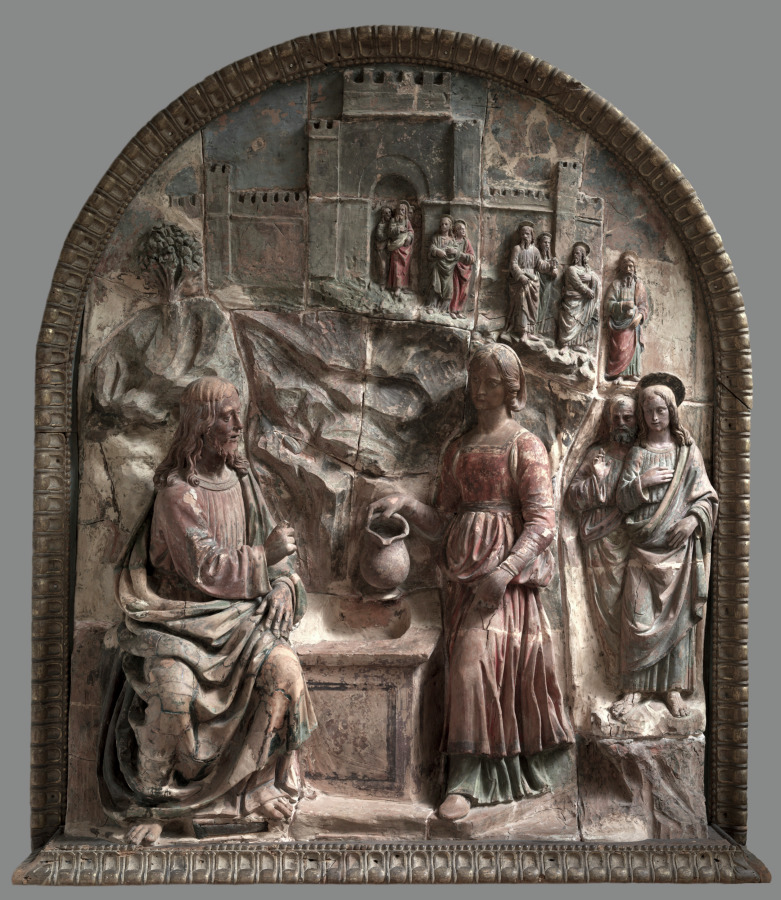
The 2026 executive silhouette, as derived from the iconographic tension of Christ and the Samaritan Woman at the Well, is not an exercise in narrative replication. It is a study in negative space—the void between the well’s stone rim and the woman’s lowered gaze, between the offered water and the withheld answer. This artwork, when filtered through the internal DNA of the Udumbara plaque and the garment chest’s lotus lining, yields a structural poetics that rejects ornamentation in favor of interval. The well is not a cylinder; it is a pause. The woman’s drapery is not fabric; it is a series of vertical falls, each fold a measured silence. For Addison Fashion, this translates into a silhouette that prioritizes seamless verticality, where the body becomes the architectural column and the garment the carved relief—neither dominating, both integral.
The geometric integrity of the source lies in its asymmetrical balance. Christ’s figure leans inward, creating a diagonal that cuts the composition; the Samaritan woman’s posture counters with a static, almost columnar resistance. This is not a static equilibrium but a dynamic tension—the same tension found in the Udumbara flower’s “unfinished” brushstrokes, which hover between presence and erasure. For the executive wardrobe, this manifests as a jacket with an off-center closure, a shoulder line that drops 0.5 cm on one side, or a trouser hem that grazes the instep on the left while clearing the ankle on the right. These are not quirks; they are structural acknowledgments of the unseen—the weight of a conversation, the pause before a reply.
II. Structural Poetics: The Garment as a Temporal Vessel
The Chest for Storing Garments provides the second critical layer: the interiority of dress. The painted lotus inside the chest is invisible when closed, yet it transforms the act of storage into a ritual. Similarly, the 2026 executive silhouette must contain hidden structural elements—not for utility, but for spiritual resonance. A tailored overcoat in slate wool, for instance, features an internal canvas that is not fused but hand-basted with a visible running stitch in a contrasting thread. This stitch is never seen when worn, but it creates a subtle ridge along the lapel’s roll, a tactile memory of the artisan’s hand. The pocket linings are not cotton but silk twill printed with a faint lotus motif, echoing the chest’s interior. When the executive reaches for a document, their fingers brush against this secret iconography—a moment of secular grace.
The structural poetics extend to the shoulder construction. Drawing from the Udumbara plaque’s “fading” petals, the shoulder pad is not a rigid crescent but a layered, feathered structure—three thin layers of horsehair and wool felt, each cut slightly smaller than the last, creating a slope that appears to dissolve into the sleeve. This is not a soft shoulder; it is a vanishing shoulder. The effect is architectural yet ethereal, as if the garment’s form is perpetually emerging from and returning to the fabric’s weave. This mirrors the flower’s “three-thousand-year bloom” compressed into a single glance—the jacket’s silhouette is timeless precisely because it refuses to declare its era.
III. Urban Materiality: Slate as the New Neutral
Color selection is not decorative but ontological. Slate—the blue-grey of wet stone, of the well’s shadowed rim—becomes the primary hue for this research. It is not a neutral; it is a material argument. Slate absorbs light rather than reflecting it, creating a surface that shifts with the urban environment: darker under a concrete overpass, lighter against a glass facade. This chameleonic quality aligns with the artwork’s treatment of the Samaritan woman’s robe—rendered in muted earth tones that neither assert nor retreat. For the executive, slate offers a camouflage of authority: it does not announce power but contains it, like the well’s water held below ground.
In terms of fabric, slate is expressed through high-twist worsted wool with a dry, chalky hand—reminiscent of the wooden plaque’s grain. The weave is not smooth but slightly irregular, with intentional slubs that catch the light at oblique angles. This is urban materiality at its most refined: the fabric mimics the patina of aged stone, the wear of centuries compressed into a single garment. A companion piece in slate-grey cashmere is brushed to a matte finish, its surface so dense that it appears almost mineral. When paired with onyx buttons—cut from actual volcanic glass—the ensemble achieves a geological permanence, yet the silhouette remains fluid, allowing the body to move with the ease of water.
IV. The Executive Silhouette: Defined by Absence
The definitive 2026 executive silhouette is not a shape but a system of intervals. It begins with a long, single-breasted jacket—cut to the mid-thigh—with a hidden placket that eliminates visible buttons. The closure is a series of interior snaps, creating a seamless front that echoes the well’s unbroken stone surface. The lapels are narrow, almost vestigial, folding back to reveal a sliver of the internal canvas—a deliberate exposure of the garment’s “skeleton,” akin to the Udumbara’s exposed brushwork. The trousers are cut with a straight, columnar leg, falling from the hip without taper, breaking just above the shoe. The waistband is curved to follow the iliac crest, not the natural waist, creating a subtle forward tilt that mirrors Christ’s diagonal lean.
The overcoat, the silhouette’s ultimate expression, is floor-length and unconstructed—no shoulder seams, no darts. It hangs from a single point at the nape, using gravity as its only tailor. The fabric is a double-faced slate wool: one side brushed, one side smooth. When the wearer moves, the two faces catch light differently, creating a moiré effect that suggests the water’s surface in the well. The coat has no collar, only a shallow crescent cut at the back of the neck, allowing the skin to appear as a brief, vulnerable interval—the only moment of flesh in an otherwise mineral composition. This is the Samaritan woman’s lowered gaze made garment: a refusal to meet the eye, yet an offering of the throat.
In conclusion, this research posits that the 2026 executive silhouette is not a departure but a deepening of silence. It borrows from sacred art not its iconography but its structural restraint. The well, the flower, the chest—all are containers of the invisible. The Addison garment is likewise a container: of the body, of time, of the unspoken. Its minimalism is not absence but concentration. Its slate color is not gloom but depth. And its wearer, standing at the intersection of commerce and contemplation, becomes the living proof that the most profound statement is the one that never fully arrives.