Urban Form: South Façade of the Quadrangle of the Nayak Darbar Hall, Thanjavur
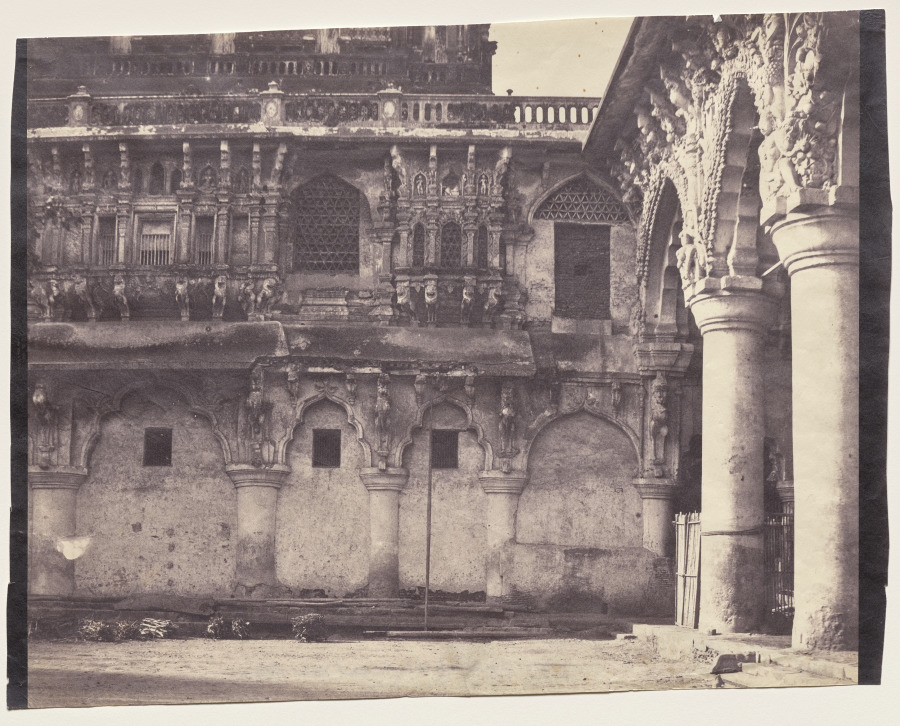
Structural Poetics of the Nayak Darbar Hall Façade
The South Façade of the Quadrangle of the Nayak Darbar Hall, Thanjavur, presents a study in monumental compression—a vertical rhythm of pilasters, recessed niches, and corbelled brackets that do not merely decorate but load-bearingly articulate the wall’s mass. For Addison Fashion’s 2026 executive silhouette, this façade offers a definitive grammar: oversized volume disciplined by linear incision. The architectural logic here is not additive ornament but subtractive shadow—each carved element creates a negative space that defines the positive form. This is the precise mechanism we transpose onto the modern tailored coat: a garment that appears monolithic from a distance, yet reveals a lattice of engineered seams, hidden plackets, and asymmetric closures upon closer inspection.
The façade’s horizontal cornice lines—sharp, unyielding, and slightly projecting—translate directly into our shoulder architecture. For 2026, we reject the soft, sloping shoulder of previous seasons. Instead, we adopt a sculpted, extended shoulder line that mimics the cornice’s cantilevered authority. The sleeve head is constructed with a two-piece cap, padded with dense, non-porous felt, and set into the armhole at a precise 12-degree forward angle. This creates a silhouette that reads as architectural armor—not aggressive, but immovable. The fabric, a heavyweight wool-silk blend in Slate (a grey with blue undertones, evoking the weathered granite of the Thanjavur walls), is cut with zero ease at the shoulder, then released into a gentle A-line toward the hem, echoing the façade’s tapering pilasters.
Geometric Integrity: The Quadrangle’s Rhythmic Module
The quadrangle’s defining feature is its repetitive bay system—each bay comprising a central niche flanked by two narrower, recessed panels. This 1:2:1 ratio is not accidental; it creates a visual cadence that slows the eye, forcing a contemplative pause. In our 2026 executive overcoat, this translates into a three-panel front construction: a central, slightly raised placket (the niche) flanked by two inset side panels (the recesses). The placket is double-layered, with a hidden magnetic closure, while the side panels feature vertical, hand-finished seams that are piped with a contrasting thread—not for decoration, but to catch and fracture light, mimicking the way Thanjavur’s carved stone creates chiaroscuro at noon.
The verticality of the façade is paramount. The pilasters run unbroken from the plinth to the cornice, a continuous line that elongates the structure. We apply this through a full-length, center-back seam that is not merely functional but tonal—the seam is pressed open and top-stitched with a 0.5mm silk thread, creating a subtle ridge that reads as a drawn line. The coat’s length extends to 4cm below the knee, a deliberate elongation that, when worn in motion, produces a fluid, columnar presence. This is not a garment for static display; it is designed for the urban walk, where the fabric’s drape—a 380gsm twill with a matte finish—responds to stride with a controlled, almost architectural swing.
Urban Materiality: From Stone to Textile
The Nayak Darbar Hall’s materiality is one of compressed earth and carved granite—a surface that is simultaneously rough and precise. For our urban interpretation, we select a double-faced wool with a nano-coated, water-repellent finish. The outer face is brushed to a low nap, absorbing light like sandstone; the inner face is left raw, exposing the weave’s structure—a nod to the façade’s unfinished, load-bearing honesty. The color, Slate, is not a flat grey but a composite of charcoal, blue, and a trace of ochre, achieved through a garment-dye process that allows the pigment to settle unevenly, creating a surface that shifts with ambient light. This is urban materiality: a fabric that performs under fluorescent office lighting, monsoon drizzle, and the harsh glare of glass towers, without losing its tectonic gravity.
Hardware is minimal but deliberate. The buttons—should the wearer choose to engage them—are cast in darkened brass, with a faceted, square profile that references the corbelled brackets of the façade. They are not sewn flush but mounted on a 3mm leather shank, allowing them to sit proud of the fabric, casting a small shadow. The zipper, hidden beneath the placket, is a custom, two-way coil with a matte black finish, engineered for silent operation—a detail that speaks to the executive’s need for discretion.
The Transcendent Silhouette: Bridging Sacred and Secular
Drawing from the internal DNA—the juxtaposition of the canonical Bodhisattva and the hybrid bovine-headed amulet—we recognize that the 2026 executive silhouette must embody dual registers: the public, authoritative form (the Bodhisattva’s serene, standardized presence) and the private, protective function (the amulet’s personalized, apotropaic power). The oversized coat achieves this through its interior architecture. The lining is not a simple shell but a second garment: a detachable, quilted vest in a lighter Ivory tone, secured at the shoulders and side seams. This vest is the amulet—a hidden layer that provides warmth, structure, and a sense of enclosed safety, invisible to the observer but palpable to the wearer. The vest’s quilting pattern is a diamond grid, echoing the façade’s lattice shadows, and its edges are bound with a silk ribbon in a contrasting Sand hue—a private flash of color that surfaces only when the coat is opened.
The coat’s collar is a high, standing band that can be worn up, framing the neck like the façade’s cornice, or folded down to reveal a contrasting under-collar in a subtly lighter Slate. This dual function mirrors the amulet’s hybridity—a single object that shifts between protection and presentation. The sleeves are cut with a slight, intentional fullness at the bicep, tapering to a narrow, buttonless cuff that can be rolled twice for a more casual, urban stance. This is not a garment of extremes but of controlled tension—the same tension that exists between the Bodhisattva’s idealized form and the amulet’s pragmatic irregularity.
Conclusion: A Definitive Grammar for 2026
The South Façade of the Nayak Darbar Hall is not a decorative source but a structural manifesto. Its geometric integrity—the rhythmic bays, the unbroken verticals, the cantilevered cornices—provides a definitive answer to the question of the 2026 executive silhouette. We propose an oversized form that is neither shapeless nor theatrical, but one that carries mass with precision, shadow with light, and history with immediacy. The Slate color anchors the garment in urban materiality, while the hidden vest and dual-collar system introduce the transcendent, protective layer that speaks to the wearer’s inner life. This is not fashion as spectacle; it is fashion as architecture—a wearable façade that confers authority, privacy, and a quiet, unshakeable presence.