Urban Form: Covered Teapot
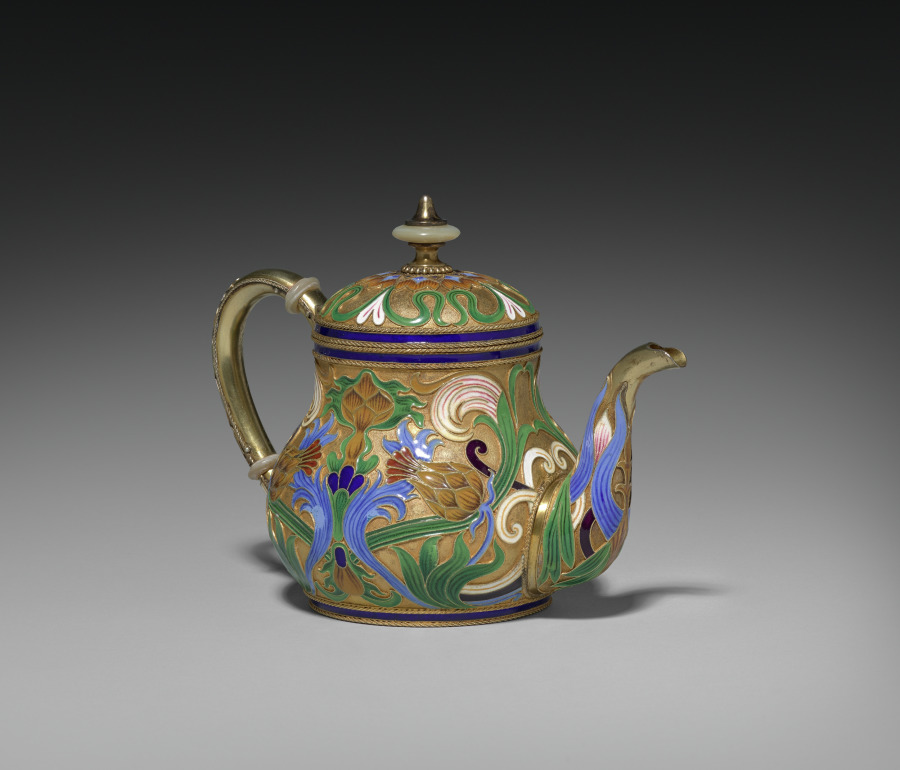
Formal Deconstruction: The Covered Teapot as a Dialectical Object
The covered teapot, in its most reductive reading, is a vessel of containment—a cylinder capped by a dome, a spout extending as a functional appendage, a handle completing the ergonomic circuit. Yet within the Addison Fashion 2026 Urban Silhouette Research framework, this domestic artifact is not a utilitarian object but a structural thesis. Its geometry oscillates between the Mold Fragment with Musicians—a broken clay shard where figures are caught mid-gesture—and the Standing Disciple Mahakasyapa Holding a Cylindrical Reliquary, a painted icon of serene verticality. The teapot, like these two masterworks, occupies a liminal zone: it is neither fully closed nor open, neither purely functional nor purely symbolic. This duality is the core of its relevance to the executive wardrobe, where the body itself becomes a vessel for professional identity.
1. The Cylindrical Body: Verticality and the Architecture of Restraint
The teapot’s primary mass—a cylinder—mirrors the reliquary’s columnar form in Mahakasyapa’s hands. In the Dunhuang mural, the reliquary is not merely held; it is presented, its vertical axis aligned with the disciple’s spine, creating a single, unbroken line from earth to crown. This is the silhouette of authority: uncompromising, grounded, yet aspirational. For the 2026 NYC executive, this translates into the long-line blazer or the columnar overcoat—garments that suppress lateral bulk and emphasize a continuous vertical flow. The teapot’s cylinder, however, is not a rigid tube; its walls subtly taper or swell depending on the potter’s hand. Similarly, the modern executive silhouette must allow for micro-adjustments in fit—a slight drape at the shoulder, a gentle taper at the hem—to avoid the stiffness of a uniform. The Sand palette, chosen for this analysis, reinforces this architectural quality: it is the color of raw clay, of unglazed potential, evoking both the archaeological fragment and the pristine gallery wall.
2. The Lid and Spout: The Dialectic of Closure and Release
Where the cylinder represents containment, the lid and spout introduce the tension of controlled emission. The lid is a disc of closure, yet it is never fused to the body; it rests, poised, ready to be lifted. This is the executive’s public-private boundary—the ability to present a sealed exterior while retaining the capacity for revelation. In the Angkor fragment, the musicians’ lips are “half-open, as if about to sound,” a frozen moment of imminent release. The teapot’s spout, similarly, is a channel for what is held within, but it is also a protrusion that breaks the vessel’s pure geometry. In garment terms, this manifests as the asymmetric closure or the strategic slit—a single, deliberate interruption in the silhouette that suggests motion without sacrificing composure. The spout’s angle, often slightly upturned, echoes the tilt of a musician’s head in the mold fragment: a gesture of listening, of anticipation. For the NYC executive, this translates into a shoulder seam that sits slightly forward, or a collar that lifts just off the nape—details that imply readiness, not rigidity.
3. The Handle: The Ergonomics of Power
The handle is the teapot’s most anthropomorphic element—it is where the hand meets the object, where intention becomes action. In the reliquary painting, Mahakasyapa’s hands are not gripping but cradling; the gesture is one of custodianship, not possession. The teapot’s handle, whether a loop or a sharp angular ear, must balance this same duality: it must be graspable yet not aggressive, supportive yet not subservient. In the 2026 wardrobe, this is the sleeve construction—the point where the arm meets the garment. A raglan sleeve, for instance, allows for a fluid range of motion while maintaining a clean line from shoulder to wrist, much like the handle’s smooth arc from body to grip. Conversely, a set-in sleeve with a precise cap creates a sharper, more defined shoulder—echoing the angular handles found in Khmer ceramics, which project a sense of deliberate, almost martial readiness. The choice between these two is a choice between fluidity and structure, between the musician’s suspended motion and the disciple’s frozen reverence.
4. Surface and Texture: The Patina of Time
Both source artifacts are defined by their surfaces—the mold fragment’s eroded relief, the mural’s layered pigment. The teapot, when glazed, offers a smooth, reflective plane; when unglazed, it reveals the porous, tactile grain of clay. This dichotomy is crucial for the executive wardrobe’s fabric selection. A Sand-toned wool crepe with a matte finish mimics the unglazed ceramic—absorbent, grounded, and quietly luxurious. A silk twill with a subtle sheen, on the other hand, recalls the glazed surface, catching light and suggesting a polished, outward-facing persona. The 2026 NYC executive does not choose between these; she layers them. A matte shell beneath a lustrous outer layer creates a dialogue between interior and exterior, between the private self and the public presentation—exactly as the teapot’s unglazed interior holds the liquid while its glazed exterior presents to the room.
5. The Empty Interior: Negative Space as Power
Finally, the teapot’s most profound feature is its emptiness. It is a vessel defined by what it does not contain—air, potential, the absence of liquid until filled. This negative space is the ultimate luxury in an urban environment defined by density and noise. The mold fragment’s musicians play “silent music”; the reliquary holds relics unseen. Similarly, the executive silhouette must incorporate deliberate voids: a wide-leg trouser that creates a column of air around the leg, a cape that does not cling but hovers, a neckline that exposes the clavicle’s architecture without revealing more. These are not absences but presences—spaces that allow the wearer to breathe, to move, to be perceived without being consumed. In the Sand palette, these voids become even more pronounced, as the color’s neutrality allows light to define the form rather than the fabric’s pattern.
Conclusion: The Teapot as a Blueprint for 2026
The covered teapot, when dissected through the lens of Khmer and Tang-dynasty aesthetics, ceases to be a kitchen object and becomes a manifesto for minimalist power dressing. Its cylinder demands verticality; its lid and spout negotiate closure and release; its handle balances ergonomics and authority; its surface negotiates time and texture; its void offers respite. For the Addison Fashion 2026 executive, these principles coalesce into a wardrobe that is not merely worn but inhabited—a series of architectural decisions that, like the mold fragment and the mural, transcend their material origins to articulate a timeless dialectic between the sacred and the secular, the broken and the whole, the silent and the resonant. In Sand, this vision is rendered in the color of earth and ash, of beginnings and endings, of the vessel that holds everything precisely because it contains nothing.