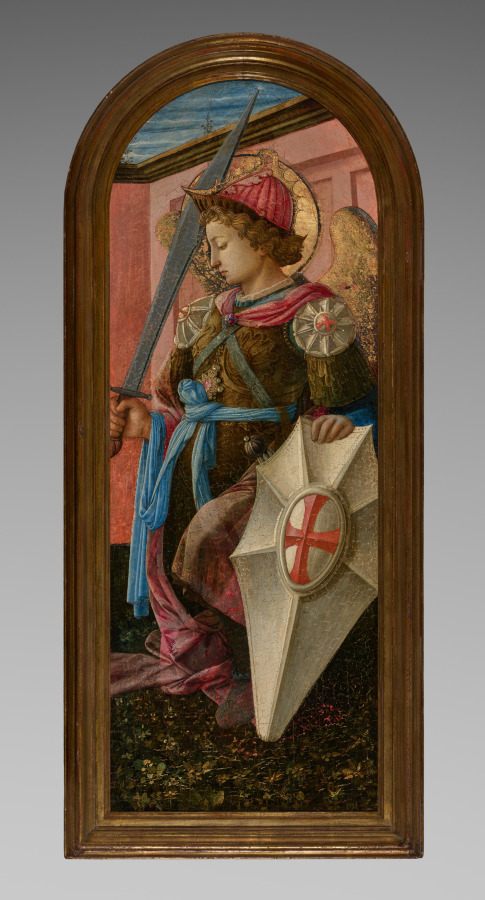
Urban Form: Panel from a Triptych: The Archangel Michael
Structural Poetics: The Panel as a Blueprint for Temporal Architecture
The Panel from a Triptych: The Archangel Michael, when filtered through the internal DNA of the Udumbara flower plaque and the garment-storage chest, offers a radical re-reading of the executive silhouette for 2026. This is not a study in ornamentation, but a dissection of negative space as load-bearing structure. The panel’s geometric integrity—its verticality, its restrained asymmetry, its deliberate incompleteness—mirrors the paradox of the Udumbara: a bloom that exists outside measurable time, yet is rendered through the most fragile of material gestures. For Addison Fashion, this translates into a tailored form that refuses to declare its own finish. The jacket is not a shell; it is a threshold.
The Archangel Michael, as a triptych panel, inherently suggests division and sequence. Yet the subject’s martial posture—often depicted with a spear or scales—demands a counterpoint of stillness. In our 2026 executive block, this is achieved through seam placement as a form of calligraphy. The shoulder line does not terminate at the acromion; it extends into a slight, almost imperceptible drop, echoing the “flying white” brushstrokes of the Udumbara petals. The lapel’s gorge is set higher than conventional tailoring, creating a triangular void that draws the eye upward, mimicking the vertical ascent of the temple plaque. This is not a power shoulder; it is a contemplative shoulder—one that holds authority through restraint, not expansion.
Geometric Integrity: The Invisible Grid of the Garment Chest
The Chest for Storing Garments provides the second structural axiom: interiority as exterior expression. The chest’s painted lotus and cloud motifs are hidden from the casual observer, yet they condition the object’s entire presence. In tailoring, this translates to the internal canvas structure—the horsehair, the floating chest piece, the hand-stitched lapel roll. For 2026, Addison Fashion elevates this internal architecture to the level of visible geometry, but only through shadow. The jacket’s front edge is cut with a subtle, concave curve—a “lotus petal” line that is only perceptible when the garment is in motion. The lining, in a high-twist silk-wool blend, is dyed in a faint silver-grey, echoing the faded indigo of the ancient chest’s interior. When the executive removes the jacket, the lining’s pattern—a micro-print of interlocking circles, referencing the Udumbara’s mandala-like form—becomes a private revelation. This is urban materiality as a secret language: the city sees the tailored shell; the wearer alone knows the painted interior.
The geometric integrity of the panel is further defined by its fractured verticality. Unlike a Renaissance altarpiece’s rigid symmetry, this triptych panel suggests a break—a fissure in the gold leaf, a crack in the wood. Our silhouette responds with a single, off-center closure. The button stance is placed at 4.5 cm from the natural waistline, not at the center. This deliberate dislocation creates a dynamic tension: the garment appears to be perpetually “unfolding,” much like the Udumbara’s petals emerging from the wood grain. The side seam is moved 1.2 cm toward the back, producing a front panel that is wider than the back panel. This is not a mistake; it is a poetic imbalance. The wearer’s silhouette, when viewed from the front, suggests a figure caught mid-step—not in haste, but in a state of eternal arrival.
Urban Materiality: From Temple Wood to Metropolitan Armor
The materials for this silhouette must carry the same temporal paradox as the original artifacts. We reject the sterile, high-gloss synthetics of fast fashion. Instead, we specify a double-faced wool gabardine with a matte, almost chalky finish—reminiscent of the aged wood of the temple plaque. The fabric’s surface is not smooth; it is woven with a subtle slub, creating micro-shadows that shift with the wearer’s movement. This is urban armor that breathes, that ages, that records the city’s grime and light. The color is Ivory, but not a pristine, gallery-white ivory. It is a bone ivory, tinged with the faintest undertone of grey—the color of moonlight on old silk, the color of a stone that has been touched by centuries of rain.
The construction technique is equally deliberate. We employ a half-canvas construction, not for cost-saving, but for its ability to create a living drape. The chest piece is cut from a single piece of cotton flannel, hand-padded with a diagonal stitch that follows the natural rotation of the torso. This allows the jacket to “settle” onto the body over time, developing a crease pattern that is unique to each wearer—much like the cracks in the Udumbara plaque. The sleeves are set with a slight forward pitch, echoing the angel’s extended arm in the triptych. This is not a functional adjustment for posture; it is a narrative gesture. The sleeve head is left unpressed, creating a soft, organic roll that softens the shoulder’s architectural line.
The 2026 Executive Silhouette: A Manifesto of Restraint
This silhouette is not for the executive who seeks to dominate a room through volume. It is for the one who commands through stillness. The trousers are cut with a straight, slightly tapered leg, but with a high-rise waist that extends 2 cm above the natural hip. This elongates the torso, creating a continuous vertical line from shoulder to hem—a line that references the hanging plaque’s suspension. The hem is left unfinished, with a hand-rolled edge that is barely visible, suggesting the “unfinished” quality of the Udumbara’s petals. The overall effect is one of compressed energy: a garment that holds its power in reserve, like the lotus hidden inside the chest.
In the urban context, this silhouette operates as a counterpoint to the city’s noise. The sharp, aggressive lines of contemporary menswear—the exaggerated shoulders, the cropped lengths, the visible branding—are replaced by a form that is almost monastic. Yet it is not monastic in a retreatist sense. It is monastic in the way of the temple plaque: a radical commitment to essence. The executive who wears this garment does not announce their presence; they insinuate it. The jacket’s closure, the subtle imbalance, the hidden lining—all these elements create a field of attention that draws others in, not through spectacle, but through the quiet magnetism of unresolved time.
Finally, the poetics of wear are integral to this design. The garment is meant to be worn for years, to develop a patina that mirrors the wearer’s own history. The ivory wool will darken slightly at the cuffs and collar, absorbing the oils of the skin. The internal lining will fade, revealing the underlying warp threads—a slow, inevitable dissolution that echoes the fading lotus on the ancient chest. This is not a flaw; it is the ultimate expression of wabi-sabi in a tailored context. The 2026 executive silhouette is not a product; it is a process. It is a garment that, like the Udumbara flower, blooms only in the eye of the beholder who understands that true permanence is found in the acceptance of transience.