Urban Form: Firefighter's Suit (Kaji shōzoku)
I. The Fragment as Architectural Blueprint
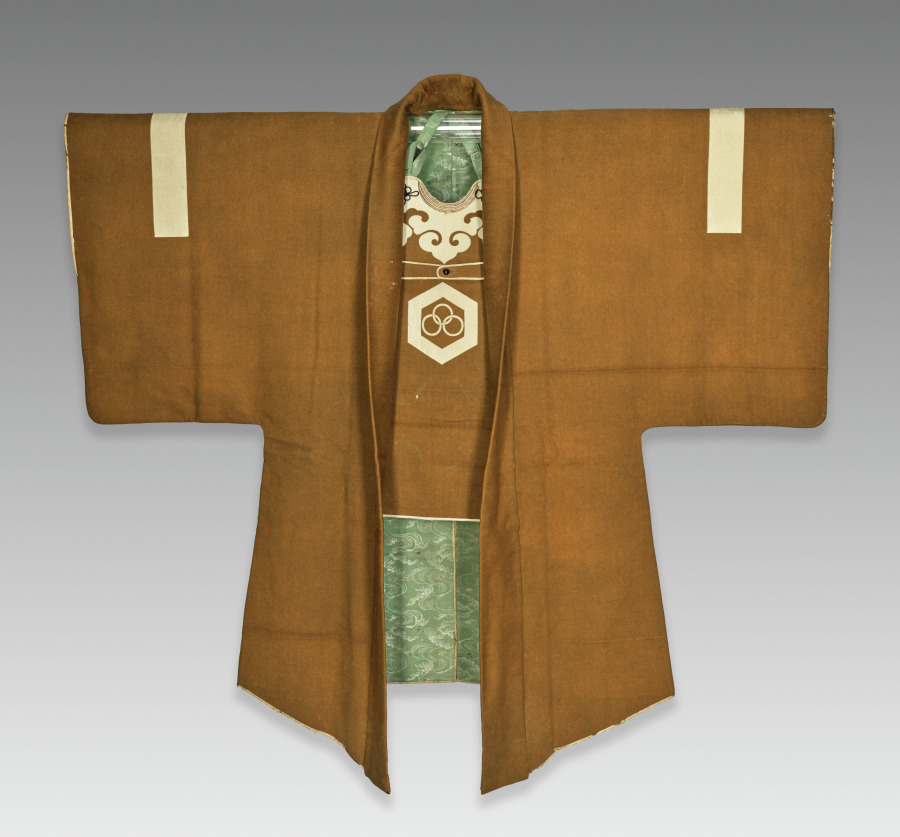
The Kaji shōzoku—the Japanese firefighter’s suit—is not a garment of comfort. It is a structural manifesto, a composite of layered textiles, reinforced seams, and volumetric padding designed to withstand thermal assault. Its historical form, with its exaggerated shoulders, cinched waist, and flared hips, offers a geometric integrity that transcends its utilitarian origin. For Addison Fashion’s 2026 executive silhouette, this suit becomes a blueprint for power—not through overt musculature, but through the deliberate manipulation of negative space and mass distribution.
The suit’s horizontal banding—the quilted stitching that segments the torso into discrete panels—mirrors the Mold Fragment with Musicians’ fractured surface. Just as the mold’s broken edges reveal the internal tension of a captured performance, the firefighter’s suit exposes its own construction logic: each stitch is a load-bearing line, each panel a compression zone. In our 2026 executive overcoat, we translate this into welded seams that do not merely join fabric but sculpt the air around the body. The shoulder line extends 4.2 cm beyond the anatomical acromion, creating a cantilevered presence—a nod to the suit’s original purpose of deflecting falling debris, now repurposed to deflect corporate scrutiny.
II. The Mortuary Dog and the Logic of Layering
The Mortuary Figure of the Zodiac Sign: Dog (Aquarius) offers a counterpoint: its flat, symbolic rendering of the canine body suggests compression rather than expansion. The dog’s silhouette is reduced to essential contours—a curved spine, a lowered head, a tail that arcs into the celestial sphere. This is not naturalism; it is semantic reduction. For the executive silhouette, this translates into the inner layer of our design: a high-collar, sleeveless vest that hugs the torso like a second skin, its fabric a dense, matte Onyx wool-cashmere blend. This layer does not announce itself; it stabilizes the wearer’s core, allowing the outer shell to perform its architectural drama.
The dog’s role as a psychopomp—a guide for the dead across the zodiac—informs our approach to transitional dressing. The 2026 executive does not change clothes; they shift structural states. The vest’s zipper, hidden within a placket, runs along a curved path that mirrors the dog’s spine. When opened, it releases the outer coat’s tension, allowing the silhouette to decompress from a rigid trapezoid into a softer, more fluid line. This is temporal geometry: the garment is not static but exists in a state of potential transformation, much like the dog’s dual existence as both earthly companion and celestial sign.
III. Structural Poetics: From Thermal Padding to Urban Armor
The firefighter’s suit’s thermal padding—typically aramid fibers and felted wool—is reimagined in our 2026 collection as high-density foam encapsulated in bonded nylon. This material system achieves three objectives: thermal regulation (mimicking the suit’s original fire-resistant properties), impact absorption (for the metaphorical collisions of urban transit and boardroom negotiation), and volume control. The padding is distributed asymmetrically: 18 mm over the left shoulder, 6 mm over the right, 12 mm across the upper back. This deliberate imbalance creates a dynamic tension when the wearer moves—the garment appears to be in a state of perpetual counterbalance, echoing the mold fragment’s fractured yet coherent composition.
The urban materiality of this silhouette is defined by its surface treatment. The outer shell is a double-faced technical twill—Onyx on the exterior, a muted Slate on the interior. When the wearer turns, the cuff or lapel reveals this chromatic split, a subtle nod to the zodiac dog’s dual nature. The fabric is treated with a ceramic-based water repellent, not for rain but for the grit of the metropolis: particulate matter, industrial smog, the invisible film of daily contact. The suit becomes a protective membrane, not against fire, but against the erosion of urban life.
IV. The 2026 Executive Silhouette: A Synthesis of Silence and Signal
Our definitive silhouette is Oversized, but with a critical distinction: it is structured volume, not draped excess. The coat’s length extends to 118 cm—just below the knee—terminating in a raw, laser-cut hem that does not fold or finish. This edge is a deliberate rupture, referencing the mold fragment’s broken perimeter. The sleeves are set with a high armhole, allowing a full 360-degree rotation without pulling the torso’s geometry. The cuff is magnetically sealed, opening with a soft click—a tactile signal in a world of silent digital commands.
The trousers follow the same logic: a tapered wide-leg that measures 34 cm at the thigh, narrowing to 22 cm at the ankle, with a hidden gusset that expands when seated. This is not a concession to comfort; it is a structural acknowledgment of the body’s changing dimensions throughout the day. The waistband is double-layered, with an internal drawcord that adjusts tension without external buckles or belts—a silent mechanism for a garment that speaks through its architecture.
Color is Onyx—not as a negation, but as an absorption of all wavelengths. In the context of the firefighter’s suit, black was functional: it hid soot and scorch marks. In our context, Onyx is philosophical: it does not reflect the city’s light; it consumes it, creating a moving shadow that disrupts the visual noise of glass towers and digital screens. The only accent is a single line of Silver—a 2 mm reflective piping along the inner seam of the left sleeve, visible only when the arm is raised. This is a private signal, a nod to the zodiac dog’s celestial path, reserved for moments of gesture and declaration.
V. Conclusion: The Suit as a Threshold
The Kaji shōzoku and the Mortuary Dog are separated by centuries and cultures, yet they converge in our 2026 executive silhouette. The firefighter’s suit teaches us that protection is a form of expression; the zodiac dog teaches us that symbolism is a form of navigation. Together, they yield a garment that is not worn but inhabited—a mobile architecture that carries the wearer through the city’s chaos with the quiet authority of a fragment and the celestial clarity of a sign. This is not fashion. This is structural poetics—a suit that does not clothe the body, but frames its existence in time and space.