Minimalist
Slate
Urban Form: Cake Basket
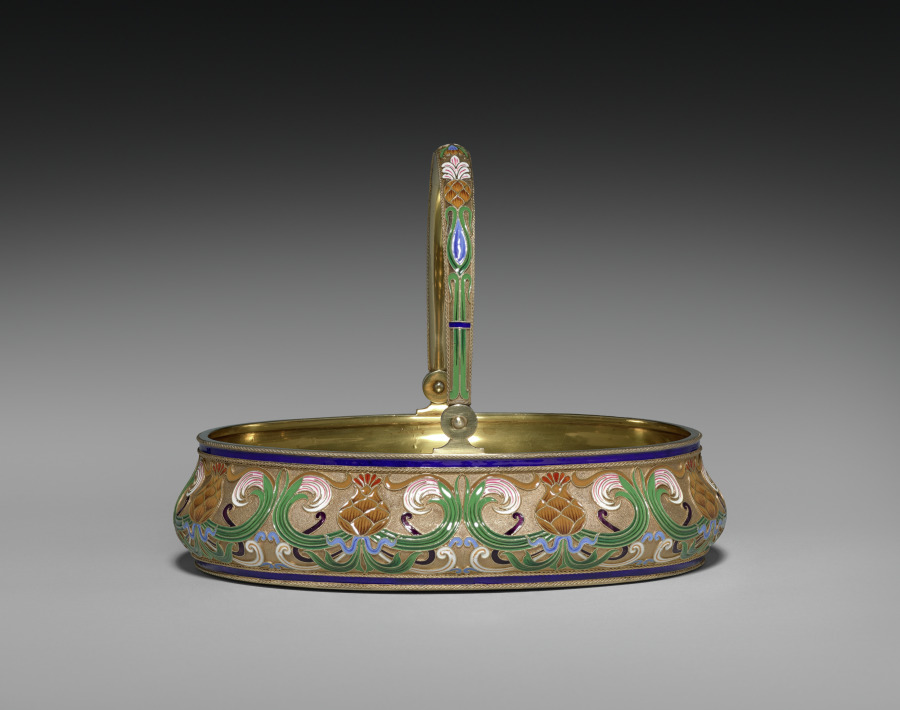
I. Preliminary Framework: The Dialectic of the Fragment and the Loop
The subject object—a cake basket—is ostensibly a utilitarian vessel, yet its architectural logic mirrors the dual aesthetic tensions found in the *Mold Fragment with Musicians* and the *Fluted Ring with Dragon Head (Huan)*. The former is a relic of process, a negative space that holds the ghost of performance; the latter is a closed circuit, a geometric eternity punctuated by a single animate intrusion. For Addison Fashion’s 2026 executive wardrobe, the cake basket serves as a structural metaphor: it is simultaneously a container (the mold) and a boundary (the ring), its woven or metallic lattice offering both containment and exposure. This analysis deconstructs the basket’s form—its radial symmetry, its negative volume, its tactile surface—to derive a silhouette system that privileges restraint, temporal layering, and the deliberate interruption of the continuous line.II. Form Analysis: Radial Containment and the Interrupted Circumference
A. The Mold’s Legacy: Negative Space as Structural Truth
The *Mold Fragment* teaches us that the unseen is not absence but potential. A cake basket, particularly one of open weave or slatted construction, operates on this principle: its structural integrity relies on voids. The vertical struts and horizontal wefts create a grid that is neither fully opaque nor fully transparent—a condition of *semi-occlusion*. For the executive silhouette, this translates into garments that do not cling but hover. The 2026 Addison blazer, therefore, is cut with a dropped shoulder and a slightly concave side seam, creating a micro-air gap between fabric and torso. This is not oversizing; it is *engineered distance*. The shoulder line, like the basket’s rim, is a firm terminus, but the body beneath is never fully revealed—only suggested through the fall of a slate-toned wool crepe. The negative space between the arm and the torso becomes a deliberate design element, echoing the mold’s finger-indented surface: imperfect, human, and thus authoritative.B. The Ring’s Geometry: Circularity as Power Structure
The *Huan* ring’s unbroken circumference represents cyclical authority—the eternal return of the executive’s daily ritual. The cake basket’s base, if circular, anchors this principle. In tailoring, this manifests as the *continuous waist seam*—a single, uninterrupted line that wraps the body, not to cinch, but to define a plane of stability. The Addison trouser, for 2026, adopts a high-rise, wide-leg cut with a internal belt that is invisible from the exterior. This is the “fluted” effect: the garment’s circumference is constant, but the internal structure (like the dragon head emerging from the ring) provides a point of tension. The result is a silhouette that moves with the wearer but never loses its architectural integrity. The hem, like the ring’s outer edge, is clean, unadorned, and falls precisely to the top of the shoe—no break, no pooling. This is the *closed circuit* of the executive uniform: every line returns to its origin, creating a visual loop that signals control.C. The Dragon’s Interruption: The Anomaly as Signature
The dragon head breaking the ring’s purity is the most critical formal lesson. In the cake basket, this is the *handle*—an appendage that is both functional and sculptural. For Addison, this translates into a single, asymmetric design element per garment. A jacket may have one exaggerated lapel that folds back to reveal a contrasting under-collar in a lighter slate. A coat may feature a single, oversized pocket placed off-center, its flap cut on the bias. This is not decoration; it is a *strategic rupture*. The executive wardrobe must not be monotonous; it requires one point of visual interruption per ensemble to prevent the eye from settling into complacency. The interruption must be deliberate, like the dragon’s eye—small, sharp, and knowing. In practice, this could be a belt with a sculptural metal clasp (evoking the ring’s materiality) or a shirt with a single, hidden placket that, when unbuttoned, reveals a flash of skin—a momentary, humanizing break in the armor.III. Color Theory: Slate as the Chromatic Bridge
A. The Mud and the Jade: From Earth to Ether
The *Mold Fragment* is the color of dried clay—a warm, brownish gray that speaks of labor and time. The *Huan* ring is the color of pale jade—a cool, translucent green-gray that suggests immortality. Slate, as a color, occupies the precise midpoint: it is neither warm nor cold, neither earthly nor ethereal. It is the color of a storm-laden sky over a city of glass and steel. For the 2026 executive, slate functions as a *neutral with memory*. It does not recede like black (which absorbs and ends) nor assert like navy (which is institutional). Slate is the color of the *process*—the mold before the bronze, the stone before the carving. It allows the wearer to be present without performing. In a wardrobe, slate is used in three tonalities: deep slate (almost charcoal) for outerwear, mid-slate for suiting, and pale slate (verging on silver) for shirts and knits. This creates a monochromatic system that is not flat but *stratified*, like sediment layers in the mold’s clay.B. The Absence of White: Rejecting Purity
The 2026 palette deliberately excludes pure white and pure black. White implies a blank slate, a beginning; black implies finality. Slate, in its ambiguity, implies *continuation*. The executive’s day is neither a start nor an end—it is a loop, like the ring. Shirts in pale slate are not crisp; they have a matte, slightly brushed finish, echoing the mold’s rough surface. Trousers in deep slate are not severe; they have a subtle, unstructured drape that moves like the dragon’s imagined body—present but unseen. This chromatic choice is a direct response to the DNA source: the mold’s musicians are not performing for an audience; they are caught in the act of creation. Slate allows the wearer to be similarly *caught*—in a moment of decision, of negotiation, of quiet authority—without the theatricality of brighter hues.C. Texture as Color: The Role of Surface
In the absence of chromatic variation, texture becomes the primary color differentiator. The cake basket’s woven surface—whether rattan, wire, or molded plastic—offers a study in light absorption and reflection. Addison’s slate fabrics are chosen for their tactile variance: a double-faced wool with a napped finish for outerwear (absorbing light like the mold’s clay), a smooth, high-twist gabardine for suiting (reflecting light like polished jade), and a fine, mercerized cotton for shirts (catching light like the ring’s fluted edges). This textural hierarchy creates a visual rhythm that replaces color contrast. The eye moves from matte to sheen to matte again, mimicking the basket’s alternating voids and solids. The result is a wardrobe that is monochromatic but never monotonous—a study in *material logic*.IV. Synthesis: The 2026 Executive Silhouette
The final form is a three-piece system: a long-line vest (the mold), a single-breasted jacket with a dropped shoulder (the ring), and a wide-leg trouser with an internal belt (the interruption). All are in slate, but each uses a different texture. The vest is in a brushed flannel, unlined, with exposed seam allowances—a nod to the mold’s unfinished interior. The jacket is in a crisp, high-twist wool, with a single, asymmetric lapel that folds to reveal a pale slate under-collar—the dragon’s head. The trouser is in a fluid, double-faced crepe, with a hidden waistband that cinches internally, creating a smooth exterior—the ring’s unbroken circumference. The ensemble is completed by a single accessory: a leather belt with a cast-metal clasp shaped like a simplified dragon head, its eye a small, polished slate stone. This is the *object* that bridges the mold and the ring—a functional piece that carries the memory of both the musician’s hand and the dragon’s gaze. The wearer, thus attired, does not merely dress; they *inhabit* a system of meaning that is at once ancient and immediate, processual and eternal. The cake basket, humble as it is, has yielded a blueprint for power that is quiet, cyclical, and utterly modern.
Technical Insight
NYC Perspective: Translating Slate tones into Minimalist silhouettes.