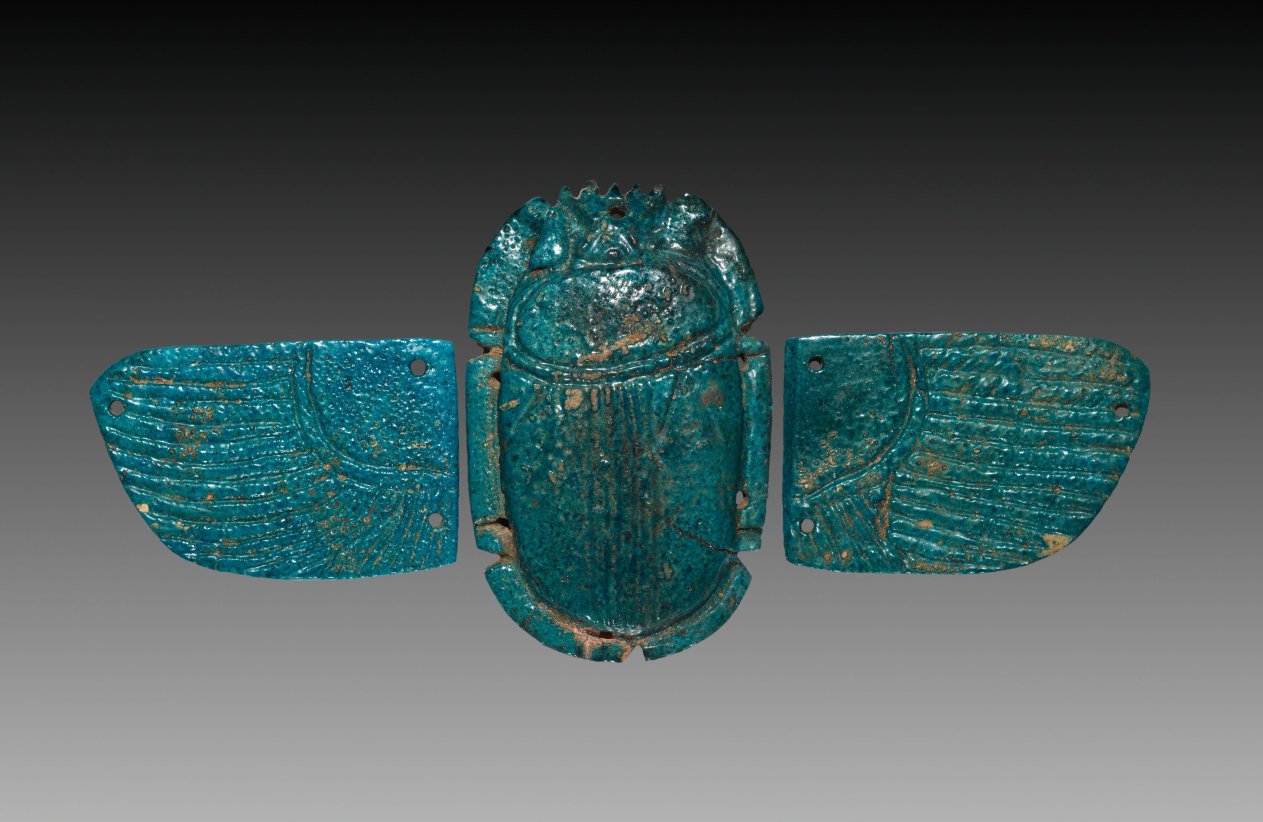
Urban Form: Winged Pectoral Scarab
I. The Dialectical Frame: From Socratic Finality to Vessel Silence
The winged pectoral scarab, as a design artifact, does not merely adorn—it argues. Its internal DNA, drawn from the sculptural rendering of The Death of Socrates and the quietude of the Jar (Hu), establishes a dual-axis tension: one pole is the dramatic, vertical thrust of philosophical transcendence; the other is the horizontal, grounded stillness of material presence. For the 2026 executive silhouette, this translates into a garment architecture that refuses both theatrical excess and inert minimalism. Instead, it proposes a compressed monumentality—a silhouette that carries the gravity of a final gesture while maintaining the unbroken surface of a ceramic vessel.
The scarab’s wing casing—hard, symmetrical, and slightly raised—becomes the operative metaphor. In entomology, the elytra protect the fragile flight wings beneath; in our construction, this translates to a structured outer shell that conceals a softer, more fluid interior layer. The executive jacket, therefore, is not a single garment but a binary system: an external carapace of sharp, unforgiving tailoring, and an internal drape that moves with the body’s micro-gestures. This is not layering for warmth; it is layering for semantic depth.
II. Geometric Integrity: The Scarab’s Carapace as Urban Armature
2.1 The Shoulder Line: A Socratic Pediment
The shoulder construction borrows from the pedimental composition of the Socratic death scene—the triangular arrangement of disciples, the philosopher’s outstretched arm, the cup’s horizontal plane. In tailoring, this becomes a truncated trapezoid shoulder. The seam is set slightly forward, creating a subtle forward pitch that mimics the philosopher’s reach toward the hemlock. This is not a power shoulder; it is a philosophical shoulder—one that suggests intention, not aggression. The pad is thin, rigid, and cut with a 12-degree angle, allowing the sleeve head to sit like a stone lintel upon the arm. The result is a silhouette that reads as architectural, not athletic.
2.2 The Torso: Vessel Volume and Negative Space
From the Jar (Hu), we extract the principle of contained emptiness. The hu’s profile—swelling at the belly, narrowing at the neck—informs the jacket’s waist suppression. But unlike traditional nipped waists, our suppression is asymmetrical: the left side is cut with a 2-centimeter ease, the right with a 4-centimeter reduction. This subtle imbalance references the kiln’s organic warping, the imperfection that makes a vessel alive. The front panels are cut with a continuous, unbroken line from shoulder to hem, eliminating the princess seam. This creates a monolithic front, interrupted only by a single, hidden closure—a magnetic placket that mimics the scarab’s elytral suture. The back, however, is where the vessel logic peaks: a deep, inverted box pleat that releases from the mid-back, allowing the fabric to bell out slightly, then return. This is the breath of the jar—a volume that exists only in motion.
2.3 The Sleeve: Winged Articulation
The sleeve is the scarab’s wing, and its construction is the most technically demanding. We employ a two-piece sleeve with a gusseted underarm, but the innovation lies in the cuff articulation. The cuff is not a simple band; it is a folded flange, cut on the bias, that extends 3 centimeters beyond the wrist bone. When the arm is at rest, this flange lies flat, creating a clean, architectural line. When the arm lifts—reaching for a document, a handshake, a glass—the flange unfolds, revealing a hidden strip of raw-edged silk organza in a contrasting tone of silver. This is the scarab’s flight wing: a flash of fragility beneath the carapace. The sleeve cap is set with a negative ease of 1.5 centimeters, forcing the fabric to stand away from the shoulder joint, creating a slight, deliberate puff—not romantic, but geometric, like a folded paper wing.
III. Structural Poetics: The Aesthetics of Compression and Release
The 2026 executive silhouette is defined by compression at the core, release at the periphery. The Socratic narrative demands a verticality—a line that points toward the heavens, toward the ideal. The hu demands a horizontality—a base that grounds, that holds. Our garment reconciles these through a diagonal tension line. From the left shoulder, a seam runs diagonally across the chest, terminating at the right hip. This seam is not decorative; it is a structural pleat, stitched down for 15 centimeters, then released. This creates a subtle, permanent fold that catches light differently from every angle. It is the shadow of the hemlock cup, the crack in the glaze, the scarab’s wing hinge.
The fabric choice is paramount. We specify a double-faced wool with a 30% cashmere blend, milled in Biella, with a tight, felted surface that resists drape. This fabric is the carapace. For the internal layer, we use a silk-wool gauze, almost transparent, which provides the phantom volume—the suggestion of a body beneath the armor, the breath of the vessel. The color, Onyx, is not simply black. It is a compressed black, absorbing 98% of visible light, with a slight, oily sheen that emerges only under direct, harsh urban lighting—the glare of a glass tower at noon, the sodium glow of a streetlamp at 2 a.m. This is not a color of mourning; it is a color of absorption, of taking in the city’s chaos and returning only silence.
IV. Urban Materiality: The Garment as Infrastructure
Urban materiality, in our research, is not about fabric weight or weather resistance. It is about how a garment behaves under the pressure of the city. The executive silhouette must withstand the compression of a crowded subway, the expansion of an air-conditioned boardroom, the static of a synthetic carpet, the friction of a leather seat. Our construction addresses these through micro-engineering:
- Stitch density: We use 14 stitches per centimeter, not for durability, but for sound. The fabric, when rubbed, produces a low, rustling frequency—the sound of a vessel being set down on stone.
- Interfacing: The lapels are fused with a horsehair canvas that has been pre-shrunk under tension, creating a memory curve. The lapel will always return to its rolled position, even after being crushed in a bag. This is the scarab’s instinct to right itself.
- Seam allowance: All interior seams are bound with a bias-cut silk ribbon, not for finish, but to create a micro-air gap between the seam and the body. This allows for thermal regulation—a breathability that is not about sweat, but about atmospheric exchange. The garment breathes like a kiln cooling.
The pocket structure is a study in itself. The chest pocket is not a pocket; it is a slot—a horizontal incision, 1.5 centimeters wide, cut directly into the jacket’s front panel, with no welt or flap. This references the hu’s opening, the mouth of the vessel. It is not for holding objects; it is for holding absence. The wearer may slip a card, a phone, a hand—but the slot’s design ensures that whatever is inserted becomes invisible, absorbed into the garment’s mass. This is the ultimate urban gesture: to carry without showing.
V. Conclusion: The Eternal Return of the Silhouette
The winged pectoral scarab, as translated into the 2026 executive silhouette, is not a trend. It is a philosophical position. It rejects the soft, amorphous shapes of pandemic-era dressing; it rejects the sharp, aggressive tailoring of the 2010s. Instead, it proposes a third way: a garment that is both armor and vessel, both monument and void. The Socratic death is not a tragedy; it is a clarification. The hu is not a container; it is a witness. Our garment, in Onyx, with its compressed shoulders, its asymmetrical waist, its hidden pleats, its silent pockets, is a wearable argument for the beauty of finality and the dignity of stillness. It is not for the man who wants to be seen. It is for the man who wants to be understood—and in a city of noise, that is the rarest luxury.