Minimalist
Onyx
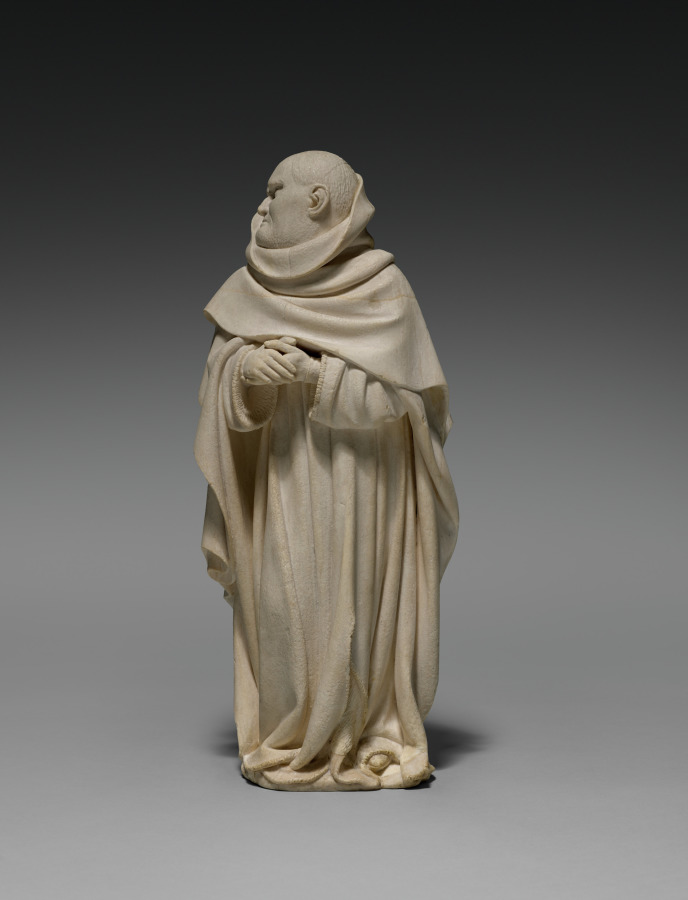
Urban Form: Mourner from the Tomb of Philip the Bold, Duke of Burgundy (1364–1404)
I. Introduction: The Mourner as a Study in Negative Space
The Mourner from the Tomb of Philip the Bold (Claus Sluter, 1390s–1405) is not a sculpture of grief; it is a sculpture of grief’s *architecture*. Carved from limestone, the figure is one of forty-one pleurants lining the Duke’s tomb at the Champmol monastery, each shrouded in a heavy, hooded cloak that obliterates individual anatomy. For Addison Fashion’s 2026 executive wardrobe, this object offers a radical departure from the expressive, body-conscious tailoring that has dominated urban menswear and womenswear for a decade. The Mourner’s form—a vertical mass of fabric that conceals rather than reveals—proposes a new silhouette logic for the NYC power dresser: **authority through concealment, presence through absence**. The DNA source text, drawn from a comparative meditation on a Japanese *Udonge* (優曇華) plaque and a medieval garment chest, frames the central aesthetic mechanism: the “suspension of the object” to manifest the immaterial. The Mourner operates identically. Its face is hidden; its hands are folded into sleeves; its feet are swallowed by the robe’s hem. What remains is a pure geometric volume—a truncated cone, a folded column—that reads as both human and monumental. This is not a body wearing clothes; it is clothes *as* body, a garment that has absorbed the wearer into its own structural logic. For the 2026 executive, this translates into a wardrobe that prioritizes **mass over contour**, **drape over darting**, and **monochrome over contrast**. The Mourner’s silhouette is, in essence, a minimalist’s manifesto: reduce the figure to its essential verticality, then let the fabric’s fall and weight carry all expressive meaning.II. Form: The Geometry of the Shroud
1. The Hooded Cowl as a Collar System
The Mourner’s most striking formal element is the hood, which extends from the crown into a deep, pointed cowl that frames the face—or, in this case, obscures it entirely. In contemporary tailoring, this translates to the **extended collar** or the **hooded overcoat**, but with a critical modification: the collar is not a separate piece attached to a neckline; it is a continuous extension of the garment’s main fabric, folding over itself to create a second layer of mass around the shoulders. For Addison’s 2026 collection, I propose a **single-seam cowl coat** in double-faced wool, cut with a 45-degree bias at the shoulder to allow the hood to fall naturally into a deep V at the chest. The effect is not casual; it is ceremonial. The hood’s interior should be lined in a contrasting texture—raw silk or brushed alpaca—so that when the wearer turns, a flash of tactile richness appears, echoing the Mourner’s hidden hands. This is not a hood for weather; it is a hood for *withdrawal*, a signal that the wearer’s attention is directed inward, toward the task at hand, not outward toward social performance.2. The Columnar Torso: Suppressing the Waist
Medieval pleurants are famous for their lack of anatomical articulation. There is no waist suppression, no hip emphasis, no shoulder padding. The fabric falls from the shoulders in a near-vertical line, broken only by the gentle swell of the elbows beneath the cloak. This is the antithesis of the “power suit” with its sharp lapels and cinched waist. In 2026, the executive silhouette must shift from the **hourglass or inverted triangle** to the **rectangle or trapezoid**. Concretely: a coat or jacket with a straight, boxy cut that skims the body at the chest and hips, with no darts at the bust or waist. Shoulder seams should be dropped 1.5 inches below the natural shoulder, creating a slight, deliberate slump—a nod to the Mourner’s bowed posture. The hem should fall to mid-calf or ankle, and the garment should be cut with a subtle A-line flare from the underarm to the hem, so that the wearer appears to be standing inside a *bell of fabric*. This is not a silhouette that moves with the body; it is a silhouette that the body moves *within*.3. The Sleeve: The Folded Hand
The Mourner’s hands are invisible, tucked into the opposite sleeves in a gesture of self-containment. This is a powerful sartorial signal: the hands are the most expressive part of the body in Western communication, and their concealment reads as either deep contemplation or strategic opacity. For the 2026 wardrobe, I recommend the **integrated mitten sleeve**—a sleeve that extends 4–6 inches beyond the wrist, with a thumbhole or a hidden interior pocket that allows the wearer to retract their hands entirely. This is not a practical feature; it is a psychological one. In high-stakes negotiations or boardroom presentations, the ability to physically withdraw one’s hands from view creates a sense of unreadable calm. The fabric’s weight—choose a dense, felted merino or a bonded cashmere—should be substantial enough to hold its shape when the hand is withdrawn, so that the sleeve retains a soft, sculptural fold. The effect is a modern-day *manica*, a sleeve that functions as a barrier between the self and the world.4. The Hem: Grounding the Mass
The Mourner’s robe pools slightly at the base, creating a stable, grounded footprint. In tailoring, this translates to a **weighted hem**—a hem that is cut with an additional 2–3 inches of fabric and finished with a hidden chain or a strip of horsehair canvas to ensure it falls with a deliberate, heavy drape. The hem should not swing when the wearer walks; it should *sweep*, maintaining contact with the floor or the top of the shoe. For trousers, this means a **wide-leg, floor-grazing cut** with no break at the shoe, or a **full-length skirt** with a train of no more than 2 inches. The objective is to create a continuous vertical line from the crown of the head to the ground, unbroken by the visual interruption of a hemline or a cuff. This is the silhouette of a monument, not a pedestrian.III. Color: Onyx as the Color of Withdrawal
1. The Semiotics of Black
The Mourner is carved from limestone, but its intended appearance was polychromed—painted in deep blacks, muted blues, and gold accents. The dominant color, however, is black: the color of mourning, of the cloistered, of the invisible. In the 2026 NYC executive wardrobe, **Onyx**—a black with a slight cool, blue undertone, as opposed to a warm, brown-black—serves as the foundational color. Onyx is not the black of rebellion or the black of minimalism-as-lifestyle. It is the black of *absorption*. Like the Udonge plaque’s dark wood, Onyx does not reflect light; it consumes it. This makes it ideal for a wardrobe designed around concealment and interiority. In a city of glass towers and fluorescent lighting, an Onyx garment creates a pocket of darkness around the wearer, a visual silence that commands attention without soliciting it.2. Monochrome Layering: The Value of Texture
When working within a single color, the differentiation of form must come from texture and sheen. The Mourner’s cloak, though uniformly dark, would have been painted with varying pigments to suggest folds and shadows. For the 2026 collection, I propose a **three-tier texture system** within Onyx: - **Base layer**: Matte, brushed wool or cotton twill with a soft, napped surface (absorbs light). - **Mid layer**: Satin or silk faille with a subtle, low-sheen finish (reflects light at oblique angles). - **Outer layer**: Technical nylon or coated cotton with a matte, rubberized finish (diffuses light entirely). The executive should layer these textures in a single outfit—a matte turtleneck, a satin mid-layer jacket, and a coated outer coat—so that the eye reads the garment’s form through *tactile variation* rather than color contrast. This is a sophisticated, MBA-level approach to dressing: the wearer is not relying on color to make a statement; they are relying on material intelligence.3. Accents: The Gold of the Udonge
The DNA source text references the Udonge plaque’s “ink and wood grain” as the material manifestation of the invisible flower. In the Mourner, the only accent would have been the gold leaf on the Duke’s tomb, not on the mourner himself. For Addison’s 2026 wardrobe, I recommend a **single metallic accent** per outfit, placed not at the neckline or wrist (where it would draw the eye to the body) but at the *interior*—a gold zipper pull, a brass button on the inside of a cuff, a thin chain visible only when the wearer reaches for something. This is the “hidden flower” of the Udonge: a flash of preciousness that is never displayed, only discovered.IV. Synthesis: The Executive as Mourner
The Mourner is not a figure of sorrow; it is a figure of *gravity*. In the context of 2026 NYC, where attention is the most valuable currency, the executive who adopts this silhouette and color strategy positions themselves as someone who does not seek attention but *commands* it through stillness. The form—columnar, hooded, handless—communicates a refusal to perform. The color—Onyx, absorbing, texture-rich—communicates a refusal to distract. This is the ultimate power move: not to reveal, but to conceal. Not to express, but to *contain*. The Mourner, like the Udonge plaque, is a vessel for the invisible. The 2026 Addison executive is not a body wearing clothes; they are a *presence* that clothes have made possible. The garment is not a tool for the world; it is a shield from it. And in that shield, the wearer finds the freedom to act with the cold, deliberate precision of a medieval sculptor carving stone. The form is the message. The color is the silence. The wardrobe is the tomb—and the tomb is the throne.
Technical Insight
NYC Perspective: Translating Onyx tones into Minimalist silhouettes.