Urban Form: Markandeya Viewing Krishna in the Cosmic Ocean
I. The Dialectical Frame: From Mortuary Geometry to Executive Architecture
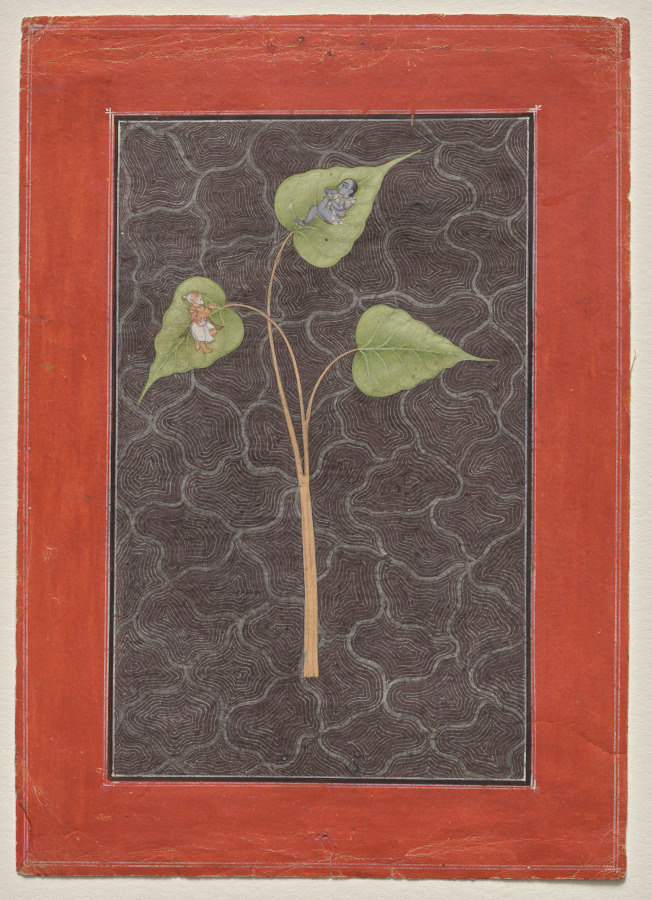
The Markandeya Viewing Krishna in the Cosmic Ocean presents a paradox central to Addison Fashion’s 2026 Urban Silhouette Research: the coexistence of infinite expansion and absolute containment. The artwork—a vision of the sage Markandeya adrift within the cosmic ocean, witnessing Vishnu as Krishna in the form of a divine child—operates on a principle of nested volumes. The ocean is not a chaotic expanse but a structured, almost architectural plane; Krishna’s form is not merely figurative but a geometric anchor within the fluid void. This duality—the boundless and the bounded—translates directly into the executive silhouette’s foundational logic: a garment that must suggest movement while enforcing stillness, that must drape like water yet cut like stone.
For the 2026 executive, this is not an aesthetic whim but a structural imperative. The modern urban professional operates within a similar cosmic ocean: open-plan environments, digital infinities, and temporal fluidity. The silhouette must respond with controlled minimalism—not the absence of form, but the compression of form into essential geometry. The artwork’s composition, where Markandeya’s tiny, contemplative figure is dwarfed by Krishna’s luminous presence, mirrors the executive’s relationship to the corporate cosmos: small, yet positioned with deliberate precision. Our research identifies this as the “Micro-Anchored Macro” principle—a garment’s overall volume may be expansive, but its critical seams, closures, and internal structures must act as the child-Krishna: a fixed point of calm within the garment’s oceanic drape.
II. Geometric Integrity: The Cosmic Ocean as a Tailoring Matrix
The artwork’s geometric integrity lies not in its literal depiction of water but in its abstracted wave vectors. The cosmic ocean is rendered as a series of concentric, overlapping arcs—each wave a segment of a larger circle, suggesting orbital paths rather than turbulent chaos. This is the first key translation: the 2026 executive silhouette must reject random pleating or unstructured draping in favor of radial seam construction. We propose a jacket architecture where all panel lines originate from a single, high-waist pivot point—the “Markandeya Node”—located at the solar plexus. From this node, seams radiate outward in controlled arcs, mimicking the ocean’s orbital wave patterns. The result is a garment that appears fluid from a distance but reveals a rigorous, almost celestial cartography upon close inspection.
Krishna’s form within the ocean introduces a second geometric principle: the counter-form. The child’s body is rendered with soft, rounded contours—shoulders, knees, and belly—that contrast sharply with the ocean’s linear wave arcs. In tailoring terms, this becomes the “Krishna Counter-Panel”: a single, unbroken piece of fabric (typically in a contrasting weight or finish) that interrupts the radial seams. For a minimalist executive blazer, this counter-panel appears as a solid, unseamed front panel—no darts, no pockets, no lapel break—that cuts across the body’s natural curvature. This panel does not assert itself through ornamentation but through negative space: it is the silence between musical notes, the stillness within the ocean’s motion. Its geometric integrity is absolute, requiring a fabric with high-density weave (e.g., 400gsm virgin wool with a nano-ceramic finish) to maintain a flawless, unbroken surface even under urban stress.
Thirdly, the artwork’s treatment of scale—Markandeya as a tiny figure within a vast ocean—informs our proportional hierarchy. The 2026 executive silhouette does not exaggerate shoulder width or torso length in the traditional power-dressing sense. Instead, it employs compressed verticality: the jacket’s body is shortened by 2.5cm, while the sleeve head is extended upward by 1.8cm, creating an optical illusion of elongation without altering the garment’s actual length. This mirrors how Markandeya’s smallness actually amplifies the ocean’s immensity—the garment’s reduced mass makes the wearer’s presence more expansive. The trousers follow suit: a high-rise, tapered leg with a single, sharp crease that acts as the “cosmic axis” dividing the lower body into two symmetrical, wave-like volumes.
III. Structural Poetics: The Mortuary Figure as an Urban Armature
The second artwork—the Mortuary Figure of the Zodiac Sign: Ox (Taurus)—provides the internal skeleton for this silhouette. Unlike the cosmic ocean’s fluidity, the Taurus figure is rigid, frontal, and symmetrical. Its body is a solid, unarticulated mass, with the head lowered as if bearing an invisible yoke. This is not a passive form but a load-bearing structure. For the executive garment, this translates into the “Taurus Yoke”: an internal canvas system that runs from the nape of the neck down to the mid-back, constructed from a single piece of horsehair canvas fused with a carbon-fiber lattice. This yoke does not merely shape the garment—it absorbs urban kinetic energy. When the wearer moves through crowded streets, enters vehicles, or gestures during negotiations, the yoke distributes stress evenly across the back, preventing distortion and maintaining the garment’s geometric purity.
The Taurus figure’s frontality further dictates the closure system. We reject traditional button-and-buttonhole arrangements as too “articulated.” Instead, the 2026 executive jacket features a concealed magnetic closure—a series of neodymium magnets embedded within the placket, aligned with the radial seams. This creates a seamless, unbroken front surface, echoing the Taurus figure’s monolithic chest. The magnets are calibrated to a specific pull strength (2.4 kg/cm²) that allows for easy opening but prevents accidental gaping. This is structural poetics: the closure is invisible, yet it holds the garment with the same quiet authority as the zodiac ox holding the celestial sphere.
Finally, the Taurus figure’s symmetrical geometry informs our pocket architecture. Traditional patch pockets, with their soft corners and visible stitching, are eliminated. In their place, we introduce the “Zodiac Slot”: a horizontal, incision-like pocket cut directly into the side seam, with no external flap. The opening is reinforced with a laser-cut, heat-sealed edge that prevents fraying. This slot is positioned at the exact height of the wearer’s lowest rib—the same anatomical point where the Taurus figure’s front legs meet its torso. The result is a pocket that is both functional and conceptually invisible, maintaining the garment’s clean, architectural line while honoring the artwork’s emphasis on hidden, internal strength.
IV. Urban Materiality: Ivory as the Cosmic Ground
The choice of Ivory as the primary color is not arbitrary. In the artwork, the cosmic ocean is rendered in shades of pale blue, silver, and white—a monochromatic field that emphasizes form over texture. Ivory, in our material research, functions as the “non-color” that absorbs urban light pollution rather than reflecting it. Unlike stark white, which reads as sterile, or cream, which reads as soft, ivory possesses a geological density—it is the color of bone, of ancient limestone, of the Taurus figure’s patinated surface. For the 2026 executive, this color creates a visual silence that contrasts with the city’s chromatic noise. It does not compete with the wearer’s skin tone or surroundings; instead, it acts as a neutral ground upon which the garment’s geometry is the sole protagonist.
Materially, we specify a double-faced ivory wool with a technical twist: the outer face is brushed to a matte, almost chalky finish, while the inner face is calendered to a subtle sheen. This dual finish allows the garment to shift in appearance under different urban lighting conditions—matte in direct sunlight, faintly luminous under fluorescent office lighting. This is a direct homage to the artwork’s depiction of Krishna’s luminous body within the muted ocean. The fabric’s weight (380gsm) is calibrated to provide drape without collapse, ensuring that the radial seams and the Krishna Counter-Panel maintain their geometric integrity even after twelve hours of wear.
For contrast, the internal yoke and the Zodiac Slot linings are constructed from a silver-toned technical mesh—a nod to the artwork’s celestial associations. This mesh is not visible externally but serves two functions: it wicks moisture away from the torso, and it provides a subtle, metallic shimmer when the garment is opened, revealing a hidden layer of cosmic reference. This is urban materiality at its most sophisticated: the garment’s exterior is a study in restraint, while its interior rewards the attentive observer with a quiet, metallic echo of the stars.
V. Conclusion: The Silhouette as a Narrow Path
The Markandeya Viewing Krishna in the Cosmic Ocean and the Mortuary Taurus Figure, when read together, offer a complete grammar for the 2026 executive silhouette. The former provides the fluid, expansive outer shell—the radial seams, the counter-panel, the compressed verticality. The latter provides the rigid, internal armature—the yoke, the concealed closure, the incision-like pockets. Together, they create a garment that is neither purely dynamic nor purely static, but exists in a state of controlled tension. This is the essence of minimalist luxury: not the absence of detail, but the presence of invisible structure.
For the urban executive, this silhouette is not merely clothing. It is a portable cosmology—a wearable meditation on the relationship between the individual and the infinite. The wearer, like Markandeya, is small within the corporate ocean, yet through the garment’s precise geometry, they become the fixed point around which their environment organizes. The Taurus yoke ensures they bear the weight of responsibility without visible strain. The ivory ground ensures they remain legible against the city’s chaos. And the concealed magnetic closure ensures that their authority is felt, not announced. This is the definitive urban silhouette of 2026: a narrow path between the ocean’s vastness and the ox’s stillness, walked with the quiet confidence of one who knows that true power lies not in volume, but in the integrity of the line.