Minimalist
Slate
Urban Form: Architecture of the Middle Ages: Screen in St. Jacques, Dieppe
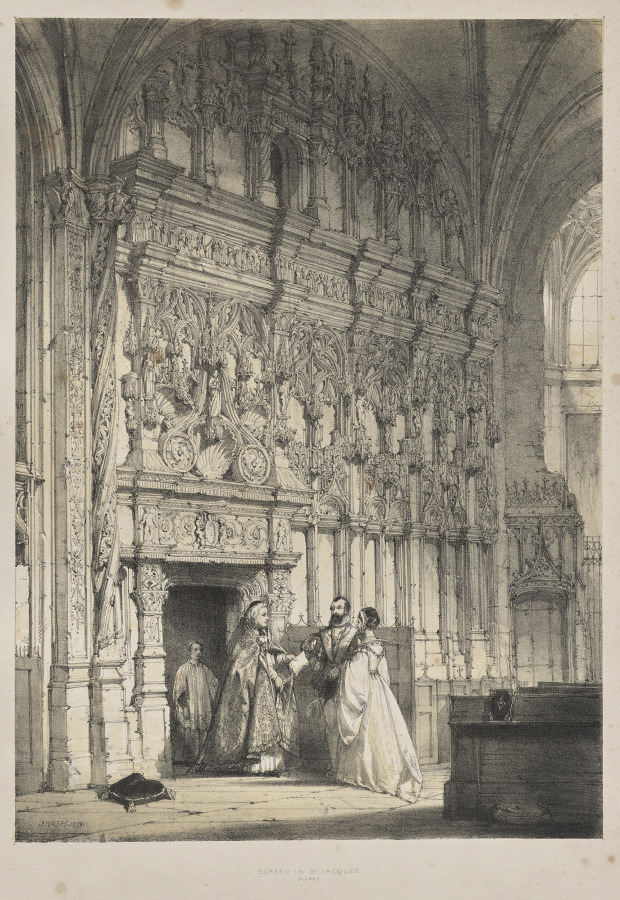
I. The Architectural Premise: Gothic Screen as Urban Armature
The Screen in St. Jacques, Dieppe, is not a relic of ecclesiastical ornament but a treatise on load-bearing transparency. Its carved stone tracery—repetitive, interlaced, yet rigorously vertical—functions as a proto-modern grid, a system of compression and release that anticipates the tensile logic of contemporary skyscraper facades. For Addison Fashion’s 2026 executive silhouette, this medieval screen offers a blueprint for dressing the urban body as a structural member: not merely clothed, but engineered. The screen’s geometric integrity lies in its refusal of the pictorial. Unlike the narrative reliefs of Gothic portals, this screen abstracts its iconography into pure interval. The vertical mullions rise without capitulation, their rhythm interrupted only by the horizontal transoms that lock them into place. This is not decoration; it is a load path made visible. The 2026 executive must inhabit a similar logic: the suit becomes a frame, the body a load-bearing core, and every seam a joint designed to transfer stress without visible strain.II. Structural Poetics: From Tracery to Tailoring
The screen’s tracery—cusped arches, trefoil openings, and quatrefoil nodes—operates on a principle of negative space as structural truth. The stone is carved away not to weaken but to articulate the forces that hold it upright. In tailoring, this translates to the removal of excess as a form of strength. The 2026 silhouette rejects padding and interfacing that simulate mass; instead, it employs precise understructure—hidden boning, fused canvases, and laser-cut internal stays—that allow the fabric to stand away from the body only where the body’s own architecture demands it. Consider the screen’s vertical emphasis. The mullions are not merely repeated; they are tapered at their bases and flared at their capitals, creating a visual compression that reads as gravitational resistance. For the executive jacket, this becomes a high-armhole, narrow-shoulder, elongated-torso construction. The shoulder seam is moved forward, echoing the screen’s engaged columns, while the waist suppression is minimal—not to suggest softness, but to imply that the torso is a column under load. The jacket’s hem falls at the mid-hip, never flaring, because flare would suggest instability. The sleeve is cut in one continuous arc from shoulder to wrist, mimicking the screen’s unbroken verticals, with a two-piece construction that allows the elbow to articulate without disrupting the line.III. Urban Materiality: Stone, Slate, and the Skin of the City
The screen’s material—Caen limestone, now weathered to a matte, granular slate—offers a chromatic and tactile directive. Its surface is not polished to a shine but left with a tooth, a micro-texture that catches light obliquely. For the 2026 executive wardrobe, this dictates a fabric palette anchored in slate-toned wool melton, brushed to a low nap, and bonded with a breathable technical membrane. The cloth must feel dense but not heavy, like stone that has been cut thin enough to transmit light. A double-faced cashmere in a heather of charcoal and blue-gray replicates the screen’s variegated patina, while a high-twist worsted in a matte finish offers the same optical dryness as the weathered limestone. The screen’s urban relevance is its resistance to ornament as narrative. In a city of glass and steel, this stone screen stands as a counterpoint—not nostalgic, but tectonic. The 2026 executive silhouette adopts this by eliminating all superfluous hardware: buttons are hidden under plackets, zippers are invisible, and pockets are cut on the seam. The only visible fastening is a single, long, horn button at the neck, echoing the screen’s central boss. This is not minimalism as absence; it is minimalism as concentrated presence, where every element must justify its existence through structural necessity.IV. The Rhythmic Interval: Repetition as Power
The screen’s power lies in its measured repetition—each bay identical, yet the whole creating a cumulative, almost hypnotic rhythm. This is the same principle that governs the 2026 executive’s monochromatic dressing. A suit in slate, a shirt in a slightly lighter slate, a tie in a darker slate: these are not variations but intervals, each one a transom that locks the vertical line. The executive’s stride, the swing of the arm, the turn of the head—these become the cusped arches that animate the static frame. The screen also teaches proportion through division. Its height is divided into three horizontal bands: a low dado, a middle register of tracery, and an upper clerestory. The 2026 executive silhouette adopts this tripartite division: the jacket’s length, the trouser’s rise, and the shoe’s heel height must form a ratio of approximately 1:2:3. The jacket ends at the first division, the trouser break at the second, and the shoe’s sole at the third. This is not a rule but a structural rhythm, ensuring that the body reads as a coherent elevation, not a collage of unrelated parts.V. The Eternal in the Ephemeral: A Conclusion
The Screen in St. Jacques, Dieppe, endures because it does not attempt to freeze a moment but to structure the passage of time itself. Its shadows shift with the sun, its stone erodes imperceptibly, yet its geometry remains legible across centuries. The 2026 executive silhouette, in its slate-toned, minimally adorned, structurally rigorous form, aspires to the same condition: not a trend, but a tectonic constant within the urban flux. This is the definitive urban silhouette for the executive who understands that power is not displayed but distributed—through seams, through intervals, through the quiet repetition of a line that holds the body as firmly as a medieval screen holds a cathedral’s weight. The garment is not a second skin; it is a load-bearing wall, and the executive who wears it becomes the architect of their own gravity. In a city that fragments attention, this silhouette offers the unbroken vertical—a stone-cold assertion that the only true luxury is the ability to stand, unadorned, and still command the space around you.
Technical Insight
Technical Insight: Translating Slate palettes into Minimalist silhouettes for the modern metropolis.