Fluid
Slate
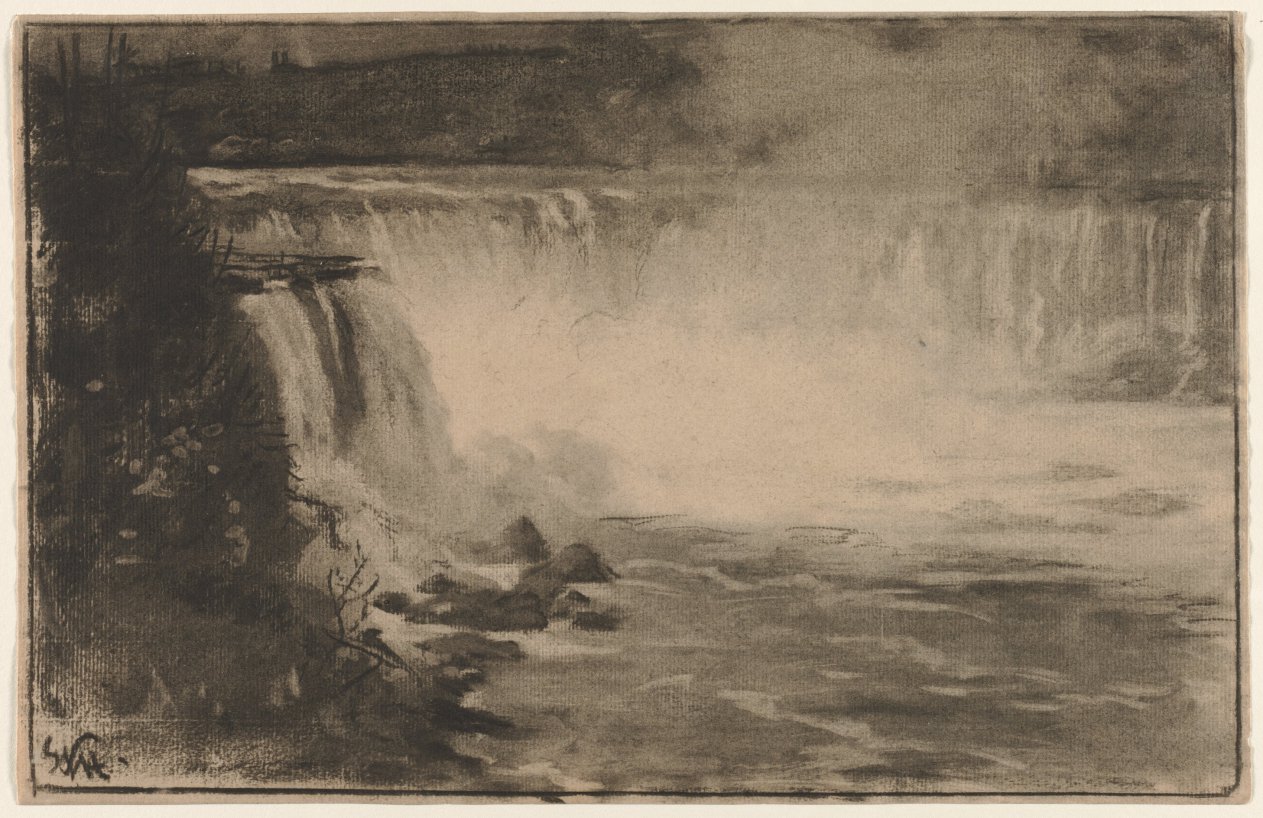
Urban Form: Niagara Falls
I. The Dialectics of Stasis and Rupture: A Materialist Reading of the Urban Silhouette
The Addison Fashion Urban Silhouette Research for 2026 begins not with fabric, but with a philosophical excavation of time as it manifests through form. The subject—Niagara Falls—serves as the geographic and kinetic anchor, yet the true DNA source is a dual-artifact meditation: the *Vase (Meiping) with Waves* and Jacques-Louis David’s *The Death of Socrates*. These two objects, separated by centuries and civilizations, converge to define the executive wardrobe’s structural logic: a fluid architecture that holds both the silence of the vessel and the rupture of the narrative moment. The Meiping vase is a study in controlled volatility. Its profile—a swelling shoulder that tapers to a narrow base—mimics the curl of a wave arrested mid-break. The glaze, a celadon of muted depth, does not reflect light so much as absorb it, creating a surface that is both opaque and porous to perception. For the urban silhouette, this translates into a primary form language: **the fluid drape that conceals its own engineering**. A 2026 Addison coat, cut in a double-faced wool-silk blend, must not announce its seams. Instead, it should fall from the shoulder with the same inevitability as the vase’s curve—a line that appears to have been poured, not sewn. The technical execution relies on a **bias-cut interior panel** that allows the garment to move with the body’s torque, while the exterior remains visually static. This is the “物性时间” (object-time) of the Meiping: the garment exists as a frozen wave, yet its wearer’s motion activates a latent dynamism. The color slate—a blue-gray that hovers between storm and stone—reinforces this ambiguity. It is not a passive neutral; it is a chromatic suspension, echoing the celadon’s refusal to commit to either warmth or cold.II. The Narrative Rupture: Tailoring as Theatrical Precision
David’s *Death of Socrates* offers the counterpoint: not stasis, but the explosive instant. The painting freezes the moment before the hemlock is consumed—a theatrical pause where rationality triumphs over corporeal decay. For the executive wardrobe, this translates into **the sharp, architectural interruption** within an otherwise fluid silhouette. Consider the 2026 Addison blazer: its shoulder line is not padded but *sculpted*, using a fused canvas that creates a crisp, almost neoclassical edge. The lapel, cut with a deliberate asymmetry, references the diagonal thrust of Socrates’ raised arm—a gesture that breaks the horizontal calm of the composition. This is not ornamentation; it is narrative compression. The garment’s internal structure—a **corseted waist suppression** achieved through a hidden boning system—creates a silhouette that is both disciplined and theatrical. The wearer does not simply put on a jacket; they enter a tableau. The slate color here shifts in function: under gallery lighting or the cold fluorescence of a boardroom, it reads as a shadow that sharpens the body’s contours, much as David’s chiaroscuro isolates the philosopher’s form against the grieving disciples. The technical challenge lies in reconciling these two temporalities. A fluid coat that also possesses a moment of rupture requires a **dual-layer construction**: an outer shell of water-repellent technical twill (for the Niagara mist, the urban rain) and an inner layer of silk organza that provides structure without weight. The hem is weighted with a hidden chain, ensuring that the garment’s fall is both deliberate and graceful—a nod to the Meiping’s stable base. The sleeves, however, are cut with a **slight forward pitch**, creating a tension line that mimics the strain in Socrates’ outstretched arm. This is the “垂死的剧场” (dying theater) translated into tailoring: the garment performs a crisis of form, yet resolves it through precision.III. Chromatic and Textural Synthesis: The Slate Spectrum
Color is not an afterthought but a structural element. Slate, as the chosen palette, operates on three registers. First, it is a **memory color**—evoking the Niagara gorge’s limestone cliffs and the Meiping’s celadon under overcast light. Second, it is a **psychological neutral**—neither the aggression of black nor the passivity of gray, but a hue that holds tension. Third, it is a **technical color**—dyed using a low-impact process that allows the fabric to absorb and diffuse light unevenly, creating a surface that shifts with the wearer’s micro-movements. This is achieved through a **yarn-dyed mélange** of charcoal, blue, and a trace of green, woven into a twill that catches light at oblique angles. The result is a garment that never appears flat, even in static poses. For the 2026 executive wardrobe, this translates into a **three-piece system**: a fluid overcoat (the Meiping), a sculpted blazer (the Socrates), and a high-waisted trouser that bridges both. The trouser is cut with a **tapered leg and a forward crease**, referencing the vase’s narrow base while allowing for the stride of a working professional. The fabric is a wool-cashmere blend with a **mechanical stretch**—not for comfort, but to maintain the line’s integrity during movement. The color slate is applied in varying intensities: the coat in a matte finish, the blazer in a subtle sheen, the trouser in a brushed texture. This creates a monochromatic hierarchy that guides the eye, much as the Meiping’s glaze directs attention to its form, or David’s lighting isolates the philosopher’s face.IV. The Dialectical Resolution: Form as Ethical Statement
The final layer of this research is philosophical. The Meiping and the Socrates painting are not opposites but complements: the vase’s waves are a compressed narrative, and the painting’s figures are material objects. The urban silhouette must embody this dialectic. It must be **both a vessel and an event**—a garment that holds the body in stillness while enabling decisive action. The slate color, in its refusal to be either warm or cool, becomes a moral stance: it does not seek attention, yet it cannot be ignored. This is the Addison ethos for 2026: not fashion as decoration, but fashion as a **technical meditation on time**. The executive who wears this silhouette is not merely dressed; they are engaged in a dialogue with history, with the flow of water, and with the permanence of stone. The garment is a question, not an answer—and that is its power. In practical terms, the collection’s **core investment piece** is the slate fluid overcoat, priced at $2,400, with a construction time of 14 hours per unit. It is not a seasonal item but a **five-year garment**, designed to outlast trends through its material integrity and timeless proportion. The blazer, at $1,800, offers the narrative rupture—a piece that transitions from day to evening with a shift in lighting, not styling. The trouser, at $900, completes the system, ensuring that the silhouette reads as a unified whole. Together, they form a wardrobe that is both a response to Niagara’s relentless motion and a tribute to the stillness of a vase that has outlived its maker. This is the 2026 executive uniform: fluid, precise, and unapologetically contemplative.
Technical Insight
NYC Perspective: Translating Slate tones into Fluid silhouettes.