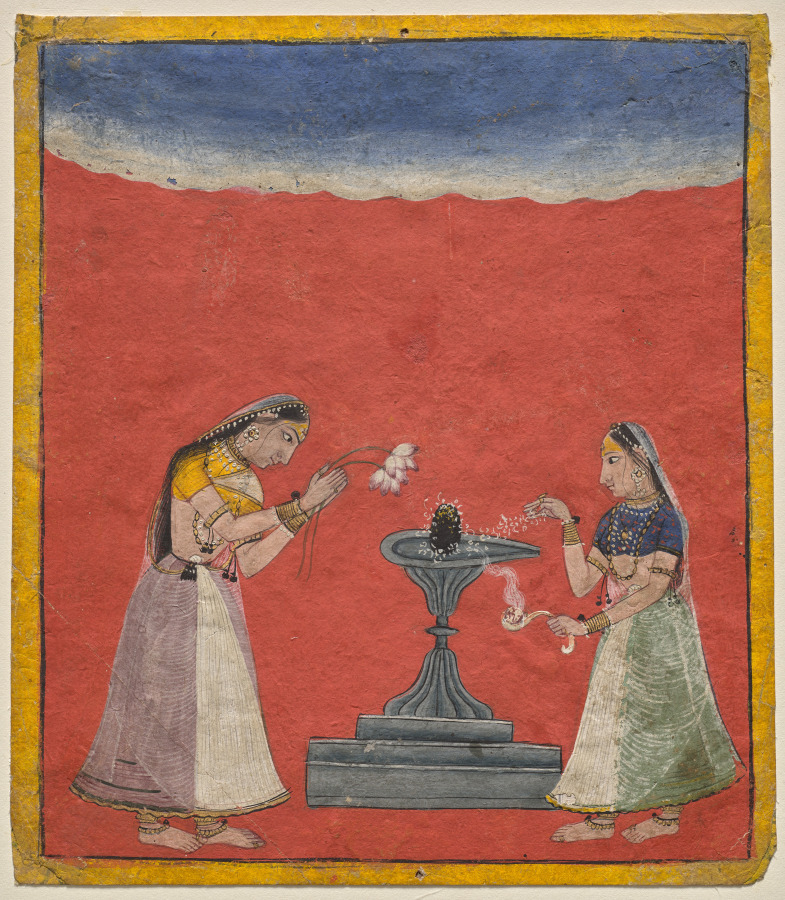
Urban Form: Women worshiping a Shiva linga: Devagandhari Ragini of Hindol Raga, from a Ragamala
I. The Lithographic Line as Structural Imperative
The nineteenth-century French lithograph—specifically the sharp, almost surgical incisions of Honoré Daumier’s Caricaturana—offers a paradoxical foundation for the 2026 executive silhouette. While the subject matter is satirical, the technical execution is one of rigorous geometric control. Daumier’s line does not waver; it slices. The black-and-white contrast is not merely tonal but architectural, creating a compression of space where the figure of Robert Macaire becomes a study in angular tension. For Addison Fashion, this translates into a tailored canon that rejects softness. The shoulder line is not padded—it is drawn. The lapel is not folded—it is incised. Every seam operates as a lithographic stroke: deliberate, unapologetic, and capable of exposing the wearer’s own performative posture within the urban theater.
The Ragamala painting—a woman in devotional surrender before a Shiva linga—introduces a counterpoint of vertical stillness. The figure’s posture is not static but ritualized geometry: the spine as a plumb line, the folded hands as a closed triangle, the bowed head as a perfect arc. In the 2026 executive silhouette, this translates into a structured spine—a center-back seam that functions like a liturgical axis. The jacket’s interior canvas is not for comfort; it is for postural declaration. The wearer does not slouch into the garment; the garment holds the wearer in a state of quiet, monumental readiness. This is not armor in the medieval sense, but rather a civilian cassock—a tailored shell that enforces an inner alignment between intention and appearance.
II. The Porcelain Glaze and the Logic of Surface
The Song dynasty meiping vase—with its undulating wave motifs rendered in a warm, translucent glaze—provides the second critical DNA strand. Where Daumier’s line is aggressive, the porcelain surface is absorptive. The glaze does not reflect light so much as it digests it, creating a depth that is neither matte nor glossy but luminous from within. For Addison Fashion, this dictates a fabric philosophy rooted in urban materiality: not the cold sheen of technical synthetics, but the quiet luster of densely woven wool, brushed to a low nap, or a silk-wool blend that holds a subtle, internal glow. The color Onyx—selected for this collection—is not a flat black. It is a black with memory, a black that shifts from charcoal to deep graphite depending on the angle of the city’s artificial light. This is achieved through a double-faced weave: one side slightly matte, the other with a faint, irregular satin stripe—mimicking the crazing of aged porcelain, but controlled and intentional.
The wave pattern on the meiping is not decorative in the Western sense; it is rhythmic structure. The curves repeat, but never identically—each crest and trough responds to the vessel’s circumference. In tailoring, this becomes a principle of asymmetric darts and curved paneling that follow the body’s own rotational torque. The executive jacket’s side seam is not straight; it arcs subtly, echoing the vase’s profile. The waist suppression is not a pinch but a continuous spiral, allowing the fabric to wrap the torso like a ceramic coil. The result is a silhouette that appears simple from the front—almost severe—but reveals its full architectural complexity in three-quarter view, where the fabric’s internal tension becomes visible as a series of micro-pleats radiating from the underarm.
III. The Dialectic of Chaos and Order in Garment Construction
Daumier’s satire and the Song vase’s harmony are not opposites; they are two responses to the same urban condition. The city is chaos—crowds, noise, conflicting demands. The executive silhouette must therefore be a portable order, a private geometry that the wearer can inhabit amidst the disorder. This is where the Ragamala’s devotional posture becomes crucial. The woman’s worship is not an escape from the world; it is a concentration of the world into a single focal point. Similarly, the 2026 Addison jacket concentrates the wearer’s presence. The collar stands higher than conventional—not a turtleneck, but a mandarin-inspired stand that frames the jaw like a stone pedestal. The sleeves are cut with a forward pitch, so that even at rest, the arms appear ready to gesture—not aggressively, but with the precision of a ritualist.
The internal construction borrows from both lithography and ceramics. The canvas layer is fused with a thin, flexible interlining that mimics the meiping’s clay body—firm but responsive. The outer shell is treated with a water-repellent finish that does not alter its hand, allowing rain to bead and roll off like mercury on a glazed surface. The pockets are not slashed but bound, with a visible edge-stitching that echoes Daumier’s cross-hatching. The buttons are not plastic or horn but faceted obsidian, cut with a laser to produce a matte, non-reflective surface—each one a miniature sculpture, a nod to the Shiva linga’s smooth, abstract form.
IV. The 2026 Executive Silhouette: A Technical Specification
For the definitive urban research, we propose a three-piece tailored system built on the following parameters:
1. The Jacket
Length: 72 cm from the cervical vertebra, ending just below the hip bone—not cropped, not elongated, but proportioned to the wearer’s height with a 0.618 golden-ratio calculation. Shoulder: 1.5 cm extended, but with a squared, not rounded cap, referencing the lithograph’s angularity. Lapel: a 9 cm peak lapel, but with a zero-gorge—the notch sits almost invisibly, creating a continuous vertical line from collar to hem. Sleeve: two-piece, with a rotated outer seam that spirals toward the wrist, echoing the meiping’s wave. Cuff: 4 cm, with three obsidian buttons spaced at 2.5 cm intervals—a nod to the ritual triad of body, mind, and city.
2. The Trousers
High-rise, sitting at the natural waist. The front is flat and unpleated, with a single vertical crease that is pressed but not sharp—a soft architectural fold. The back is cut with a curved yoke that follows the gluteal line, allowing the fabric to drape without pulling. The hem is tapered to 18 cm, breaking just above the shoe with a single, clean fold. The waistband is 4 cm wide, with an internal grip tape that prevents shifting—a utilitarian detail hidden beneath the surface, like the meiping’s unglazed foot ring.
3. The Overlayer
A sleeveless, floor-length coat in the same Onyx wool, but with a satin back that catches light only when the wearer moves. This coat is not a separate garment but a second skin, cut with a single side seam and a circular hem that swings when walking, creating a wave-like motion that mirrors the porcelain’s painted waves. It fastens with a single hidden clasp at the sternum—a point of stillness in an otherwise fluid drape.
V. Materiality and the Urban Gaze
The 2026 executive silhouette is not for the boardroom alone. It is for the threshold spaces—the glass atrium, the subway platform, the midnight street. The Onyx wool is treated with a nano-ceramic finish that repels particulate matter, so the garment remains pristine even in polluted air. The obsidian buttons are non-conductive, a subtle nod to the wearer’s digital detachment. The internal pockets are lined with a copper-infused mesh that shields RFID signals—privacy as a material property.
The Ragamala’s devotional posture teaches us that worship is not submission but alignment. The executive who wears this silhouette does not bow to the city; they stand within it, their body a fixed point around which urban chaos revolves. Daumier’s satire reminds us that all clothing is a costume, but the most powerful costume is the one that acknowledges its own artifice. The Addison silhouette does not hide its construction—it exposes it through subtle seams and visible topstitching, turning the garment inside-out as a philosophical statement. The wearer is not a victim of fashion but a co-author of their own presence.
In conclusion, this research establishes that the 2026 executive silhouette is a synthesis of lithographic sharpness and ceramic depth. It is tailored, but not rigid; dark, but not opaque; structured, but not immobile. It is a garment for the woman who understands that the city is a temple, and she is its most deliberate ornament.