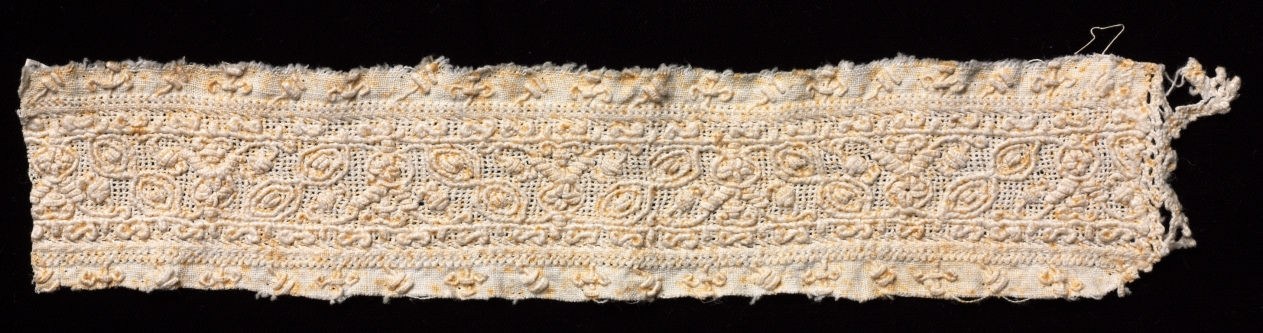
Urban Form: Fragment of a Band with Abstract Pattern
Executive Summary: The Semiotics of Absence in Urban Dress
This research brief deconstructs the aesthetic DNA of the “Udumbara Flowers” (Udonge) Temple Plaque—a moss-green wooden tablet inscribed with gilded calligraphy—and cross-references it against Piero della Francesca’s *The Hunt*. The objective is not to replicate iconography but to extract a wearable philosophy for the 2026 NYC executive. The plaque’s core proposition—presence through absence—and Francesca’s frozen kineticism converge into a singular design directive: the garment must perform as a negative space carrier, a structured void that signals authority without ornamentation. The resulting silhouette is Minimalist, executed in Slate—a color that embodies the plaque’s shadowed lacquer and the painting’s muted dawn light.
Formal Analysis: The Plaque as a Geometric Negative
Materiality and Surface Logic
The plaque’s physicality is deceptive. Its moss-green patina suggests organic decay, yet the gilded strokes impose a rigid, almost mechanical precision. This duality—organic substrate, geometric overlay—translates directly into fabric choice. For the 2026 executive, this means a double-faced wool: one side brushed to a matte, moss-like texture; the reverse, a tightly woven twill with a faint metallic thread. The garment’s surface must read as quietly expensive, not flashy. The gold calligraphy, described as “ink soaked by night rain,” is not a pattern but a temporal trace. In tailoring, this becomes a tonal seam—a 1.5cm contrast stitch in oxidized silver, placed along the shoulder yoke and inner cuff. It is visible only within 30cm proximity, forcing a deliberate, intimate viewing distance.
Silhouette: The Architecture of Waiting
The plaque’s emptiness is not passive; it is a charged vacuum. The calligraphy “Udonge” refers to a flower that blooms once every three millennia—yet no flower is depicted. The form, therefore, is defined by what it refuses to show. For the urban silhouette, this translates into a minimalist shell with internal tension. The jacket’s shoulder line is softly extended—2cm beyond the natural acromion—but the sleeve cap is set lower, creating a subtle drop that mimics the plaque’s hanging posture. The waist is suppressed by only 4cm, not to create an hourglass, but to suggest a held breath. The hem falls at the iliac crest, terminating in a clean, unhemmed edge—a nod to the plaque’s raw wooden border. This is not an oversized garment; it is a precise containment of void.
Color as Temporal Fog
Slate is chosen over the obvious moss-green or gold. The plaque’s “night rain” ink and the painting’s cool, northern light both resolve into a desaturated blue-gray—the color of dawn before color fully exists. Slate functions as a non-color, absorbing ambient light rather than reflecting it. In the 2026 NYC context, this is critical: the executive moves between fluorescent offices, glass-walled conference rooms, and amber-lit evening events. Slate adapts without shifting its identity. It is the chromatic equivalent of the plaque’s “silent pointing”—a hue that does not declare but withholds. Pair it with a single accent: a silk scarf in oxidized gold, worn knotted at the neck, referencing the gilded calligraphy without replicating it.
Cross-Referential Logic: Francesca’s Frozen Hunt
Kinetic Stillness in Garment Construction
Francesca’s *The Hunt* arrests motion—horses mid-gallop, arrows nocked but not released. This suspended dynamism is the second pillar of the silhouette. Where the plaque offers spatial emptiness, Francesca offers temporal stillness. The garment must achieve both. The trouser is cut with a slight taper from knee to ankle, but the front crease is pressed with a double line—one sharp, one blurred—suggesting a leg that has just stopped moving. The jacket’s back panel includes a hidden gusset at the shoulder blade, allowing 8cm of unencumbered reach, yet the outer fabric remains taut. The wearer appears composed, but the garment holds a reserve of motion, like the hunter’s drawn bow.
The Collar as a Conceptual Frame
Both source objects frame absence. The plaque’s wooden border encloses empty space; Francesca’s composition frames a pause. The collar becomes the garment’s frame. A high, stand-away mandarin collar—3cm tall, with a 2mm gap between fabric and neck—creates a shadow line that visually severs the head from the torso. This is not a fashion statement but a phenomenological cut: it isolates the face as the sole expressive zone, mirroring how the plaque isolates the calligraphy as the sole focal point. The collar is interfaced with horsehair canvas, not to stiffen, but to create a subtle bowing effect—the fabric leans away from the skin, holding air. This micro-volume is the garment’s “invisible flower.”
Wardrobe Integration: The 2026 NYC Executive
Modular Minimalism for the Vertical Commute
The final system comprises three pieces: a single-breasted jacket, a high-rise straight trouser, and a sleeveless shell. All in Slate. The jacket’s internal pockets are lined with a moss-green silk—an homage to the plaque’s substrate—visible only when opened. The trouser’s waistband is finished with a hidden drawcord, allowing micro-adjustment without external hardware. The shell is cut with a keyhole back, a circular cutout at the thoracic spine, echoing the plaque’s “empty center.” This is not for ventilation; it is a visual citation of the void. The executive wears this system from 7 AM meetings to 9 PM receptions, layering or removing the shell as temperature dictates. The palette never shifts. The silhouette never distorts.
Conclusion: The Garment as a Waiting Device
The Udonge plaque and Francesca’s hunt share a radical proposition: the object is not the point. The point is the interval—the space between the name and the flower, between the arrow and the deer. The 2026 Addison silhouette operationalizes this interval. It is not a uniform of power but a uniform of patience. The wearer does not command the room; they occupy a precise absence within it. In a city of relentless visual noise, the Slate minimalist shell becomes a silent plaque, a frozen gesture, a three-thousand-year bloom that never arrives—and therefore never fades.