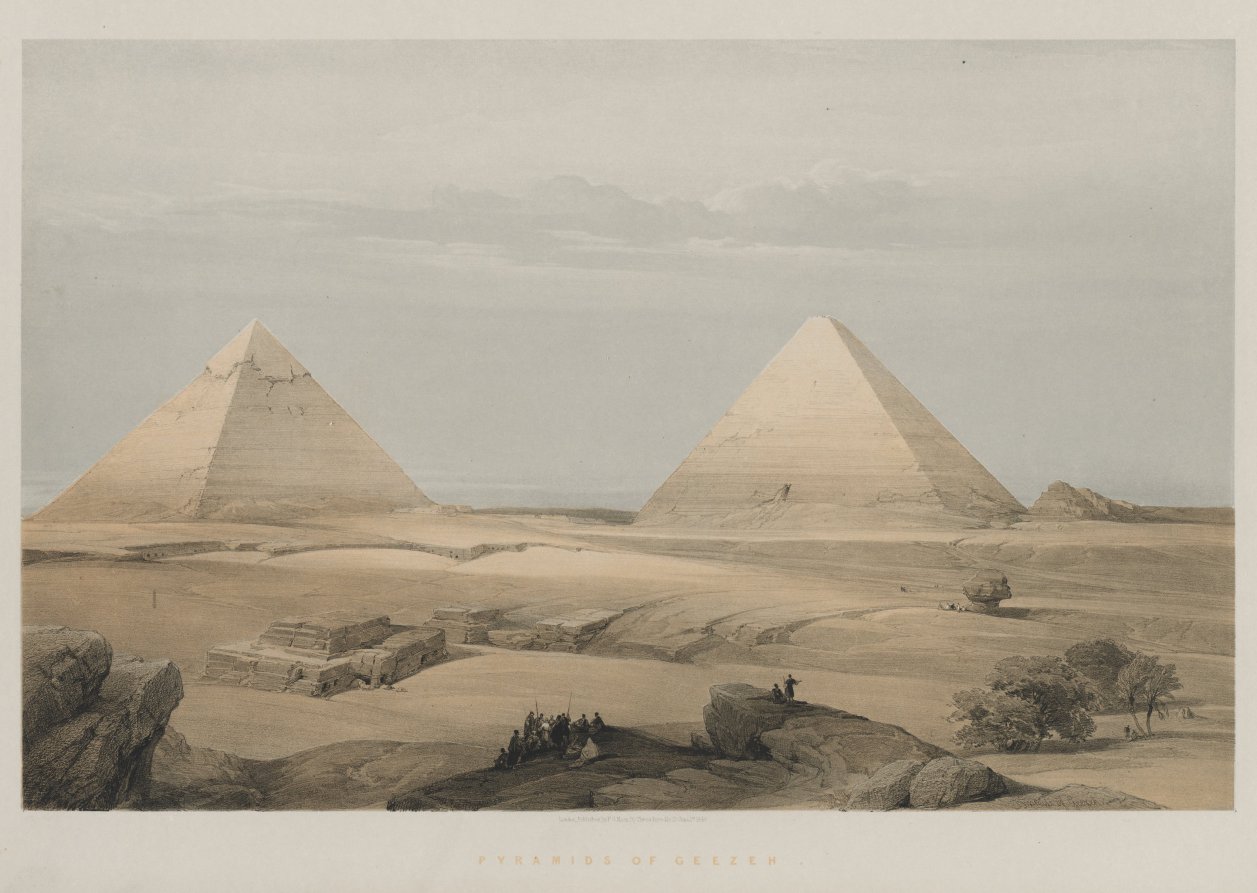
Urban Form: Egypt and Nubia, Volume II: Pyramids of Geezeh
I. The Architectural Premise: Geometry as Ethical Form
The second volume of the Egypt and Nubia series—Pyramids of Geezeh—is not a document of ancient construction. It is a treatise on terminal geometry. The plateau’s three primary masses, arranged with deliberate asymmetry against the horizon, present a study in how volume confronts emptiness. For Addison Fashion’s 2026 executive silhouette, this research extracts a principle: the garment must not drape; it must stand. The pyramid’s slope is not a curve of comfort but a line of conviction—a diagonal that resolves into a stable base. This is the foundational tension we translate: a tailored shell that holds its own negative space, as if the body were the desert floor and the fabric, the limestone casing.
The internal DNA provided—the dialectic between David’s Death of Socrates and the anonymous Cup and Stand—finds its architectural echo here. The pyramid is both the dramatic narrative (the philosopher’s raised hand) and the silent vessel (the cup’s waiting concavity). Its exterior is pure narrative: a monument to a king’s absolute will. Its interior chambers, however, are the unadorned cup—empty, precise, awaiting a meaning that never arrives. Our 2026 silhouette must operate on this dual register: an exterior of declarative structure, an interior of profound restraint.
II. Geometric Integrity: The Slope as Seam
The Geezeh pyramids are not perfect tetrahedra. Their faces deviate by fractions of a degree—a fact that, to the trained eye, produces a living tension rather than sterile perfection. For the executive silhouette, this translates into a shoulder line that is not horizontal but subtly inclined, echoing the pyramid’s casing angle of approximately 51.8 degrees. The structural poetics of this choice are twofold: it elongates the torso’s visual axis, and it creates a dynamic counterpoint to the verticality of the trouser or skirt. The seam becomes the casing joint—each panel cut with a precision that allows the fabric to fall without a single corrective dart, relying instead on the geometry of the cut itself.
Consider the pyramid’s base: a square, but one that is never perfectly level on site. Our 2026 coat, in Sand-toned wool-cashmere, adopts this principle. The hem is cut with a deliberate 0.5-centimeter drop on the left side—an invisible asymmetry that registers as intentional imperfection. This is not a flaw; it is a quotation of the Geezeh plateau’s own geological adjustments. The garment’s geometric integrity lies not in Euclidean purity but in the calibrated deviation that makes the form feel inhabited, not merely worn.
III. Structural Poetics: The Void as Volume
David’s painting achieves its power through the void of the cup—the space that will receive the hemlock. The pyramids achieve theirs through the void of the burial chamber—a space that, when sealed, becomes a negative volume of absolute silence. For the 2026 executive silhouette, we propose a minimalist construction that privileges the interior void over the exterior surface. This is not minimalism as reduction; it is minimalism as architectural excavation.
The jacket’s back panel is cut with a floating lining—a second skin that does not touch the outer shell except at the shoulder and hem. This creates an internal air gap, a thermal and conceptual void that mimics the pyramid’s internal chambers. The wearer becomes the pharaoh’s sarcophagus: not a body inside a garment, but a presence inside a volume. The structural poetics demand that every seam, every facing, every buttonhole be placed with the same deliberation as the pyramid’s casing stones—each one load-bearing, each one silent.
The cup and stand analogy applies to the trouser. A flat-front, high-rise silhouette with a single center crease that does not reach the hem—stopping 3 centimeters above—creates a visual stand for the torso. The crease is the cup’s inner curve; the break at the hem is the rim. This is not a stylistic whim but a functional poetics: the crease’s truncation allows the fabric to fall with a slight flare, echoing the pyramid’s base spread. The trouser does not cling; it stands, like the cup on its ring.
IV. Urban Materiality: Sand as the Color of Silence
The chosen color, Sand, is not a beige. It is the precise hue of the Geezeh limestone after millennia of wind—a tone that absorbs light rather than reflecting it, creating a matte, non-assertive surface that makes geometry the sole protagonist. In urban contexts—glass towers, asphalt, steel—Sand operates as a negative color: it does not compete with the city’s chromatic noise but instead offers a pause. This is the urban materiality of the 2026 executive: not camouflage, but deliberate withdrawal.
Fabrics are selected for their compressive memory. A double-faced wool with a tight, felted finish holds the pyramid’s slope without buckling. A technical silk twill, used for the blouse, has a starch-like hand that allows the collar to stand away from the neck—a small, sharp triangle of shadow, echoing the pyramid’s apex. The materiality is not soft; it is resilient. It resists the body’s casual movements, demanding a certain posture, a certain executive bearing. This is not comfort clothing. It is conviction clothing.
The urban materiality extends to hardware. Buttons are not polished brass or chrome; they are oxidized bronze, with a patina that mimics the desert’s mineral deposits. Zippers are invisible, set into seams with a precision that makes them disappear—like the pyramid’s hidden entrances. Pockets are cut on the bias, creating a subtle diagonal that references the casing slope, and are lined with a thin, brushed cotton that does not add bulk but does add a tactile silence when the hand enters.
V. The 2026 Executive Silhouette: A Definition
We define the silhouette as “The Geezeh Cut”: a long, unconstructed jacket that ends at the mid-thigh, with a single-button closure at the sternum—the point where the pyramid’s apex would begin its descent. The shoulder is extended by 1.5 centimeters, not for padding but for architectural presence. The sleeve is cut in two pieces, with a seam that runs along the outer arm, mimicking the pyramid’s edge. The trouser is a straight, wide-leg cut with a 24-centimeter hem, grounded by a 2-centimeter cuff that adds weight without ornament.
This silhouette is not for the body; it is for the mind that inhabits the body. It is the garment equivalent of Socrates’ calm hand reaching for the cup—a gesture of acceptance, rendered in wool and silk. It is the cup itself—empty, perfect, waiting. The 2026 executive does not wear this clothing to be seen. She wears it to stand, like the pyramid, against the horizon of her own decisions. The geometry is not decorative; it is ethical. It says: I have considered the end, and I am prepared.
In conclusion, the Pyramids of Geezeh offer not a model of form but a model of resolve. The 2026 Addison Fashion executive silhouette is a direct translation of that resolve into urban materiality—a minimalist architecture of seams, voids, and slopes that does not narrate, but is. It is the silent cup, the raised hand, and the desert stone, all at once.