Urban Form: Italian Sketchbook: Abstract Sketch (page 5)
I. Preliminary Deconstruction: The Sketch as Structural Manifesto
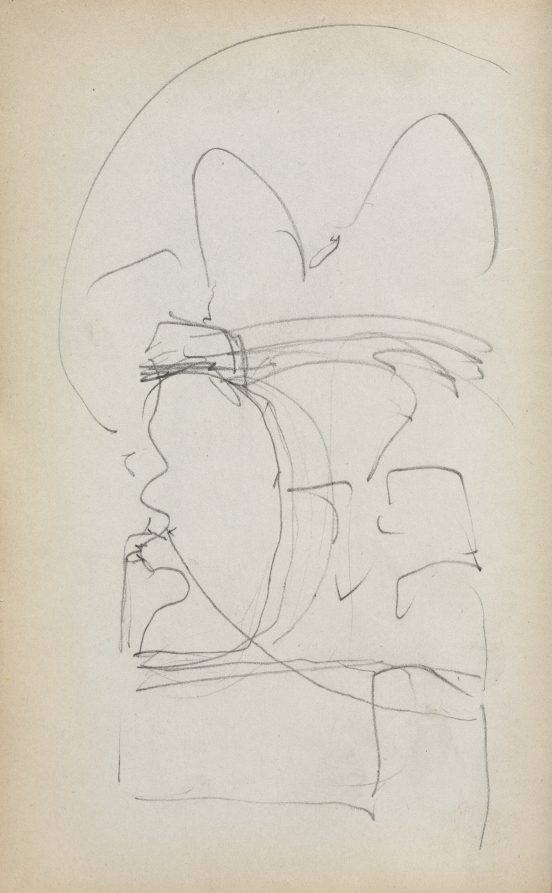
The Italian Sketchbook, page five, presents an abstract rendering that resists facile interpretation. It is not a garment, nor a textile, nor a pattern—it is a spatial proposition. The internal DNA, drawn from a comparative study of a Buddhist temple plaque and a Han dynasty bronze mirror, offers a dialectical tension between the void and the form, between the ephemeral bloom and the eternal cosmos. For Addison Fashion, this is not mere cultural appropriation; it is a technical blueprint for the 2026 executive silhouette. The sketch’s geometric integrity lies in its refusal to choose between concave and convex, between negative and positive space. Instead, it synthesizes both into a singular, architectural garment logic.
The plaque’s “udumbara flower”—a metaphor for the rare, the momentary, the unmanifest—is carved in relief, its petals emerging from the wood’s grain as if from a void. The mirror, conversely, is a perfect circle, its back densely populated with deities, chariots, and the White Tiger, all compressed into a radial order. The sketch translates this duality into a shoulder line that is both present and absent: a tailored structure that does not assert itself but rather suggests containment through negative space. The 2026 executive silhouette, therefore, is not about padding or exaggeration; it is about precision through subtraction.
II. Geometric Integrity: The Circle and the Negative Form
A. The Circular Mandate
Both artifacts share a circular logic—the plaque’s halo-like backplate and the mirror’s disc. In the sketch, this translates into a seamless, continuous line that runs from the shoulder to the hem, unbroken by darts or pleats. The executive silhouette for 2026 adopts a cylindrical torso, not as a restrictive tube, but as a modulated column where the fabric falls with gravitational authority. The circle is not literal; it is implied through curvature—a slight convexity at the chest, a concave sweep at the waist, and a return to verticality at the hip. This is the geometry of the mirror: a closed system that reflects outward order while concealing internal complexity.
B. The Negative Petal
The udumbara flower’s “non-flower” essence—its paradoxical existence as both absence and presence—informs the sketch’s treatment of the armhole and neckline. Here, the garment does not frame the body; it carves around it. The armhole is cut high and deep, creating a negative petal shape that visually lifts the torso. The neckline, whether a sharp crescent or a soft scoop, is not decorative but structural: it defines the boundary between the garment’s materiality and the wearer’s skin, echoing the plaque’s carved recesses. This is the “void” made wearable—a deliberate absence that generates presence.
III. Structural Poetics: From Temple to Tower
A. The Vertical Axis
The Han mirror’s radial composition—deities and beasts arranged around a central knob—suggests a hierarchical order. The sketch transposes this into a vertical axis of authority. The 2026 executive silhouette elongates the torso through a high, structured waist that sits just below the ribcage, not to cinch, but to establish a fulcrum. From this point, the garment flows downward in a controlled, almost architectural drape, reminiscent of a column’s fluting. The seams are not hidden; they are expressed as lines of tension, running from the shoulder blade to the hem, mimicking the mirror’s engraved chariot tracks—paths of movement frozen in time.
B. The Shoulder as Threshold
In both artifacts, the boundary between the sacred and the mundane is marked by a threshold. For the plaque, it is the transition from wood to carved flower; for the mirror, it is the rim that separates the reflective face from the decorated back. In the sketch, this threshold is the shoulder seam. For 2026, the shoulder is neither padded nor dropped; it is cut with a subtle forward pitch, creating a slight, almost imperceptible slope. This is not a gesture of softness but of calculated deference—the garment acknowledges the body’s movement without surrendering its own structure. The shoulder becomes a lintel, supporting the garment’s vertical weight while allowing the arm to move with independent grace.
IV. Urban Materiality: Ivory as the New Concrete
A. Fabric as Surface, Not Skin
The chosen color—Ivory—is not a neutral; it is a material argument. In urban contexts, ivory suggests raw concrete, unbleached linen, or honed travertine. For the 2026 executive silhouette, the fabric must be dense yet breathable, with a matte finish that absorbs light rather than reflecting it. A wool-cashmere blend with a tight, almost felted weave would achieve this: it holds the circular geometry without collapsing, and its surface—slightly irregular, like the plaque’s wood grain—offers a tactile counterpoint to the city’s glass and steel. The fabric is not a second skin; it is a built environment, a micro-architecture that the wearer inhabits.
B. Seams as Urban Lines
The sketch’s seams are not functional afterthoughts; they are drafting lines that map the garment’s structural logic. In urban materiality, these seams are treated as joints—like the expansion gaps in a bridge or the mortar lines in a brick wall. They are topstitched in a slightly darker ivory thread, creating a subtle relief that echoes the plaque’s carved petals. The hem is not folded and stitched; it is cut and left raw, then sealed with a thin strip of bonded interfacing. This creates a clean, almost brutalist edge that refuses to fray, mirroring the mirror’s sharp rim. The result is a garment that reads as prefabricated, precise, and permanent—yet it moves with the wearer, its seams flexing like the mirror’s engraved chariot wheels in motion.
V. The 2026 Executive Silhouette: A Synthesis of Void and Order
The definitive silhouette emerging from this research is a long, unconstructed coat—or a structured tunic—that falls to mid-calf, with a high, internal waist seam and a gently flared hem. It is neither oversized nor fluid; it is minimalist in its restraint, yet it carries the weight of both artifacts. The front is closed with a hidden placket, its buttons concealed like the mirror’s central knob—functional but invisible. The back features a single, central seam that curves slightly, echoing the plaque’s halo. The sleeves are set in with a high, narrow armhole, allowing for a full range of motion while maintaining the garment’s architectural line.
This silhouette is not for the casual observer. It demands a wearer who understands that power is not loud—it is the quiet authority of a perfectly balanced line. The udumbara flower blooms once in three thousand years; the executive wears this garment as if it, too, were a rare event. The mirror reflects the cosmos; the garment reflects the wearer’s internal order. In the urban landscape, where chaos is the default, this silhouette offers a geometry of calm—a circle that contains, a void that defines, and an ivory surface that absorbs the city’s noise into silence.
VI. Conclusion: The Garment as Threshold
The Italian Sketchbook’s page five is not a drawing to be copied; it is a philosophy to be worn. Its geometric integrity—derived from the circular mirror and the negative petal—translates into a silhouette that is both ancient and futuristic, both sacred and urban. For Addison Fashion, the 2026 executive collection will not chase trends; it will construct time. Each garment will be a threshold, like the plaque’s carved flower or the mirror’s reflective face, inviting the wearer to step from the mundane into the eternal present. This is the definitive urban silhouette: not a shape, but a state of being, rendered in ivory, structured by void, and ordered by the circle.