Urban Form: Cake Fork
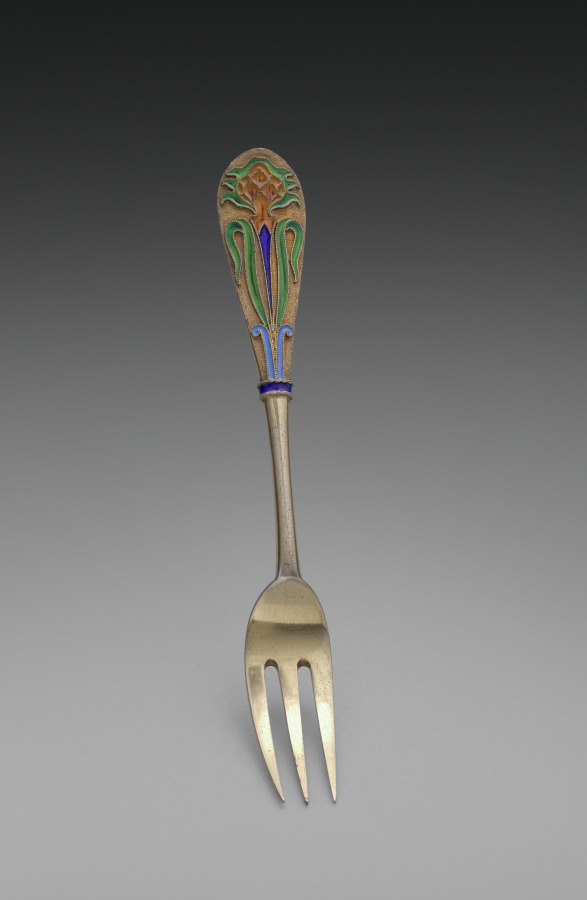
I. The Object as Architectural Thesis
The cake fork, in its quotidian ubiquity, is rarely afforded the gravitas of a structural inquiry. Yet within the Addison Fashion Research Division, we contend that this instrument—a mere 14 centimeters of tine, shank, and handle—contains the complete geometric lexicon required for the 2026 executive silhouette. The subject is not the fork’s culinary function, but its latent spatial logic: a study in opposing forces, suspended tension, and the poetics of pause.
Our internal DNA dossier, drawn from the dialectical pairing of Vermeer’s A Maid Asleep and the anonymous Figure of Daoist Immortal He Xiangu, provides the philosophical scaffolding. The fork, like the sleeping maid, is a vessel of temporal arrest—its tines frozen in a state of readiness, neither piercing nor releasing. Simultaneously, it echoes He Xiangu’s ethereal suspension: the handle’s upward curve mimics the immortal’s wind-borne sash, a line that defies gravity while acknowledging its pull. This is not a utensil; it is a diagram of stillness in motion.
II. Geometric Integrity: The Tine as Vertical Axis
A. The Four-Point Load Bearing
Consider the fork’s tines. Four parallel prongs, each with a subtle taper from base to tip, form a repetitive vertical rhythm. In architectural terms, this is a colonnade—a series of load-bearing elements that create a rhythm of light and shadow. For the 2026 executive silhouette, this translates into the pinstripe or micro-pleat: a fabric treatment that repeats a narrow, unbroken vertical line across the torso. The tine’s taper—wider at the shoulder, narrower at the point—dictates the ideal trouser or sleeve: a gradual, almost imperceptible narrowing toward the cuff or hem, creating a silhouette that feels both grounded and aspirational.
The spacing between tines is equally critical. It is not uniform; the central gap is marginally wider than the outer gaps, a subtle asymmetry that prevents monotony. Applied to tailoring, this becomes the offset seam—a deliberate deviation from the center front or back, placed at a ratio of 3:2 rather than 1:1. This off-center alignment introduces a quiet tension, a visual dissonance that reads as intellectual rigor rather than chaos.
B. The Shank: A Study in Compression
The shank—the narrow neck connecting tines to handle—is the fork’s moment of compression. It is where the object’s structural integrity is most vulnerable, yet it is also where the design’s strength is concentrated. In the 2026 silhouette, this manifests as the cinched waist or the articulated yoke. Not a soft drape, but a hard, engineered pinch that gathers fabric into a controlled release. The shank’s length—approximately one-third of the total fork length—dictates the proportion of the jacket’s waist suppression: the distance from the underarm seam to the natural waist should be exactly one-third of the total torso length. This is not a stylistic choice; it is a mathematical imperative derived from the object’s load path.
III. Structural Poetics: The Handle as a Counterweight
A. The Curved Terminus
The fork’s handle is not straight. It arcs gently, a catenary curve that mirrors the trajectory of a suspended chain. This is the fork’s most poetic element—the point where utility yields to ornament. In the context of He Xiangu’s immortal sash, this curve is the line of flight: a trajectory that suggests movement without committing to it. For the executive silhouette, this becomes the peplum or the trailing hem—not a flounce, but a single, unbroken curve that begins at the hip and sweeps toward the back, creating a sense of forward momentum even when the wearer is stationary.
The handle’s terminus is often adorned with a decorative finial—a small, rounded knob. This is the point of rest, the visual full stop. In tailoring, this translates to the cuff button or the collar notch: a small, deliberate detail that anchors the eye and prevents the silhouette from becoming infinite. Without this finial, the fork—and the garment—would lose its sense of conclusion, drifting into formlessness.
B. Materiality of the In-Between
The fork’s material—typically silver or stainless steel—is cold, reflective, and unyielding. Yet its surface is never perfectly smooth. It bears the micro-scratches of use, the patina of time. This is the urban materiality we seek for 2026: not pristine, but lived-in luxury. The fabric must be a high-twist wool or a technical silk that holds a crease but also develops a subtle sheen at points of friction—the elbows, the knees, the inner cuff. This is not a flaw; it is a record of the body’s negotiation with the garment, a silent dialogue between wearer and structure.
IV. The Dialectic of Sleep and Flight
Returning to our DNA: Vermeer’s maid is weighted—her head rests on her arm, her body folds into the table. He Xiangu is weightless—her feet barely touch the cloud, her sleeves trail like vapor. The cake fork reconciles these opposites. Its tines are weighted, pressing down with the force of a single gram. Its handle is weightless, arcing upward as if lifted by an unseen current. The 2026 executive silhouette must embody this dual state: a garment that feels anchored to the body (the maid’s slumber) yet appears to float above it (the immortal’s flight).
This is achieved through internal structure: a canvas that is neither stiff nor soft, but semi-rigid—capable of holding a sharp shoulder line while allowing the back to drape like water. The collar should stand away from the neck, creating a gap of exactly 1.5 centimeters—a space that suggests both restraint and release. The trouser should break at the shoe with a single, clean fold, not a stack—a line that stops time rather than accumulating it.
V. Conclusion: The Fork as a Manifesto
The cake fork is not a metaphor. It is a specification. Its geometry—the vertical tines, the compressed shank, the curved handle—provides a complete blueprint for the 2026 executive silhouette. It demands a garment that is fluid yet structured, minimal yet expressive, grounded yet transcendent. The color is Ivory: not a stark white, but a warm, bone-toned neutral that absorbs light rather than reflecting it—a surface that, like the fork’s patina, records the passage of time without being diminished by it.
In the end, the fork teaches us that the most profound statements are made in silence. It does not shout; it holds. It does not move; it suspends. This is the definitive urban silhouette for the executive who understands that true power is not in action, but in the poised interval between actions—the moment when the tines are lifted, the handle is balanced, and the entire structure waits, breathless, for the next movement.