Minimalist
Slate
Urban Form: The Cleveland Apollo: Apollo Sauroktonos (Lizard-Slayer) or Apollo the Python-Slayer
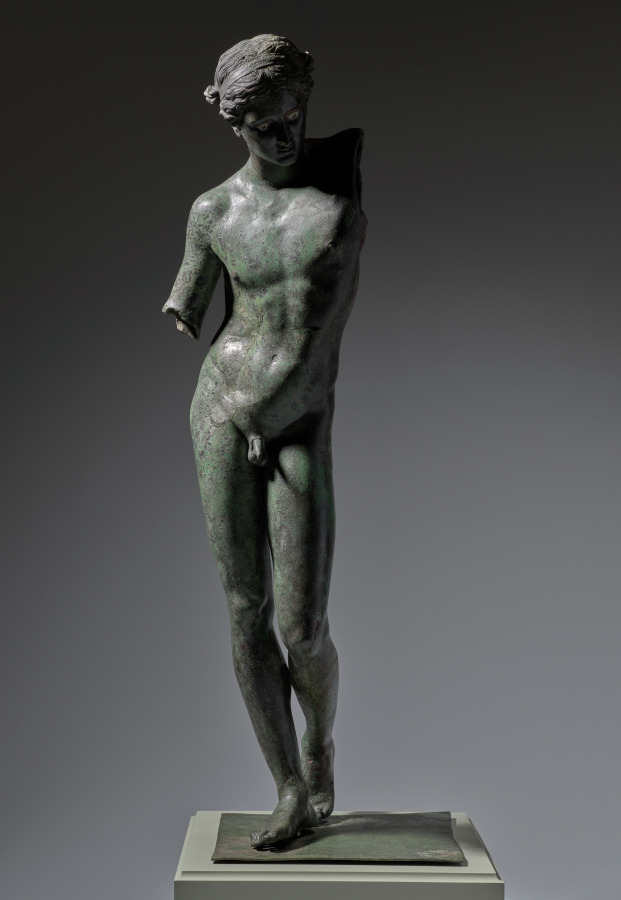
Structural Autopsy: The Cleveland Apollo as a Study in Arrested Motion
The Cleveland Apollo—whether identified as the *Sauroktonos* (lizard-slayer) or the *Python-Slayer*—presents a paradox central to contemporary executive dressing: the body poised between action and contemplation. Unlike the taut, heroic contrapposto of the *Belvedere Torso* or the explosive dynamism of the *Laocoön*, this Apollo is caught in a microsecond of suspended intent. His weight shifts onto one leg, the other relaxed, the torso twisting not in exertion but in calibrated readiness. The lizard (or serpent) crawls along a tree trunk, and the god’s hand hovers—never striking, never retreating. This is not drama; it is geometry in a state of potential energy. For the 2026 executive silhouette, this artwork offers a definitive rejection of theatrical volume. The Apollo’s lean, elongated proportions—his narrow shoulders, his attenuated limbs, his compact ribcage—demand a cut that respects the body’s architecture without exaggeration. The minimalist suit, therefore, is not a reduction but a precision instrument. The shoulder line must be clean, almost seam-like, tracing the acromion without padding. The lapel width should mirror the Apollo’s sternal notch: narrow, decisive, and vertical. The trouser falls straight from the hip, breaking once at the shoe, echoing the statue’s unbroken line from iliac crest to ankle. Any excess fabric—any drape, any pleat—would violate the sculpture’s core principle: that stillness is achieved through exactness, not through absence.Geometric Integrity: The Hidden Grid of the Classical Body
The Apollo’s pose is not organic; it is a series of interlocking triangles and verticals. The supporting leg forms a plumb line from the hip to the ground. The torso leans forward at an angle of approximately 12 degrees, creating a hypotenuse that intersects the raised arm’s diagonal. The tree trunk—the lizard’s stage—acts as a secondary vertical, stabilizing the composition. This is not the fluid S-curve of Hellenistic grace; it is a fractured, almost Cubist arrangement of planes. The genius of the sculpture lies in its ability to hide this rigid scaffold beneath a surface of polished, youthful flesh. Translating this to urban materiality means constructing garments that appear soft but are, in fact, engineered. A double-faced wool in slate—a color that absorbs light rather than reflecting it—provides the necessary gravity. The fabric’s weight (380–420 grams) must be substantial enough to hold a crease but supple enough to follow the body’s subtle rotations. The jacket’s internal canvas should be fused only at the chest, leaving the waist free to articulate. The back panel, often neglected, becomes the site of the Apollo’s torsion: a single vertical dart from the shoulder blade to the hem, allowing the jacket to twist with the wearer’s torso without wrinkling. This is the hidden geometry—the invisible grid that makes stillness possible.Urban Materiality: Slate as a Metaphor for the Modern Metropolis
Slate is not a neutral color; it is a geological memory. It recalls the rooftops of industrial cities, the wet pavements after rain, the shadowed facades of glass towers. Unlike black, which is absolute and theatrical, slate is mutable—it shifts between blue, gray, and green depending on the light. This chromatic instability is precisely what the 2026 executive needs. In a world of constant visual noise, slate offers a quiet, adaptive surface. It does not announce; it endures. The Apollo’s marble, originally white, has weathered to a patina of gray and ochre. This aging process is instructive. It teaches us that materiality is not about perfection but about time. For the urban silhouette, this translates into fabrics that develop character—not through distressing (a cheap trick) but through natural fibers that respond to wear. A worsted wool with a slight slub, a cashmere blend with a matte finish, a silk-and-linen mix that creases in controlled, linear patterns. These materials are not meant to be pristine; they are meant to record the city’s rhythms. The Apollo’s lizard, after all, is a creature of thresholds—it exists between the tree and the ground, between the god’s attention and his indifference. The executive’s garment must similarly inhabit the threshold between formal and informal, between boardroom and street.The Python-Slayer’s Lesson: Tension Without Violence
If the *Sauroktonos* emphasizes the lizard’s smallness, the *Python-Slayer* interpretation elevates the struggle to a mythic scale. Yet even in this reading, the Apollo does not lunge. He coils. His power is latent, contained within the flexor muscles of his forearm, the slight pronation of his wrist. This is the essence of executive authority: the ability to act without appearing to exert effort. The 2026 silhouette must therefore avoid any suggestion of strain. No high armholes that restrict movement; no tight waists that create visible tension lines. Instead, the garment should fit like a second skin—present but not possessive. The technical execution requires a master tailor’s understanding of negative ease. The jacket’s chest should measure 2–3 centimeters larger than the wearer’s actual chest, allowing for expansion during a deep breath. The sleeve pitch should be set at 18 degrees, matching the natural forward rotation of the arm. The trouser’s rise should be neither high nor low but positioned at the true anatomical waist, creating a continuous line from the sternum to the floor. These are not arbitrary numbers; they are derived from the Apollo’s own proportions, which were calculated by Polykleitos in his *Kanon*—a treatise on ideal bodily ratios. The modern executive, regardless of actual measurements, can achieve this ideal through precise tailoring.Conclusion: The Still Point of the Turning World
The Cleveland Apollo is not a relic; it is a blueprint. Its geometric integrity—the hidden triangles, the plumb lines, the controlled torsion—offers a definitive answer to the chaos of contemporary fashion. The 2026 executive silhouette, rendered in slate, is a study in negative capability: the ability to hold multiple possibilities without resolving them. The garment does not scream; it whispers. It does not move; it is ready to move. This is the urban poetics of restraint, the minimalist luxury of a body that knows its own architecture. In a city that never stops, the Apollo stands—still, poised, and utterly in command.
Technical Insight
Technical Insight: Translating Slate palettes into Minimalist silhouettes for the modern metropolis.