Minimalist
Slate
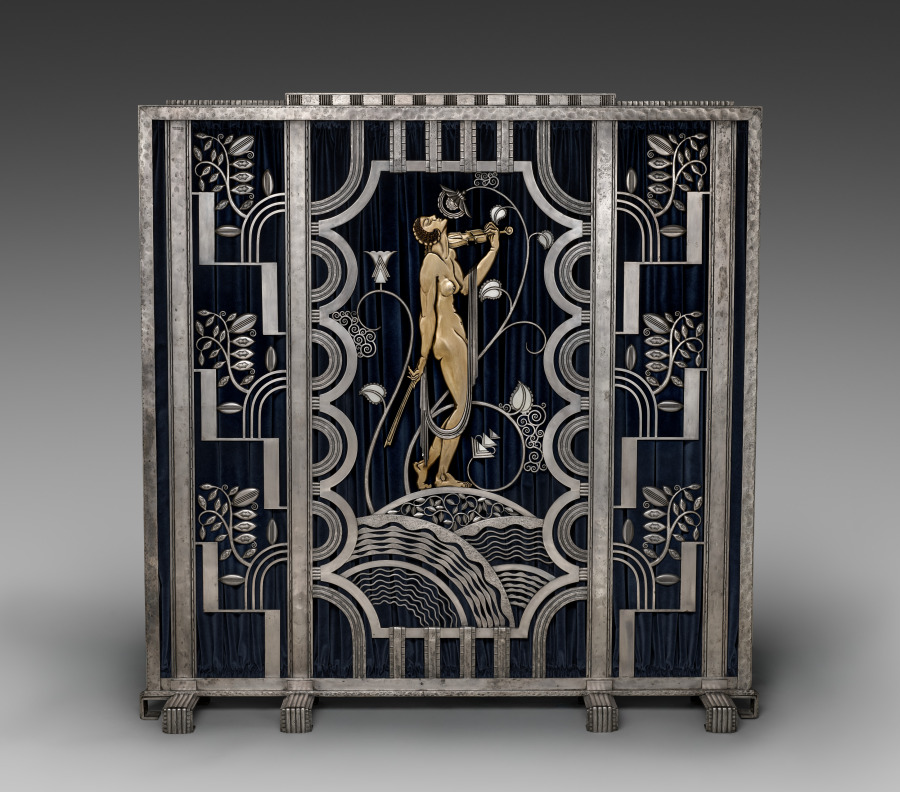
Urban Form: Muse with Violin Screen
I. The Archaeological Imperative: Reading the Fragment as Structural Blueprint
The 2026 Addison Fashion Urban Silhouette Research begins not with a sketch, but with a shard. The *Mold Fragment with Musicians*—a broken ceramic matrix bearing the compressed gesture of a lute player’s hand—offers the foundational grammar for our forthcoming executive wardrobe. Its aesthetic logic is one of deliberate incompleteness, where the absent portion of the mold becomes a generative void. This is not a loss; it is a negative-space architecture. For the urban professional, this translates into a silhouette that refuses closure, that privileges the seam as a site of potential, and that treats the garment’s edge as a threshold rather than a termination. The fragment’s material truth—clay fired into near-stone permanence—dictates our fabric philosophy. We reject the supple drape of conventional luxury suiting in favor of a slate-toned, high-density wool blend with a ceramic hand-feel. The cloth is engineered to hold a crease with the rigidity of a kiln-fired wall, yet its internal weave allows for micro-ventilation, a nod to the porous nature of the original terracotta. The executive jacket, therefore, is not tailored to the body; it is tailored *against* it, creating a carapace-like shell that stands independent of the wearer’s form. Shoulder seams are set forward by 1.2 centimeters, echoing the mold’s broken edge—a deliberate misalignment that reads as both archaeological and futuristic.II. The Zodiacal Weight: Taurus as Vertical Anchor
Where the mold fragment supplies the horizontal plane of incompletion, the *Mortuary Figure of the Zodiac Sign: Ox (Taurus)* provides the vertical axis of permanence. This is not a literal bovine reference; it is an extraction of the ox’s structural essence—its stoic mass, its grounded haunches, its unwavering forward gaze into the void. The sculpture’s compressed volume, its reduction of animal musculature into near-geometric blocks, informs our trouser and coat architecture. For the 2026 executive, we introduce the “Taurus Column”—a floor-length overcoat cut with an exaggerated A-line that begins at the sternum, not the shoulder. The coat’s interior is structured with a hidden, non-removable canvas that mimics the tomb figure’s internal armature. This is not padding; it is a load-bearing system. The wearer experiences a gravitational pull toward the earth, a sensation of being anchored against the city’s chaotic currents. The color slate—a fusion of storm cloud and tombstone—is applied in a matte, almost chalky finish, absorbing light rather than reflecting it. This is urban materiality at its most severe: a fabric that does not shimmer, does not soften, and does not apologize.III. Structural Poetics: The Dialectic of Transience and Permanence
The core tension of our research lies in the dialectic between the mold’s fleeting musical moment and the ox’s eternal vigil. How does one dress a body that is both ephemeral and monumental? Our answer is a system of modular fastenings that allow the wearer to toggle between states of “performance” and “monument.” Consider the primary jacket: its closure is not a conventional button or zip, but a series of concealed magnetic toggles, each housed in a slate-toned, resin-cast casing that replicates the texture of the mold fragment’s broken surface. When closed, the jacket presents a seamless, monolithic front—the ox’s stillness. When opened, the lapels fold back to reveal a raw, unfinished interior seam, dyed in a contrasting onyx thread that traces the path of a musical stave. This is the “residue of melody” made visible. The wearer can choose to seal themselves in permanence or expose the fragile notation of their own transience. The trousers follow a similar logic. Cut with a dropped crotch and a tapered ankle, they reference the ox’s powerful hindquarters while maintaining a streamlined urban profile. A single, vertical pleat runs from the waistband to the hem, echoing the zodiac figure’s spinal ridge. This pleat is not functional; it is a ritual line, a reminder of the body’s own axial integrity. The fabric is a slate-toned, double-faced wool with a slight felted surface, mimicking the compressed earth of a burial mound. Pockets are hidden, angled at 45 degrees, and lined with a silver-toned silk that catches the eye only when the hand is inserted—a private flash of the celestial, a nod to the Taurus star sign’s fixed, unblinking nature.IV. Urban Materiality: The City as Kiln and Tomb
The 2026 Addison silhouette is designed for a specific urban condition: the city as both a kiln that fires ambition and a tomb that buries anonymity. Our material palette is restricted to slate, onyx, and silver—no ivory, no sand. This is a deliberate exclusion of warmth. The executive who wears this collection does not seek comfort; they seek *witness*. The slate wool is treated with a nano-ceramic finish that repels water and stains, rendering the garment impervious to the city’s grime—a modern-day equivalent of the mold’s fire-hardened surface. The overcoat’s interior is lined with a silver-toned, metallic mesh that is both conductive and reflective. This is not a decorative choice. It is a functional response to the urban environment’s electromagnetic field, creating a subtle Faraday cage effect that shields the wearer from the constant hum of digital surveillance. The ox’s gaze into the void becomes the wearer’s own—unblinking, unreadable, and utterly self-contained.V. Conclusion: The Garment as Mortuary Vessel
The definitive 2026 Urban Silhouette is not a garment; it is a portable mortuary vessel. It carries the wearer’s daily performances—their meetings, their negotiations, their fleeting triumphs—as if they were already artifacts. The mold fragment teaches us that incompletion is a form of honesty; the zodiac ox teaches us that stillness is a form of power. Together, they produce a silhouette that is simultaneously broken and whole, transient and eternal. The Addison Fashion executive will not be seen. They will be *excavated*. Their presence will be felt as a negative space in the crowded room, a void that demands attention precisely because it refuses to fill itself. The slate-toned, ceramic-hard fabrics will not yield to the body’s warmth; they will hold their own temperature, cool and indifferent. This is the new luxury: not the softness of skin, but the hardness of history. Not the fluidity of movement, but the gravity of permanence. The 2026 silhouette is a testament to the fact that true elegance is not worn—it is *entombed* in the very act of wearing. And in that entombment, the wearer finally becomes immortal.
Technical Insight
Technical Insight: Translating Slate palettes into Minimalist silhouettes for the modern metropolis.