Urban Form: Altarpiece with Relics
I. Preliminary Framing: The Dialectics of Surface and Substance
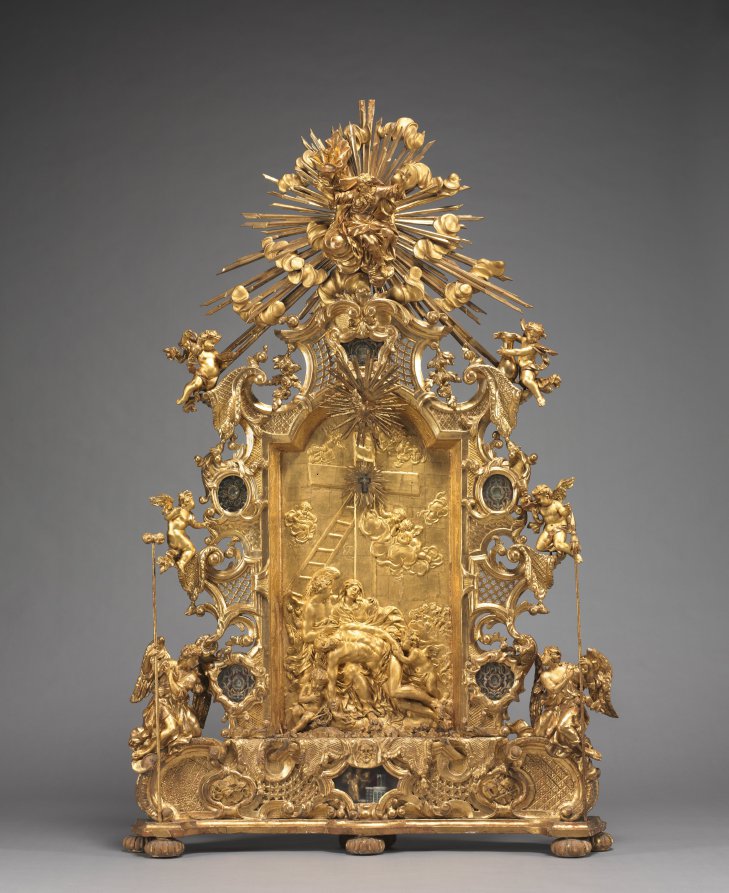
The Altarpiece with Relics—a conceptual fusion of the gilded silver mirror and the sarcophagus panel—presents a singular provocation to contemporary womenswear. At first glance, these artifacts occupy opposing ontological poles: one is a tool of transient reflection, the other a monument to permanent rest. Yet their shared aesthetic DNA lies in a rigorous manipulation of two-dimensional planes to generate three-dimensional meaning. For the 2026 executive silhouette, this translates into a wardrobe architecture that rejects ornamentation as mere decoration and instead deploys surface treatment as a carrier of existential weight. The mirror’s gold-inlaid palmette and the sarcophagus’s relief narrative are not embellishments; they are structural arguments about time, memory, and the body’s place within urban flux.
II. Geometric Integrity: The Palmette as a Spatial Grid
The split-leaf palmette, rendered in gold on silver, is not a botanical illustration but a geometric abstraction. Its symmetry is absolute, its repetition infinite, its curvature disciplined. In the context of the 2026 executive silhouette, this motif dictates a logic of segmented construction—panels that mirror each other across a central seam, creating a visual cadence that reads as both armor and architecture. The garment becomes a wearable grid: shoulder seams align with the palmette’s central axis; darts trace the leaf’s bifurcation; hem lines echo the motif’s terminal points. This is not print placement; it is structural poetics, where every seam is a line of force, every fold a shadowed recess.
The mirror’s “empty” silver ground—the void between gold filaments—offers a critical lesson in negative space. For the executive silhouette, this translates into strategic absence: unbroken expanses of matte onyx wool, interrupted only by a single, precise line of tonal piping or a metallic grommet. The garment breathes through its voids. The body is not obscured but framed, much as the mirror’s reflective field frames the fleeting face. This is minimalist luxury at its most severe: nothing is added unless it alters the spatial reading of the whole.
II.A. The Sarcophagus Panel: Narrative as Structural Load-Bearing
Where the mirror offers abstract eternity, the sarcophagus panel offers narrative compression. Its relief figures are not flat; they emerge from the stone with a controlled depth that suggests both physical presence and symbolic weight. In garment construction, this translates to dimensional tailoring—not padding or exaggeration, but a subtle layering of fabrics and interfacings that creates topographic variation across the torso. A jacket’s lapel, for instance, is not simply folded; it is built with a slight, almost imperceptible rise, as if the fabric itself carries a story of endurance. The urban materiality here is key: heavy, compacted wools, bonded cottons, and technical silks that hold their shape like carved stone, yet move with the wearer’s stride.
The relief’s narrative content—mythic or biographical—is translated into functional detailing. A pocket’s placement echoes a figure’s gesture; a vent’s angle mirrors a drapery fold. The garment becomes a silent biography of the wearer, not through logos or labels, but through the positioning of structural elements. This is the 2026 executive uniform: a suit that does not shout, but whose seams whisper of discipline, foresight, and a quiet command over time.
III. Structural Poetics: The Interface as Threshold
The mirror and the sarcophagus both operate on the principle of the interface—a plane that separates and connects. For the mirror, the interface is the silvered surface that reflects the present while the gold pattern speaks of the eternal. For the sarcophagus, the interface is the carved stone that separates the deceased from the living while narrating a life’s meaning. In the 2026 silhouette, this dualism manifests as layered transparency and opacity. A sheer silk organza shell over an opaque onyx underlayer creates a visual “reflection” without literal mirrors. The outer layer is the present—fluid, ephemeral; the inner layer is the permanent—structured, unyielding. The wearer moves between these layers, embodying both the fleeting and the fixed.
This is not mere layering for warmth; it is philosophical dressing. The executive woman of 2026 navigates a cityscape of glass towers and concrete plazas—surfaces that reflect and surfaces that endure. Her garment must do both. A coat with a high, sculptural collar and a sharp, asymmetric closure references the sarcophagus’s commemorative gravity. Beneath it, a dress with a subtle, all-over geometric jacquard—a modern palmette—offers the mirror’s promise of controlled beauty. Together, they form a complete system of urban materiality: one that acknowledges the city’s harshness while asserting the wearer’s unassailable poise.
III.A. Material Lexicon: Onyx, Silver, and the Weight of Light
The color palette for this collection is deliberately restricted: Onyx as the dominant ground, with Silver as the sole metallic accent. Onyx is not black; it is a depth that absorbs light, much like the sarcophagus’s stone absorbs the gaze. Silver, in contrast, is reflective and active—the gold’s colder, more urban cousin. The palmette’s gold is translated into silver-toned hardware: zippers, grommets, and exposed seams that catch the city’s artificial light. This is not glamour; it is precision. The silver line traces the garment’s architecture, guiding the eye along the body’s structural axes—shoulder to wrist, hip to hem.
Fabrics are chosen for their density and drape: double-faced wool, compacted cashmere, and a new generation of recycled technical twill that mimics stone’s weight without its rigidity. The finish is matte, almost dry, to avoid any suggestion of softness. Seams are pressed open and flat, like incised lines on a panel. Buttons are replaced by concealed closures—hidden hooks, magnetic plackets—so that the garment’s surface remains unbroken, a continuous field of onyx. The effect is monumental, yet the garment moves with the wearer, its internal engineering allowing for a full stride, a raised arm, a seated posture. This is the paradox of the altarpiece: it is both relic and living form.
IV. Conclusion: The Eternal in the Ephemeral
The Altarpiece with Relics ultimately teaches that permanence is not a rejection of time but a mastery of its representation. The mirror’s gold palmette does not deny the passing face; it frames it within an eternal pattern. The sarcophagus’s relief does not deny death; it transforms it into narrative. For the 2026 executive silhouette, this means a wardrobe that does not hide the body’s temporality—its fatigue, its motion, its eventual decline—but elevates it through structure. The onyx suit is not a costume of power; it is a vessel of continuity, a wearable relic that carries the wearer’s past achievements and future ambitions within its seams.
In the urban context, where every surface is a potential reflection and every building a potential monument, the Addison Fashion executive woman chooses garments that operate on both registers. She wears the mirror’s discipline and the sarcophagus’s gravity. Her silhouette is minimal, but its minimalism is not absence—it is the highest concentration of meaning. The palmette’s symmetry and the relief’s depth are not historical citations; they are structural principles for a new kind of dressing—one that acknowledges the city’s relentless pace while asserting a timeless, unshakable presence. This is the definitive urban silhouette of 2026: a study in onyx and silver, built on the poetics of the plane, and engineered for the eternal now.