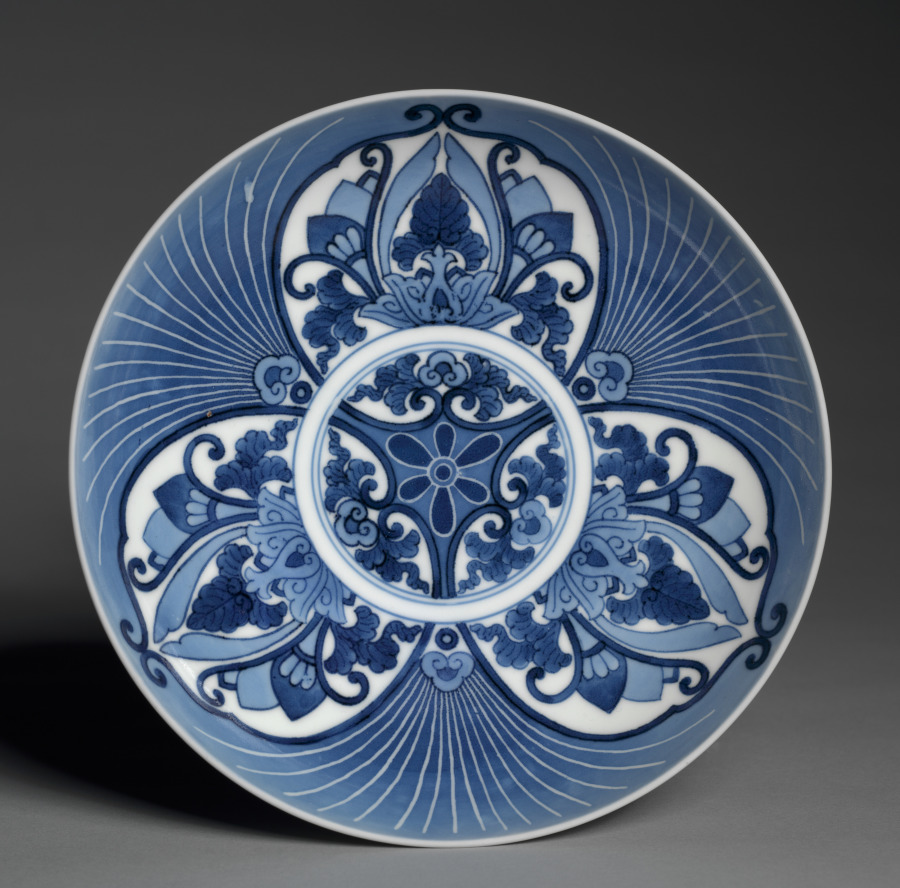
Urban Form: Dish with Ginkgo Leaves
Executive Summary: The Dialectics of Dormancy and Levitation
This Urban Silhouette Research translates the philosophical tension between Vermeer’s A Maid Asleep and the anonymous Figure of Daoist Immortal He Xiangu into a wearable architecture for the 2026 NYC executive. The subject—a dish bearing ginkgo leaves—serves as the material anchor, its fan-shaped foliage oscillating between stillness and motion, decay and permanence. The resulting design language is neither nostalgic nor avant-garde but temporal: a wardrobe that negotiates the executive’s dual existence as a stationary operator (the sleeping maid) and a kinetic strategist (the airborne immortal). The palette is anchored in Slate—a color that absorbs light without surrendering depth, mirroring the ginkgo’s chlorophyll fading into mineral gray. This is not a collection; it is a state-management system for the urban professional.
I. Form as Philosophical Syntax: From Weight to Weightlessness
A. The Vermeer Principle: Compressed Gravity
Vermeer’s maid is defined by horizontal inertia—the body’s mass distributed across a table, fabric pooling in soft, unbroken planes. The technical translation for Addison Fashion is a low-center-of-gravity silhouette: dropped shoulder seams, elongated torsos, and skirts that begin at the natural waist but fall with deliberate, unbroken volume. The ginkgo dish informs this via its radial symmetry—each lobe of the leaf echoes the maid’s folded arms, creating a visual rhythm of containment. In garment form, this manifests as asymmetric draping that mimics the dish’s shallow concavity: a wool crepe coat with a single, sculpted side panel that wraps the body like a resting hand. The hem is weighted with internal grosgrain, ensuring the fabric settles rather than floats—a nod to the maid’s “time-fog” where every fold is a frozen second.
Critically, the Vermeer principle rejects decorative interruption. No visible buttons, no contrast stitching. Instead, seams are fused and pressed to a knife-edge, creating a surface that reads as monolithic—like the dish’s glazed ceramic, unbroken except for the subtle relief of the ginkgo veins. For the executive, this translates to a blazer with internal cantilevered shoulder pads that lift the silhouette without altering its outer line, preserving the “sleeping” posture while engineering upright authority.
B. The He Xiangu Principle: Suspended Kinetics
He Xiangu’s form is defined by vertical ascension—ribbons, scarves, and hems that trail upward as if caught in a perpetual thermal draft. The ginkgo dish contributes its petiole (stem) geometry: a thin, linear element that connects the leaf to the branch, suggesting a point of release. Addison’s translation is a layered, bias-cut shell over a structured base. The outer layer—a silk-wool blend in slate—is cut on the bias to create torque: when the wearer walks, the fabric twists and snaps back, mimicking the immortal’s “wind-riding” drapery. The inner layer is a high-tensile knit that adheres to the torso, providing the “cloud” beneath the feet—a sensation of support without visible structure.
The key technical innovation is the “ginkgo notch”: a crescent-shaped cutout at the side seam, positioned at the iliac crest. This opening allows the outer shell to billow independently of the inner layer, creating a negative space that echoes the dish’s empty center. When the executive is seated (the maid state), the notch closes, compressing the volume into a clean line. When standing (the immortal state), the notch opens, releasing a fan of fabric that suggests—but never fully reveals—motion. This is kinetic modesty: the garment performs flight without sacrificing corporate restraint.
II. Color Theory: Slate as the Intersection of Sleep and Awakening
A. Chromatic Duality
Slate is not a neutral; it is a compressed spectrum. In Vermeer’s palette, slate appears as the shadowed side of white linen—a cool, recessive tone that pulls the eye toward the maid’s illuminated face. In He Xiangu’s palette, slate is the color of distant mountains—a hazy, atmospheric blue-gray that suggests altitude. The ginkgo dish, when dried, exhibits this exact transition: the vibrant green fades to a desaturated, mineral gray with faint yellow undertones. Addison’s slate is therefore double-dyed: a base of charcoal, overlaid with a micro-pigment of oxidized copper, creating a surface that shifts from blue-gray (indoor, fluorescent) to warm gray (outdoor, dusk). This ensures the executive’s presence is contextually adaptive—authoritative in the boardroom, approachable in the gallery.
B. The Ginkgo Leaf as Color Architecture
The dish’s ginkgo leaves are not uniform; they exhibit variegation—some lobes are deeper in tone, others are translucent. This is translated into a graded tonal system within the slate family: Deep Slate (for outer shells and structured pieces), Mid Slate (for bias layers and linings), and Pale Slate (for accents—collars, cuffs, and the ginkgo notch’s interior). The distribution follows the leaf’s venation: deep tones at the garment’s core (the spine), mid tones radiating outward (the shoulders and hips), and pale tones at the extremities (the wrists and ankles). This creates a visual metabolism—the eye travels from dark to light, mimicking the ginkgo’s own energy flow from stem to edge.
Critically, no black is used. Black is a terminus; slate is a threshold. The executive’s wardrobe thus avoids the binary of day/night, work/leisure, sleep/wake. Instead, it occupies a liminal chromatic zone—the color of early morning before the sun burns off the fog, or late afternoon when shadows lengthen but light persists. This aligns with the philosophical brief: the maid’s sleep is not night but a daytime trance; the immortal’s flight is not escape but sustained awareness. Slate is the only color that holds both states without contradiction.
III. Material Logic: The Dish as Structural Metaphor
A. Ceramic Rigidity vs. Textile Fluidity
The dish is fired, glazed, and fixed. The ginkgo leaves are organic, brittle, and ephemeral. Addison’s fabrications must reconcile these opposites. The solution is a composite textile: a face of 12-micron extra-fine merino (for the ceramic’s smoothness), bonded to a core of recycled nylon monofilament (for the leaf’s structural memory). This creates a fabric that holds a crease like porcelain but recovers like a leaf in wind. The weight is calibrated to 280 GSM—heavy enough to drape like the maid’s wool, light enough to flutter like the immortal’s silk. The finish is sand-washed, producing a matte, slightly grainy surface that catches light the way a glazed dish catches reflections—diffused, never sharp.
B. The Ginkgo Notch as Functional Joint
In the dish, the ginkgo leaves are arranged in a pinwheel formation, each leaf overlapping the next. This is the blueprint for the garment’s modular construction. The notch is not a cut but a hinge: a series of hidden magnetic snaps that allow the wearer to adjust the silhouette’s volume by 15% without altering the outer appearance. When closed, the garment reads as a single, unbroken column (the maid). When open, it reveals a secondary layer of pale slate, creating a visual echo of the leaf’s underside—a private, almost intimate detail visible only in motion. This is strategic transparency: the executive controls how much of their internal state is revealed, aligning with the brief’s “ethical gaze” of the sleeping maid.
IV. Application to the 2026 NYC Executive Wardrobe
A. The “Dormant Power” Suit
For the morning board meeting, the executive wears a three-piece suit in deep slate: a single-breasted jacket with the cantilevered shoulder, a high-waisted trouser with a continuous front crease (echoing the ginkgo’s central vein), and a sleeveless vest with the ginkgo notch at the side. The jacket’s lapel is cut in a modified shawl—notched but softened, referencing the dish’s rim. The overall effect is of a body at rest but coiled—the maid’s stillness with the immortal’s potential energy.
B. The “Transcendent Transit” Coat
For the evening gallery opening or cross-town negotiation, the executive layers a slate duster over the suit. Cut on the bias, the coat’s hem is asymmetrical—longer in the back, shorter in the front—creating a trajectory that suggests forward motion even when standing still. The ginkgo notch is enlarged to 8 inches, allowing the coat to flare dramatically when walking, then settle into a narrow column when stopped. The interior is lined with pale slate silk, visible only when the coat is in motion—a private reminder of the immortal’s “cloud” beneath the feet.
C. The “Ginkgo Vein” Accessory System
Accessories are reduced to linear elements: a thin, unadorned belt in mid-slate; a scarf in pale slate that can be worn as a cravat (the maid’s folded hands) or trailing (the immortal’s ribbon); and a structured tote with a single, curved handle that mimics the ginkgo’s petiole. No hardware is visible; all closures are hidden or magnetic. The effect is a wardrobe that whispers rather