Oversized
Onyx
Urban Form: Carved Bowl
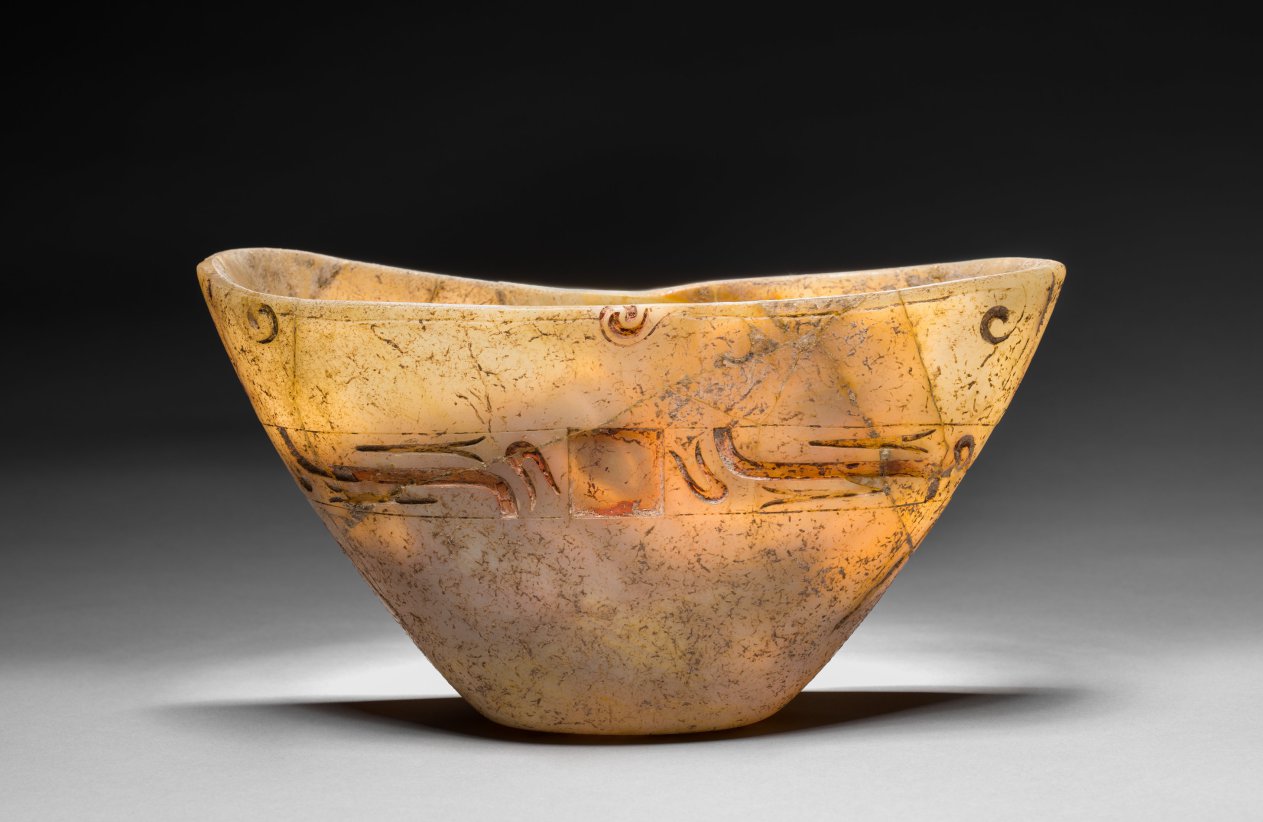
Geometric Integrity: The Carved Bowl as Architectural Volume
The Carved Bowl, examined through the lens of Buddhist sculptural tradition, presents a paradox of containment and release. Unlike the vertical aspiration of the *Bodhisattva*—whose elongated torso and flowing drapery suggest ascension toward enlightenment—the bowl form is inherently gravitational. Its geometry is defined by a concave interior that holds space, and a convex exterior that displaces it. In the 2026 executive silhouette, this translates into a radical departure from the sharp-shouldered, hyper-structured tailoring that has dominated corporate dress for two decades. The bowl’s integrity lies not in its perimeter but in its depth. We are no longer designing for the body as a linear column; we are designing for the body as a vessel. The *Amulet in the Form of a Seated Figure with Bovine Head* introduces a secondary geometric language: compression. Where the Bodhisattva expands, the amulet contracts. Its seated posture—knees drawn inward, torso folded—creates a dense, almost cubic mass. This is not the geometry of display but of protection. For the executive silhouette, this translates into strategic compression points: a cinched waist beneath an oversized shell, a high neckline that encloses the throat, or a hem that terminates abruptly at the knee, severing the line of the leg. The 2026 silhouette is therefore not a single shape but a dialogue between two opposing forces—the expansive bowl and the contracted amulet—resolved through the language of outerwear.Structural Poetics: From Sacred Icon to Urban Armor
The *Bodhisattva*’s aesthetic is one of open, didactic beauty. Its robes fall in rhythmic, parallel folds, each pleat a meditation on order. The materiality is polished, luminous, intended to catch light and guide the eye upward. In urban materiality, this translates to high-density wool crepe, double-faced cashmere, and technical silk—fabrics that hold a crease with architectural precision yet drape with a liquid fall. The Carved Bowl silhouette borrows this principle through the use of *negative space*. A coat cut with a deep, circular armhole and a swept-back shoulder creates a void between the sleeve and the torso—a carved hollow that mimics the bowl’s interior. This is not mere tailoring; it is sculptural subtraction. The garment does not cling to the body; it orbits it, creating an aura of controlled volume. Conversely, the bovine-headed amulet demands a material response rooted in density and opacity. Its protective function suggests leather, bonded neoprene, or waxed cotton—materials that resist penetration, both literal and metaphorical. In the 2026 executive wardrobe, this appears as a cropped, rigid vest worn over the bowl-shaped coat, or a belt of polished onyx-hued hardware that cinches the silhouette at the solar plexus. The amulet’s seated posture also informs the construction of trousers: a high-rise, wide-leg pant with a deep pleat at the hip, creating a folded, compressed mass that releases into a clean, wide fall. The result is a lower body that feels grounded, almost monumental, while the upper body remains fluid and expansive.Urban Materiality: Onyx, Slate, and the Logic of the Metropolis
The color palette for this research is anchored in Onyx—a black that is not flat but layered, absorbing light like the lacquered surface of a Buddhist altar. Onyx communicates authority without aggression, depth without opacity. It is the color of the night commute, of glass towers reflecting a dark sky, of the executive who moves through the city as a silent observer. The secondary palette of Slate introduces a cool, mineral grey—reminiscent of the stone from which the amulet might have been carved. Slate is the color of wet pavement, of concrete after rain, of the urban environment’s immutable substrate. Together, Onyx and Slate form a chromatic system that is both monastic and metropolitan, sacred and secular. The materiality of the Carved Bowl silhouette must therefore be *performative*. It must respond to movement, to climate, to the shifting demands of a 14-hour workday. Consider a coat in bonded Onyx wool: its exterior is smooth, almost shell-like, while its interior is brushed, soft, tactile—a private luxury against the skin. The sleeves are cut with a subtle bell shape, echoing the bowl’s curve, but are lined with a high-friction knit to prevent shifting. The collar is sculptural, rising to the nape of the neck like the rim of a vessel, then folding forward into a soft lapel that frames the face. This is not a garment for static display; it is a garment for movement through turnstiles, into boardrooms, across marble lobbies.The Executive Silhouette: A Synthesis of Sacred and Protective
The 2026 executive silhouette, as derived from the Carved Bowl and the bovine-headed amulet, is defined by three principles: *containment, release, and protection*. Containment appears in the high, enclosed necklines and the cinched waist—references to the amulet’s seated, folded posture. Release appears in the exaggerated shoulder, the deep armhole, and the sweeping hem—references to the Bodhisattva’s expansive, compassionate presence. Protection is the overarching ethos: the garment as a portable sanctuary, a wearable amulet that shields the wearer from the psychological and physical demands of urban power. In practical terms, this silhouette translates to a three-piece system. First, a base layer of fluid, ivory-toned silk—the only concession to lightness—cut with a mandarin collar and raglan sleeves, allowing unrestricted movement. Second, a mid-layer of Slate-grey bonded jersey, constructed with a sculpted, one-seam sleeve that creates a continuous line from shoulder to wrist, mimicking the bowl’s unbroken curve. Third, an outer shell in Onyx: a coat with a dramatic, circular back yoke, a hidden placket, and a hem that falls to mid-calf, terminating in a subtle flare. The coat’s interior features a single, concealed pocket at the chest—a nod to the amulet’s function as a holder of personal talismans. The trousers are equally deliberate: a high-rise, double-pleated design in Onyx wool with a slight taper from knee to ankle, creating a compressed, amulet-like mass at the hip that releases into a clean, architectural line. Footwear is minimal—a low, square-toed boot in matte black leather, its sole slightly elevated to ground the silhouette.Conclusion: The Bowl as a State of Mind
The Carved Bowl is not merely a shape; it is a philosophy of space. It teaches that power is not always about expansion—sometimes it is about the capacity to hold, to protect, to contain. The 2026 executive silhouette, informed by the dual geometries of the Bodhisattva and the bovine-headed amulet, offers a new paradigm for urban authority: one that is simultaneously open and guarded, monumental and intimate. In Onyx and Slate, in bonded wool and brushed silk, this silhouette does not shout; it resonates. It is the quiet confidence of a vessel that knows its own depth, and the silent vigilance of an amulet that guards its wearer against the chaos of the city. This is the definitive urban silhouette for the executive who understands that true presence is not about being seen—it is about being *felt*.
Technical Insight
Technical Insight: Translating Onyx palettes into Oversized silhouettes for the modern metropolis.