Minimalist
Slate
Urban Form: Saint George and the Dragon
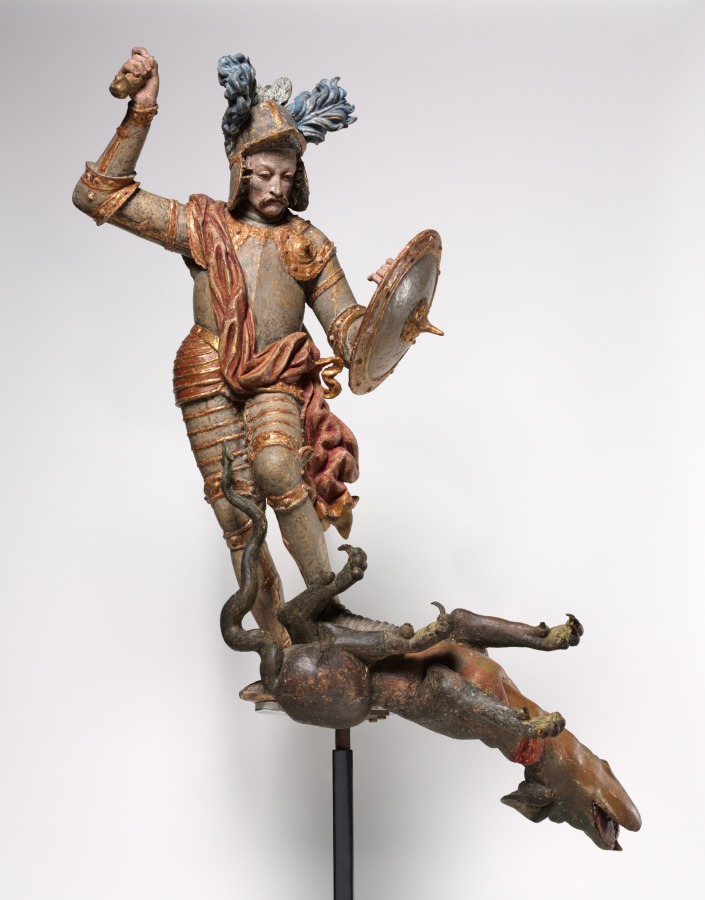
I. The Dialectical Framework: Mortal Rhythm and Cosmic Stasis
The subject matter—Saint George and the Dragon—has historically been rendered as a narrative of conquest: lance piercing scale, hoof crushing sinew, the saint’s chivalric triumph over chthonic chaos. Yet the internal DNA provided by Addison Fashion’s research unit reframes this iconography through a more archaic lens. The twin artifacts—the *Mold Fragment with Musicians* and the *Mortuary Figure of the Zodiac Sign: Ox (Taurus)*—offer a dialectical structure that dissolves the binary of hero and beast. Instead, we are presented with two opposing temporalities: the **fugitive instant** of music and the **eternal recurrence** of celestial order. For the 2026 executive silhouette, this dialectic translates into a garment that does not narrate victory but embodies **tension without resolution**. The dragon is not slain; it is absorbed into the architecture of the cloth. The saint is not triumphant; he is a vertical axis around which the dragon’s serpentine mass coils, restrained but never annihilated. This is not a heroic suit. It is a **structural poem** about the coexistence of urgency and permanence—the very condition of urban executive life.II. Geometric Integrity: The Mold Fragment’s Rhythmic Compression
The *Mold Fragment with Musicians* is a study in **compressed dynamism**. The artisans did not seek anatomical verisimilitude; they arranged bodies and instruments to suggest the flow of sound waves across a bounded plane. The result is a geometry of **interrupted vectors**—limbs angled not for naturalism but for acoustic implication. The clay retains the thumbprint’s pressure, the wet drag of the tool, the tactile evidence of a hand moving in time. In the 2026 executive silhouette, this translates into **asymmetric paneling** and **offset seams** that create a visual rhythm without breaking the garment’s overall restraint. A tailored jacket, for instance, might feature a single diagonal dart that begins at the right shoulder and terminates at the left hip—an echo of a flutist’s tilted stance. The shoulder pad is not sculpted to mimic a deltoid but to suggest a **percussive beat**: slightly forward, slightly sharp, as if the wearer is perpetually mid-gesture. The fabric itself must carry the memory of the mold’s wet clay. We specify a **slate-toned wool-cashmere blend** with a matte, slightly irregular surface—a cloth that does not gleam but absorbs light, revealing subtle variations in weave density. This is not a fabric that announces itself; it is a fabric that **records pressure**. When the wearer moves, the cloth creases along predetermined fault lines, creating a map of their daily gestures. The urban materiality here is not about armor but about **acoustic residue**—the suit as a palimpsest of the wearer’s kinetic life.III. The Mortuary Ox: Geometry of the Eternal
Contrast this with the *Mortuary Figure of the Zodiac Sign: Ox*. Here, all dynamism is excised. The ox’s body is a **solid, unbroken mass**—a low, horizontal volume that anchors the tomb’s spatial order. The horns curve inward, not as weapons but as parentheses enclosing a void. The legs are truncated, almost vestigial, suggesting that the creature does not walk but **supports**. Its geometry is that of the architrave, the lintel, the foundation stone. For the executive silhouette, this translates into the **coat**—the outer layer that confers gravity and permanence. The 2026 Addison coat is cut with a **deliberately low armhole** and a **straight, untapered body** that falls from the shoulder to the knee without interruption. There is no waist suppression, no lapel notch that draws the eye upward. Instead, the coat’s collar stands high and rigid, like the ox’s neck, and the front closure is hidden beneath a placket—a seamless plane that refuses to reveal its mechanism. The color is **slate**, but not the slate of storm clouds. This is the slate of **petrified sediment**—a blue-gray that carries the memory of volcanic ash and deep-sea clay. The fabric is a **double-faced wool** with a felted finish, dense enough to stand without internal structure. When the wearer stands still, the coat reads as a monolith. When they walk, the fabric folds into **broad, slow pleats** that mimic the ox’s latent mass—not moving, but shifting the ground beneath it.IV. Structural Poetics: The Saint as Vertical Axis
Where does Saint George reside in this dialectic? He is not a figure but a **principle of orientation**. In the original iconography, the saint’s lance is a vertical line that bisects the dragon’s horizontal coil. In our research, this verticality is expressed through the **trouser**—a high-rise, straight-leg cut that extends from the waist to the shoe without taper. The crease is pressed with surgical precision, creating a single, unbroken line that anchors the entire ensemble. The saint’s armor is translated into **internal structuring**: a canvas interlining that runs from the shoulder to the hem of the jacket, providing a rigid but invisible skeleton. The dragon’s scales become **micro-textural details**—a jacquard weave in the lining, a subtle herringbone in the shirt, a leather trim on the cuff that catches light only at certain angles. These are not decorative; they are **structural whispers**, reminders that the beast is not absent but contained.V. Urban Materiality: The Narrow Path Between Heat and Gravity
The final synthesis is a garment that operates on two temporal registers simultaneously. The jacket’s asymmetric seams and forward-pitched shoulders speak to the **fugitive instant**—the meeting that starts in five minutes, the negotiation that could pivot on a single gesture. The coat’s monolithic mass and the trouser’s unbroken verticality speak to the **eternal recurrence**—the career trajectory, the institutional memory, the brand’s legacy. The urban materiality of this silhouette is not about protection from weather or visibility in crowds. It is about **existential calibration**. The wearer is not a hero slaying a dragon; they are a figure navigating the narrow path between the musician’s heat and the ox’s gravity. The suit does not resolve this tension. It holds it, in slate-toned wool, in seams that never quite meet, in a coat that falls like a tombstone but moves like a bellows. This is the 2026 executive silhouette: **a container for contradiction**, engineered with the precision of a mortuary zodiac and the breath of a clay mold. It does not ask to be admired. It asks to be inhabited.
Technical Insight
Technical Insight: Translating Slate palettes into Minimalist silhouettes for the modern metropolis.