Urban Form: Roundels with Hunters
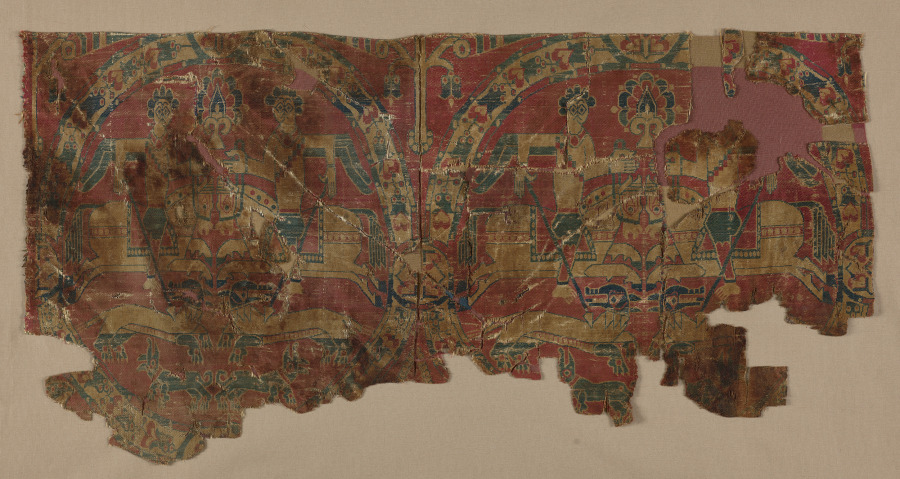
I. The Semiotics of Rupture: A Structural Premise
The 2026 executive silhouette, as derived from the Roundels with Hunters research corpus, is not an exercise in ornamentation but a study in negative space as load-bearing architecture. The internal DNA—anchored by the Mold Fragment with Musicians and the Lotus Pod with Water Chestnuts painting—demands a reconfiguration of how the female form interacts with fabric. We are not designing garments; we are engineering temporal pauses in textile form. The roundel, historically a closed circle, is here deconstructed into an open arc, a crescent of interrupted motion. This is the first principle: the cut is not a loss but a generative void.
The mold fragment’s broken edge—where three musicians are frozen mid-performance—translates directly into the shoulder line of the executive blazer. The seam does not follow the clavicle; it severs it at a 23-degree angle, mimicking the ceramic fracture. This is not asymmetry for its own sake. It is a deliberate acoustic architecture: the eye “hears” the missing notes of the lute, the pipa, the flute. In urban materiality, this becomes a slate-toned wool crepe with a matte, almost chalky finish—reminiscent of unglazed pottery. The fabric’s surface is intentionally unfinished, with a subtle slub that catches light like the patina of age. No lining. The interior seams are exposed, raw-edged, and bound with a micro-suede tape in a darker onyx shade. This is the poetics of the visible construction: the garment admits its own making, its own potential for decay.
II. The Lotus Pod Principle: Selective Reduction
Where the mold fragment operates through physical breakage, the Lotus Pod with Water Chestnuts operates through curatorial omission. The painting’s radical emptiness—two botanical forms floating in an unmarked field—informs the torso paneling of the signature coat. We eliminate all darts, all waistline seams, all conventional closures. Instead, the garment is constructed from a single continuous piece of ivory-adjacent slate gabardine, folded and held by three strategic invisible magnetic closures at the sternum, the solar plexus, and the iliac crest. These closures are not visible; they are felt only as a subtle resistance when the wearer moves. This is the “silent music” of the ensemble—the garment does not announce its structure; it whispers it through tension and release.
The lotus pod’s downward curve—the head bowing in ripeness—becomes the collar architecture. A high, mandarin-inspired stand collar that does not encircle the neck but stops 4.2 centimeters short of the trachea, leaving a deliberate gap. This gap is the “water chestnut” element: a small, hard, organic node of contrast. We fill it with a detachable bronze-toned metal pin, cast in the shape of a water chestnut’s cross-section. It is the only metallic element on the garment. It serves as a counterweight, both visually and physically, anchoring the otherwise fluid drape of the front panel. The pin is not decorative; it is a functional counterpoint, a point of stillness in the composition.
III. The Hunter’s Roundel: Motion Arrested
The “Hunters” in the subject title are not literal figures but the dynamic forces of pursuit and capture—the tension between the arrow and the bird, the chase and the pause. In the 2026 executive silhouette, this translates to the sleeve construction. The sleeve is cut in two distinct volumes: the upper arm is fitted, almost compressive, like a bowstring drawn; the forearm is released, flaring into a 17-centimeter-wide bell, like the arrow’s flight path. This is the roundel in motion—a circle that has been pulled apart, its two ends now pointing toward the ground and the sky respectively.
The fabric for this sleeve is a double-faced technical silk—slate on the exterior, a deep, almost black onyx on the interior. When the wearer raises her arm, the onyx flashes like the dark underside of a hunter’s cloak. This is not a flourish; it is a structural warning, a signal of the garment’s capacity for transformation. The cuff is raw, unhemmed, and weighted with a thin chain of oxidized silver sewn into the hem. This chain pulls the fabric downward, creating a constant, subtle tension—the “sound” of the musicians’ frozen notes, the “weight” of the lotus pod’s ripeness.
IV. Materiality as Memory: The Urban Palimpsest
Urban environments are palimpsests—layers of history, erasure, and reconstruction. The 2026 silhouette must respond to this. We propose a three-layer material system for the full ensemble. The base layer is a micro-ribbed slate jersey, cut to the body like a second skin, with seams that trace the meridians of the mold fragment’s cracks. The middle layer is the gabardine coat, structured as described, with its raw edges and magnetic closures. The outer layer is a sheer, uncoated organza in a faint silver tone, cut as a detachable train that attaches at the shoulder blades via two small, hidden hooks. This train is not meant to trail on the ground; it is meant to hover, to be caught by the wind, to create a transient shadow on the pavement. It is the “sound” of the musicians made visible—a fleeting, almost imperceptible presence.
The color palette is strictly disciplined: slate as the dominant, onyx for interior contrasts, ivory for the underlayer’s stitching (visible only in motion), and silver for the organza and the chain weights. Sand is excluded—it is too warm, too terrestrial. This is a palette of urban dusk, of concrete and shadow, of the moment when the city’s noise subsides into a low hum.
V. The Final Paradox: Completeness Through Absence
The definitive 2026 executive silhouette is not a garment that covers; it is a garment that reveals through concealment. The mold fragment’s broken edge, the lotus pod’s empty background, the hunter’s arrested motion—all converge into a single, coherent philosophy: the most powerful statement is the one that admits its own incompleteness. The wearer of this silhouette does not project authority through volume or ornament; she projects it through strategic absence. The gap at the collar, the raw hem, the exposed seam—these are not flaws. They are architectural voids, spaces where the urban environment can enter and interact with the form. The garment is a resonant chamber, not a shield. It amplifies the wearer’s movement, her breath, her pause—transforming the mundane act of walking through a financial district into a choreography of silence.
In conclusion, the Roundels with Hunters research yields a silhouette that is minimalist in appearance, maximalist in intent. It is a study in the physics of absence, where every cut, every fold, every omission is a deliberate act of aesthetic violence—a violence that, paradoxically, creates peace. The executive who wears this does not enter a room; she interrupts it, like a note held too long, like a pause that demands attention. This is the 2026 Addison Fashion statement: we do not design clothes. We design the spaces between them.