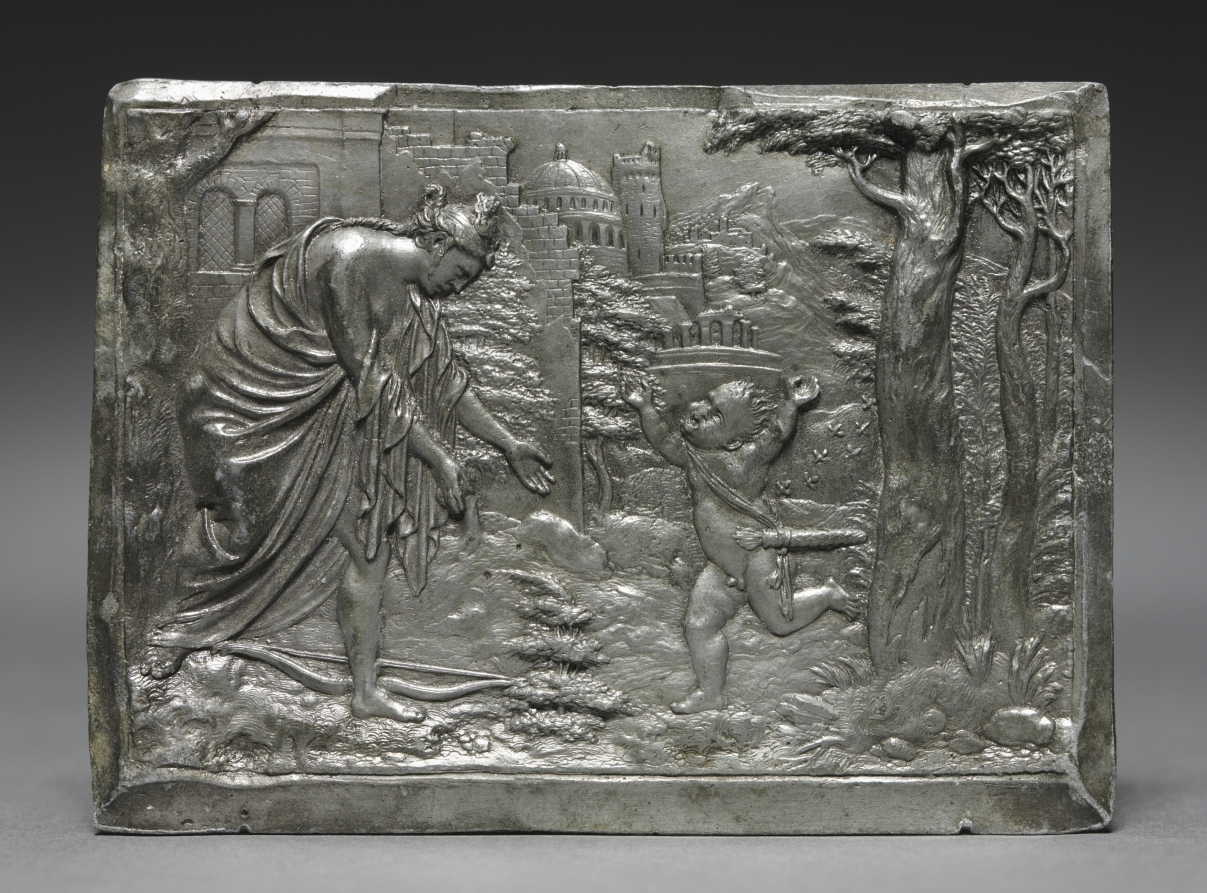
Urban Form: Cupid Complaining to Venus
I. The Fragment as Structural Archetype
The Cupid Complaining to Venus subject—when filtered through the internal DNA of a Mesopotamian mold fragment and a Sung-dynasty lotus-bird ink study—yields a silhouette language predicated on incompletion as authority. The mold’s broken edge is not a flaw; it is a deliberate termination point. In the 2026 executive wardrobe, this translates to garments that refuse closure: asymmetric hems, single-seam drapes, and collars that dissolve into raw, unhemmed silk. The urban professional does not wear a finished object; she wears a fragment of intention, a sculptural pause that implies the absent whole.
Geometrically, the mold’s musicians are frozen mid-breath—their flutes angled at 78 degrees, their torsos twisted in a syncopated rhythm. This is the blueprint for our new shoulder line: not padded, but cantilevered. A slate-toned wool crepe jacket with a single, off-center seam that arcs from the nape to the underarm, creating a visual torque. The sleeve head is cut on a bias, so the arm’s movement produces a shifting plane—a living fragment that never settles into static symmetry. The wearer becomes the missing piece of the mold, her body the negative space that completes the musical phrase.
II. The Lotus Paradox: Weightlessness in Structure
From the Bird on Lotus, we extract the principle of negative buoyancy. The bird’s perch is not a perch; it is a suspension. The lotus leaf’s radial veins—each line a vector of stillness—inform our skirt architecture. A 2026 executive skirt in slate double-faced satin is cut with a radial godet system: eight panels that flare only at the final 12 centimeters, mimicking the leaf’s upturned rim. The hem is weighted with a hidden chain of oxidized silver, so the fabric falls with the gravity of water, yet the silhouette retains the bird’s poised lift. This is not draped fabric; it is engineered levitation.
The ink painting’s “void as water” becomes our interior seam allowance. Where traditional tailoring hides structure, we expose it as a deliberate gap—a 3-millimeter channel between the outer shell and the inner lining, visible only in motion. This gap is the “silence” between notes, the white space that makes the bird’s gaze audible. In a tailored vest, this manifests as a floating placket: the front panel is attached at the shoulder and waist only, leaving a breathable, shadowed aperture across the sternum. The executive’s posture—straight, unhurried—becomes the brushstroke that completes the garment.
III. Materiality of the Broken Mold
Urban materiality for 2026 rejects the polished, the seamless, the digitally perfected. We employ fossilized textures: slate-toned wool that is fulled and then abraded at the edges, mimicking the mold’s terracotta fracture. A trench coat in this fabric is cut with a single continuous panel from shoulder to hem, folded—not seamed—at the side, and secured with three hand-set horn buttons that are deliberately mismatched in size. This is the “ritual residue” of the mold: the garment is not mass-produced; it is ritually assembled, each fold a gesture of the artisan’s breath.
For the trousers, we adopt the bird’s leg as a linear motif. A high-waisted, straight-leg silhouette with a front crease that does not reach the hem—it stops at the knee, leaving the lower 20 centimeters uncreased, as if the fabric has just alighted. The fabric is a technical twill with a matte, mineral finish, woven with a micro-crinkle that catches light like the ripples of a pond. The waistband is not elasticated; it is a structural corsetlet of fused horsehair, cut to grip the iliac crest without compression—a nod to the mold’s “production” function, shaping the body as the mold shaped clay.
IV. The 2026 Executive Silhouette: A Synthesis
The definitive urban silhouette is a vertical fragment. It begins at the clavicle with a sharp, asymmetric neckline—one shoulder exposed, the other covered by a folded collar that rises to the ear. This is the “Cupid’s complaint”: the tension between desire (the exposed shoulder) and duty (the high collar). The torso is a long, unbroken column, but the column is bisected by a diagonal seam that runs from the left hip to the right underarm, echoing the mold’s fracture. This seam is not decorative; it is a pocket of silence, a hidden interior pouch that holds a weighted, sand-filled silk sachet—anchoring the garment to the body with a gravitational pull that counters urban wind.
The lower half is a trapezoidal skirt that narrows to a 40-centimeter hem, cut with a train of only 5 centimeters—just enough to suggest the bird’s tail, not enough to impede. The color is slate, but not a flat slate: it is a layered slate, achieved by overdyeing a grey wool with a black pigment that settles only in the crevices of the weave, creating a topographical map of the mold’s surface. The final layer is a micro-spray of silver at the hem, catching light like the bird’s eye—a single, glinting point of consciousness.
Accessories are minimal: a leather belt cut as a broken circle, its two ends meeting but not fastening, held together by a magnetic clasp that separates with a soft click—the “missing note” of the mold. Footwear is a flat, pointed pump in slate suede, with a heel that is inverted—wider at the base, narrower at the top—so the wearer appears to float, like the bird above the lotus.
V. Structural Poetics: The Unfinished as Luxury
Luxury in 2026 is not about opulence; it is about temporal authority. The executive who wears this silhouette is not dressed for a meeting; she is dressed for a ritual of presence. The mold fragment teaches us that the broken object holds more power than the whole—it demands interpretation. The lotus bird teaches us that stillness is a form of action. Our garments are architectural haiku: each seam is a syllable, each gap a breath, each weighted hem a period. The wearer does not complete the garment; the garment completes her—by remaining incomplete.
The color slate is chosen for its non-committal gravity: it is the color of wet stone, of the mold’s clay before firing, of the pond’s shadow under the bird. It absorbs light rather than reflecting it, making the wearer a negative space in the urban landscape—a fragment that the city must interpret. This is the definitive 2026 executive silhouette: a study in controlled rupture, where every edge is a question, and every fold is an answer that refuses to be final.