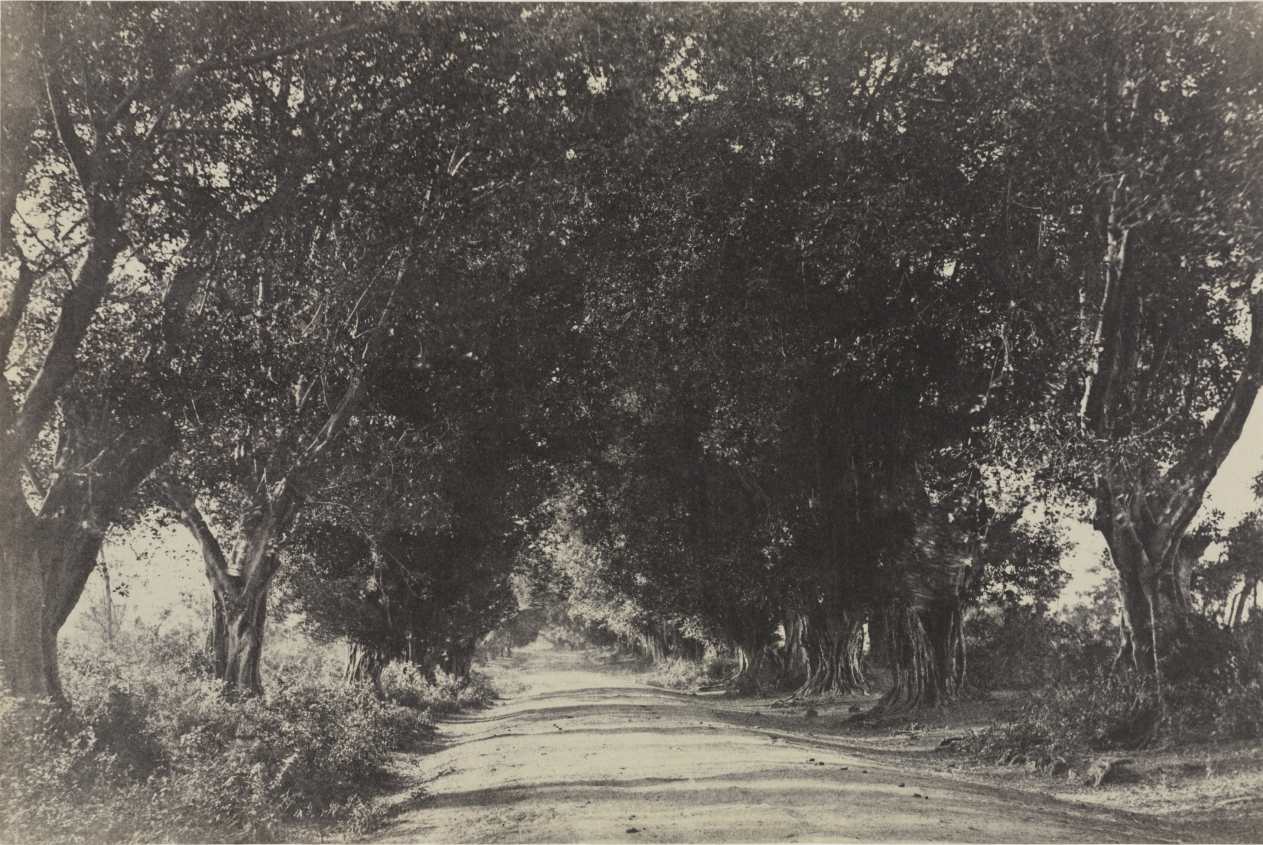
Urban Form: Avenue of the Banian Trees, Seringham, India
Urban Silhouette Research: The Banian Tree Avenue as a Study in Terminal Form
Addison Fashion’s 2026 executive wardrobe does not traffic in ornament. It traffics in structural inevitability. The Avenue of the Banian Trees in Seringham—a colonnade of aerial roots descending into a single, unified canopy—presents a living thesis on how multiplicity collapses into monolithic presence. For the NYC executive, whose daily environment is a cacophony of competing signals, the banian’s lesson is brutal and clarifying: the most powerful form is the one that has eliminated all alternatives. This research deconstructs that arboreal architecture into a wearable grammar of slate-toned minimalism, where every seam is a root, every drape a branch, and every silence a statement of terminal resolve.
I. Form as Paradox: The Container and the Contained
The banian tree does not grow upward; it grows downward from its own branches, each aerial root eventually thickening into a new trunk. The result is a single organism that appears as many—a paradox of unity and multiplicity that mirrors the dialectic between Jacques-Louis David’s The Death of Socrates and the anonymous Greek Cup and Stand. In the painting, the philosopher’s body is a vessel of rational calm, his raised hand a gesture of intellectual finality. The cup he reaches for is the narrative fulcrum—an object of poison, yet also of transcendence. In the artifact, the cup is stripped of all story: a pure, hollow sphere on a minimal stand, its emptiness its entire meaning.
For the 2026 executive silhouette, this paradox translates into outer volume that contains inner restraint. A slate-toned, double-faced wool coat with a concealed placket and zero visible hardware functions as the banian’s canopy—broad, sheltering, authoritative. Beneath it, a high-neck, sleeveless shell in matte silk crepe acts as the cup: unadorned, fitted to the torso’s exact geometry, and utterly silent. The coat does not “tell” the story of the shell; it holds it. The wearer becomes both Socrates and the cup—simultaneously the one who gestures toward meaning and the vessel that simply awaits it. The form’s tension is not resolved; it is held in perfect suspension, exactly as the banian’s roots hold the weight of a hundred trunks without a single visible joint.
II. Color as Material Logic: Slate as the New Neutral of Power
Slate is not a color; it is a condition of light. It sits between charcoal and blue-gray, absorbing more than it reflects, yet retaining a cool luminosity that reads as intelligence rather than mood. In the context of the banian avenue, slate is the color of the shaded understory—the space beneath the canopy where light filters through layers of leaves and roots, creating a dim, contemplative atmosphere. This is not the stark white of David’s neoclassical studio, nor the warm patina of the Greek artifact. It is the color of a mind at work in a world that demands performance.
In the 2026 executive palette, slate replaces black as the default for authority. Black is declarative; slate is deliberative. A slate-toned, single-breasted jacket in a high-twist worsted wool reads as more cerebral than its black counterpart, while a slate silk blouse beneath a slate vest creates a monochromatic depth that flatters the face without shouting. The color’s mutability—its ability to shift from blue to gray depending on the light source—mirrors the executive’s need to adapt across contexts: a 9 a.m. boardroom, a 1 p.m. investor lunch, a 6 p.m. gallery opening. Slate does not change its form; it changes its meaning with the environment, much like the banian’s roots, which are indistinguishable from trunks until you trace them to their origin.
III. The Geometry of Silence: Cutting Away the Narrative
David’s painting is a masterpiece of narrative density—every figure, every drape, every shadow contributes to the story of Socrates’ martyrdom. The Greek cup, by contrast, achieves its power through radical subtraction. It has no story; it is the residue of a story. The banian tree, in its mature state, similarly erases its own biography: you cannot tell which root came first, which branch is oldest. It presents only its present totality.
For the NYC executive, this means a wardrobe that refuses anecdote. No lapel pins, no contrast stitching, no exposed zippers. The silhouette is built on seam placement as a form of drawing: a princess seam that curves from the shoulder to the hem, echoing the banian’s aerial root descending to the earth; a side panel in a slightly darker slate that creates a shadow without a printed pattern; a hem that falls precisely at the mid-calf, neither elongating nor truncating, but simply ending with the finality of a root meeting soil. The garments are not “designed” in the conventional sense; they are engineered to disappear into the wearer’s presence, leaving only the impression of a person who has no need to explain herself.
IV. The Executive as Vessel: From Narrative to Residue
The most profound insight from the David/cup dialectic is that the highest form of power is the capacity to be empty. Socrates is powerful not because he argues, but because he accepts the cup. The cup is powerful not because it contains poison, but because it can contain anything. The banian is powerful not because it grows, but because it holds—soil, air, light, time.
In the 2026 Addison executive wardrobe, this translates to garments that function as portable emptiness. A slate, unstructured blazer in a fluid wool-cashmere blend has no shoulder padding, no internal canvas—it drapes from the collarbone like a root suspended from a branch. Its pockets are hidden, its buttons are covered, its lining is the same slate as its exterior, so that when the wearer removes it, there is no “inside” or “outside”—only a continuous surface. The accompanying trouser is cut with a single pleat at the front, not for fullness, but to create a vertical line that mimics the banian’s trunk—straight, unbroken, indifferent to the chaos around it. The executive who wears this does not “express” herself through her clothes; she withholds, and in that withholding, she becomes the most commanding presence in the room.
V. Conclusion: The Aesthetics of Terminal Calm
The Avenue of the Banian Trees, David’s Socrates, and the anonymous Greek cup all converge on a single principle: the deepest spirituality resides in the most unadorned material form. For the 2026 NYC executive, this is not a philosophical luxury but a survival strategy. The urban environment is a barrage of narratives—news cycles, social feeds, competitive posturing. The executive who dresses in slate-toned, minimally constructed garments that refuse narrative is the one who controls the room, not by speaking louder, but by being the vessel into which all other voices must pour.
Addison Fashion’s Urban Silhouette Research concludes that the banian’s lesson is not about growth, but about consolidation. The executive wardrobe of 2026 is not a collection of pieces; it is a single, continuous form—a root system that has become a trunk, a cup that has become a monument. Slate is its color because slate is the color of patience. Minimalism is its method because minimalism is the discipline of leaving only what is essential. And the wearer is its meaning, because in the end, the garment is not the statement. The wearer is.