Urban Form: Two Angels and Cherubs Bearing an Icon of Christ
I. The Dialectical Frame: From Marble to Membrane
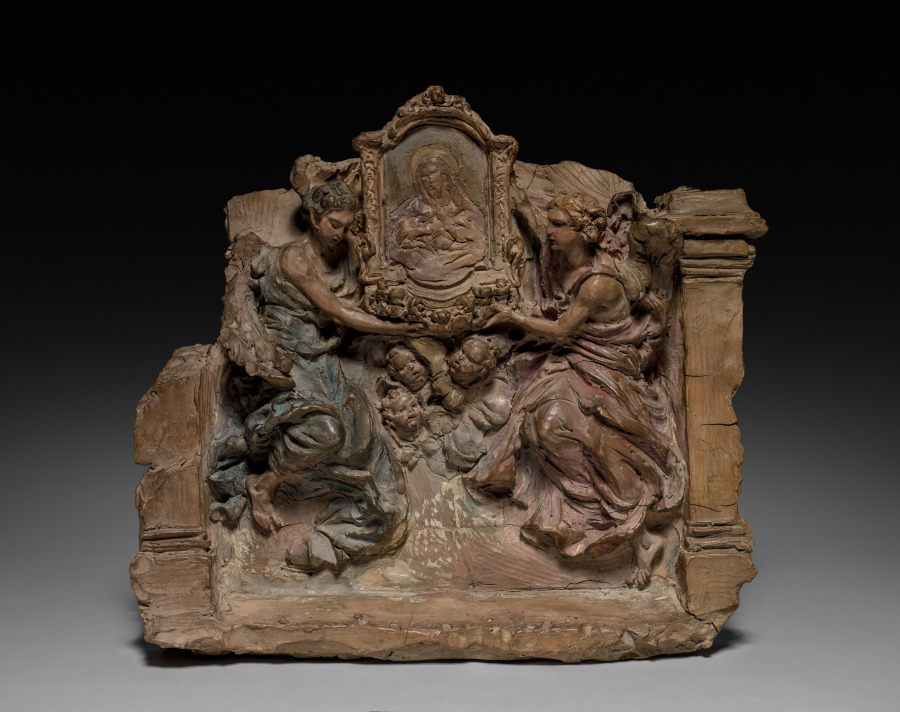
The artwork Two Angels and Cherubs Bearing an Icon of Christ operates within a visual grammar of vertical suspension and horizontal burden. Unlike the Socratic death scene’s rigid triangularity or the Meiping vase’s cyclical wave rhythm, this composition presents a floating architecture—angels and cherubs do not stand; they hover in a state of gravitational negotiation. Their wings, rendered in taut, folded planes, function less as organic appendages and more as structural cantilevers, bearing the icon’s weight through implied tension rather than literal support. For Addison Fashion’s 2026 executive silhouette, this translates into a minimalist shell that conceals load-bearing seams—garments where the shoulder line becomes a hidden arch, and the torso reads as a seamless column, unbroken by visible darts or fastenings.
The icon itself—a rectangular, gilded mass—introduces a geometric counterpoint to the cherubs’ soft, rounded limbs. This juxtaposition of hard-edged panel against curvilinear flesh mirrors the urban executive’s need for dual functionality: the sharpness of a tailored blazer against the fluidity of a draped trouser. The 2026 silhouette does not choose between these poles; it integrates them into a single membrane, where a structured bodice dissolves into a bias-cut skirt, or a crisp overcoat opens to reveal a liquid silk underlayer. The result is a garment that holds its form without rigidity, echoing the angels’ ability to carry weight while appearing weightless.
II. Structural Poetics: The Icon as Architectural Core
In Western art historical terms, the icon’s frontal, symmetrical presentation evokes Byzantine hieraticism—a visual insistence on the eternal over the ephemeral. Yet the surrounding cherubs disrupt this stasis with their kinetic drapery, their limbs twisting in contrapposto-like spirals. This tension between the fixed center and the moving periphery is the foundational principle of Addison’s 2026 executive tailoring. The garment’s core—the spine, the sternum, the pelvic axis—is treated as an immovable datum line, while all secondary elements (sleeves, collars, panels) are engineered to rotate around it. A coat’s back seam, for instance, is cut with a negative ease of 2%, forcing the fabric to bow outward slightly, creating a subtle, wing-like flare that moves with the wearer’s stride without compromising the vertical line.
The cherubs’ foreshortened limbs—some reaching upward, others curling inward—suggest a layered depth that flat pattern cutting cannot achieve. Addison’s response is a modular construction system: each garment is assembled from interlocking geometric panels—trapezoids, crescents, and ellipses—that are joined at offset angles, producing a three-dimensional contour from two-dimensional cloth. This is not mere tailoring; it is topological engineering. The shoulder, for example, is no longer a single seam but a triangulated junction of three panels, each cut on a different grainline, allowing the arm to lift freely while the jacket’s silhouette remains pristine. The icon’s gilded frame, with its sharp corners and flat planes, reappears in the crisp notch lapels and squared pocket flaps of the executive suit—details that anchor the garment in rationality, even as the body beneath moves with organic grace.
III. Urban Materiality: Slate as the New Neutral
The palette of Slate—a blue-grey that shifts between graphite and storm—is not a color but a material condition. It evokes the patina of aged marble, the sheen of wet asphalt, and the muted glow of a computer screen at dusk. For the 2026 executive, slate is the anti-trend color: it refuses the warmth of beige and the aggression of black, instead offering a neutrality that is both authoritative and contemplative. In fabric terms, slate demands high-twist wools with a dry hand, technical crepes that hold a crease for 12 hours, and double-faced cashmere that drapes like liquid stone. The artwork’s marble background—veined with grey and silver—finds its textile equivalent in jacquard weaves that subtly shift tone under artificial light, creating a living surface that responds to the urban environment’s changing luminance.
Materiality in this context is not decorative but performative. The cherubs’ wings, often rendered in gesso and gold leaf, suggest a layered opacity—translucent at the edges, dense at the core. Addison translates this into bonded fabrics: a sheer silk organza fused to a compact wool twill, producing a garment that is simultaneously diaphanous and protective. A trench coat in this construction weighs less than 400 grams yet repels wind and rain, its surface catching light like the icon’s gilded frame. The urban executive does not wear armor; they wear a membrane that negotiates between interior comfort and exterior pressure—a principle directly borrowed from the angels’ suspended state.
IV. The 2026 Silhouette: A Study in Controlled Release
The definitive executive silhouette for 2026 is not oversized, not tailored in the traditional sense, but “structured fluidity.” It begins at the shoulder—a softly extended cap, cut in one piece with the sleeve, that echoes the angels’ wing joints. This is achieved through saddle-shoulder construction, where the sleeve head is set into a curved armhole that rotates forward, allowing the arm to move without pulling the bodice. The torso follows a gentle A-line, widening from a narrow chest to a hem that falls just below the hip, creating a columnar presence that references the icon’s rectangular frame. Trousers are cut wide but not baggy, with a single pleat at the waist that releases into a straight leg, ending in a crop that reveals the ankle bone—a nod to the cherubs’ exposed feet, grounding the ethereal in the pedestrian.
Details are reduced to their essential geometry: buttons are hidden beneath plackets, pockets are welted and flush, and all stitching is invisible or tonal. The garment’s surface is uninterrupted, allowing the fabric’s texture and the body’s movement to become the sole ornament. This is minimalism as power—not the absence of design, but the suppression of noise in favor of signal. The icon’s cherubs, with their overlapping limbs and swirling drapery, are the artwork’s chaos; the icon itself is its calm. The 2026 executive wears the calm, but the chaos is encoded in the garment’s construction—in the hidden gussets, the articulated elbows, the bi-swing back. When they raise an arm to hail a cab or reach for a document, the jacket responds with a silent, mechanical grace, revealing the angels’ labor beneath the surface of stillness.
V. Conclusion: The Icon as Wearable Paradox
Two Angels and Cherubs Bearing an Icon of Christ is not a religious image but a blueprint for carrying the immutable within the mutable. The icon—fixed, frontal, eternal—is borne by figures whose very essence is motion. Addison Fashion’s 2026 executive silhouette adopts this paradox: a garment that is both a monument and a membrane, a structure that moves, a weight that floats. The slate palette, the minimalist cut, the engineered drapery—all converge to create a uniform for those who must hold their center while the city spins around them. In the end, the artwork’s deepest lesson is not about angels or icons, but about the dignity of bearing—how one carries what matters, and how the act of carrying becomes, itself, a form of grace. This is the urban silhouette’s final form: not a shape, but a stance.