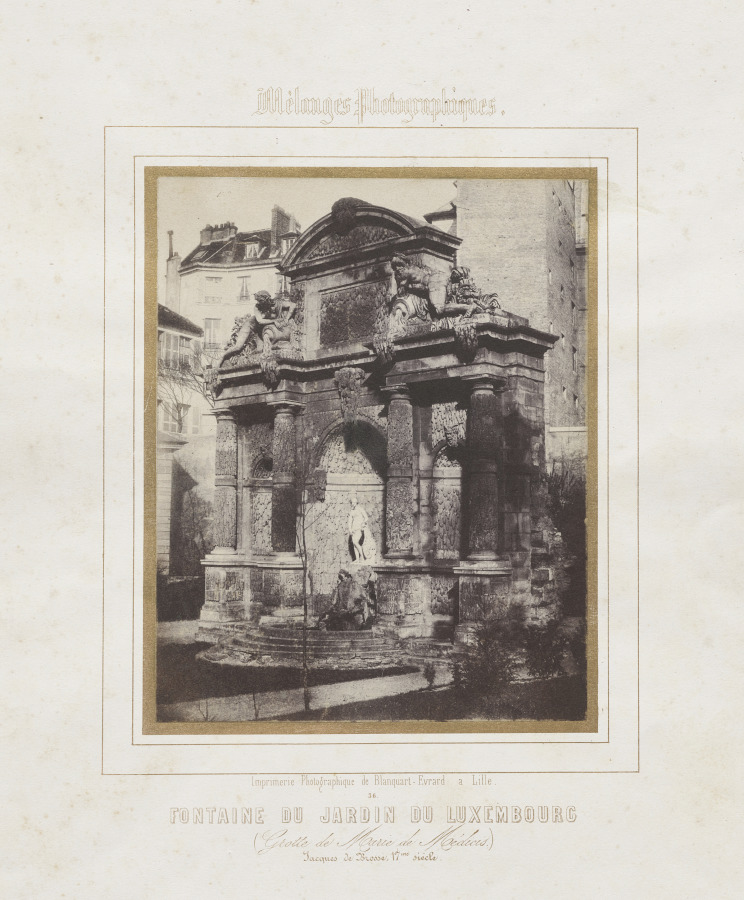
Urban Form: Fontaine du Jardin du Luxembourg (grotte de Marie de Médécis)
I. The Grotto as a Structural Archetype
The Fontaine du Jardin du Luxembourg—specifically the grotte de Marie de Médicis—is not a fountain in the conventional sense. It is a tectonic manifesto disguised as ornament. Hewn from limestone and embedded within the formal geometry of the Luxembourg gardens, the grotto presents a layered façade of rusticated arches, recessed niches, and a cascading water sheet that fractures light into a thousand grey tonalities. For Addison Fashion’s 2026 executive silhouette, this structure offers a precise lexicon: compression, release, and the deliberate concealment of load-bearing logic. The grotto’s exterior is severe, almost brutalist in its repetition of voussoirs; its interior, however, opens into a shadowed cavity where water pools in stillness. This duality—monumental exterior, contemplative void—mirrors the modern executive’s need for armor that does not imprison but rather creates a private sanctuary within the urban crowd.
Geometric Integrity: The Arch and the Plumb Line
The grotto’s defining geometry is the semicircular arch, repeated at varying scales, from the central opening to the smaller lateral recesses. In tailoring, this translates to the shoulder line as a loaded arch—not padded into aggressive breadth, but cut with a subtle, continuous curve that transfers visual weight from the neck to the sleeve head. The 2026 Addison executive blazer will employ a minimalist, unconstructed shoulder that mimics the grotto’s voussoirs: each panel of fabric acts as a discrete stone, meeting at precise, almost invisible seams. The result is a silhouette that reads as monolithic from a distance, yet reveals its segmented construction upon closer inspection—a nod to the grotto’s rusticated blocks, which appear rough-hewn but are in fact meticulously dressed.
The vertical axis is equally critical. The grotto’s pilasters, though shallow, establish a strict plumb line that anchors the composition. In our garments, this becomes the center-front seam and the princess-line panel, which run uninterrupted from the clavicle to the hem. There is no waist suppression in the traditional sense; instead, the fabric falls with a controlled, columnar gravity, echoing the water that sheathes the grotto’s façade. The executive silhouette for 2026 is therefore not hourglass but obelisk—a tapered, elongated form that narrows imperceptibly toward the ankle, creating a sense of upward thrust even when the wearer is seated.
II. Materiality: Stone in the Language of Cloth
The grotto’s materiality is its most radical proposition. Limestone, when wet, shifts from pale ivory to deep slate—a chameleonic quality that the Addison atelier replicates through technical wool blends with a matte, water-repellent finish. These fabrics are not merely dark; they are depth-charged, absorbing light rather than reflecting it, much like the grotto’s shadowed niches. The color palette is anchored in Slate, but not as a flat grey. It is a composite of blue-black undertones, fossilized beige, and the faint green of moss that accumulates in the joints between stones. Our dye process layers these hues in a single yarn, so that the garment shifts tone under different urban lighting—fluorescent, sodium, or dawn—without ever losing its fundamental sobriety.
Structural poetics demand that fabric behave like masonry. To achieve this, Addison employs fused canvas interlinings and high-twist yarns that impart a dry, crisp hand. The cloth does not drape; it stands. Trousers are cut with a single forward pleat that functions as a pilaster, adding volume at the hip but falling into a straight, unbroken line to the shoe. The jacket’s hem is weighted with a hidden chain, ensuring that it settles with the finality of a carved cornice. Pockets are engineered as negative spaces—jetted, flush, and nearly invisible, so that the garment’s surface remains as unbroken as the grotto’s primary façade.
III. The Dialogue of Sacred Artifacts: Bodhisattva and Bovine Amulet
Our internal research DNA—the Bodhisattva and the Amulet in the Form of a Seated Figure with Bovine Head—provides the philosophical counterweight to the grotto’s architectural rigor. The Bodhisattva’s “inward” gaze, with its lowered eyelids and serene mouth, informs the garment’s neckline and collar construction. The Addison 2026 collar is not a lapel that points outward; it is a folded, self-contained band that rises gently toward the jaw, creating a protective enclosure around the throat. This is not a gesture of modesty but of concentration—a sartorial equivalent of the Bodhisattva’s meditative absorption. The sleeves are cut with a slight, almost imperceptible curve at the wrist, mimicking the mudra of the hand resting in the lap, suggesting readiness without aggression.
Conversely, the bovine-headed amulet’s “outward” function—its role as a magical barrier against chaos—manifests in the garment’s closure system. The front fastening is not a simple button or zip; it is a concealed placket with magnetic snaps, engineered to release under sudden tension. This is a talismanic detail: the wearer can shed the jacket in a single, fluid motion, transforming from armored executive to unencumbered individual. The amulet’s seated, pyramidal posture also dictates the trouser’s seat and rise. We cut the waistband to sit at the true hip, with a deep, curved rise that allows for a stable, grounded stance—the wearer’s lower body becomes a plinth, immovable and enduring, while the upper body retains the Bodhisattva’s fluid ease.
IV. Urban Materiality: The Grotto in the Grid
The grotte de Marie de Médicis exists within a controlled landscape—a garden that is itself a form of urban planning. Its water, stone, and shadow are not natural; they are composed. Similarly, the 2026 executive silhouette is designed for the composed chaos of the metropolis: glass towers, concrete plazas, and the relentless rhythm of pedestrian flow. The garment’s minimalist construction—fewer seams, fewer components, no superfluous ornament—is a direct response to the visual noise of the city. Each piece is engineered to be worn for 14 hours, from early-morning negotiation to late-evening reception, without losing its architectural integrity.
The color Slate is chosen not for camouflage but for permanence. It is the color of wet stone, of the Parisian sky after rain, of the patina that accumulates on bronze statues. It does not compete with the wearer’s skin tone or the surrounding environment; it absorbs and reflects both, creating a neutral field upon which the wearer’s actions become the primary text. In this sense, the garment is not a statement but a vessel—a wearable grotto that shelters the individual’s inner life while projecting an unassailable exterior.
V. Conclusion: The 2026 Executive as Living Architecture
The Fontaine du Jardin du Luxembourg teaches us that true monumentality is not about size but about proportion, rhythm, and the tension between mass and void. The Addison Fashion 2026 executive silhouette internalizes these principles: a shoulder that arches like a vault, a torso that falls like a column, a hem that grounds like a foundation. The Bodhisattva and the bovine amulet remind us that this architecture must serve two masters—the inner quest for clarity and the outer demand for protection. Our garments achieve both through minimalist means: precise cutting, rigorous material selection, and a color palette that speaks in whispers rather than shouts. The result is not fashion but habitable form—a second skin that enables the wearer to move through the urban landscape with the quiet authority of a stone that has stood for four centuries.