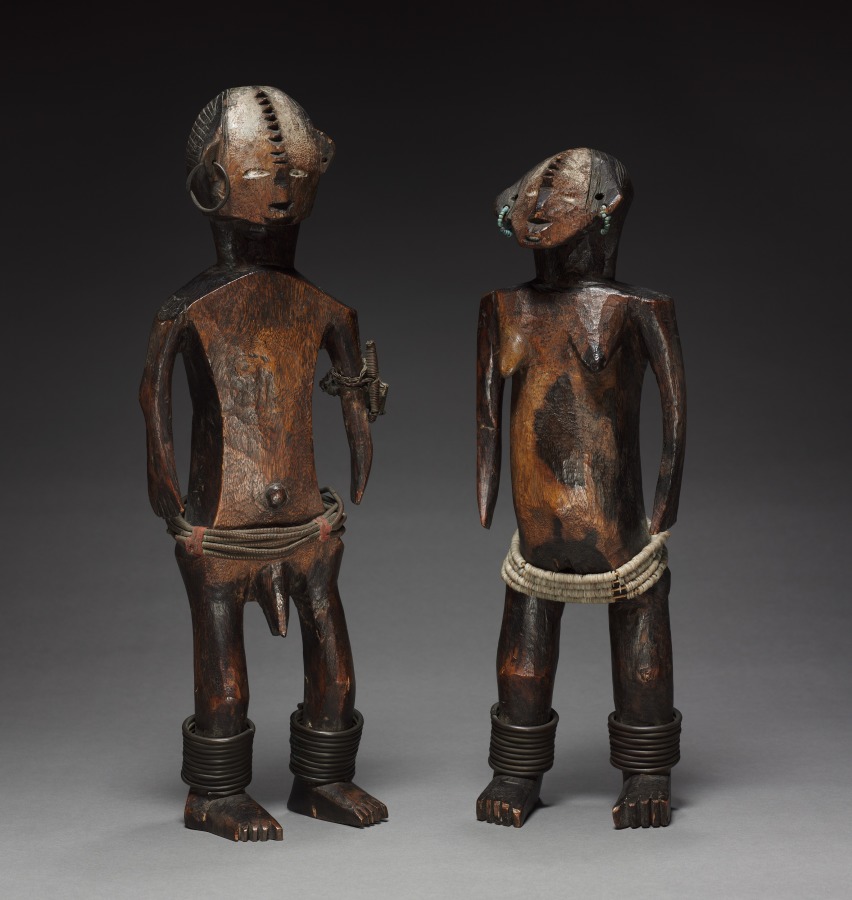
Urban Form: Pair of Figures
I. The Dialectical Frame: From Neoclassical Tragedy to Ceramic Stillness
The pairing of Jacques-Louis David’s The Death of Socrates with an anonymous Wave-Pattern Meiping Vase is not an exercise in art-historical contrast but a structural revelation. Both objects operate within a shared grammar of tension and containment—one through the theatrical geometry of oil paint, the other through the austere physics of porcelain. For the 2026 executive silhouette, this dialectic yields a wardrobe architecture that is neither overtly dramatic nor passively minimal, but rather a compressed monumentality: garments that hold the body as a vessel holds silence, while simultaneously articulating the spine as a line of philosophical resolve.
The David canvas is a study in triangulated pathos. Socrates’ raised index finger and the slumped left hand form an inverted V, a vector of transcendence contradicted by gravitational collapse. The disciples’ postures—masked faces, clasped knees, bowed heads—create a radial composition around the central martyr, each figure a discrete geometric unit within a larger frieze. This is not realism; it is ideational diagrammatics. The light, falling from the upper left, does not illuminate flesh but rather etches a rationalist grid onto the scene, converting agony into argument.
The meiping vase, by contrast, offers a rotational geometry. Its swelling shoulder, narrow neck, and flaring foot trace a continuous curve that mimics the painted wave scrolls—each undulation a repetition that denies climax. The cobalt strokes are not descriptive of water but are kinetic notations, a calligraphic loop that suggests perpetual motion without narrative progression. The glaze’s matte sheen functions as a temporal seal, freezing the wave’s energy into a state of eternal potential. Where David uses chiaroscuro to dramatize a moment, the vase uses contour to negate time altogether.
II. Structural Poetics: The Spine as a Philosophical Line
For the 2026 executive silhouette, the primary architectural reference is the vertical axis—the line that connects Socrates’ raised finger to the vase’s narrow neck. This axis is not merely anatomical; it is a moral posture. The tailored jacket, therefore, must be engineered with a sculpted shoulder seam that extends slightly beyond the natural acromion, creating a visual bracket that echoes the vase’s shoulder curve. The lapel’s gorge is set high, producing a sharp V that mimics the philosopher’s gesture—a silent declaration of intent rather than aggression.
The torso paneling follows the meiping’s logic: no darts, no waist suppression, but a continuous shell that skims the body’s circumference. This is achieved through a fusible interlining of wool and ceramic micro-fiber, a hybrid material that offers the drape of cloth with the memory of fired clay. The result is a garment that holds its shape against the body’s movement, not unlike the vase’s wall holding the void within. The sleeve head is set with a minimal pad—just enough to suggest the Davidic light source, a subtle elevation that reads as intellectual alertness rather than military stiffness.
Trousers are cut with a straight, columnar leg, tapering only at the ankle to echo the meiping’s foot ring. The front crease is pressed with a razor’s edge, referencing the rationalist grid of David’s composition. There is no break at the hem; the trouser falls cleanly onto the shoe, creating a continuous vertical line from shoulder to ground. This is the urban materiality of slate: a color that absorbs light without reflecting emotion, a surface that suggests stone worn smooth by centuries of rain.
III. Urban Materiality: The Fabric as Temporal Insulator
The choice of slate as the primary palette is deliberate. It is not the black of mourning nor the grey of indecision, but the intermediate zone where David’s shadows meet the vase’s glaze. In fabric, this translates to a worsted wool with a high-twist yarn, producing a surface that is dense yet breathable, with a subtle luster that catches light only at certain angles—much like the meiping’s glaze under a raking lamp. The weave is a two-by-two twill, offering a diagonal texture that references the wave scrolls without literal imitation.
For outerwear, a double-faced cashmere is bonded to a thin layer of ceramic-coated nylon. This composite is the urban equivalent of the vase’s body: it resists wind and moisture while maintaining a soft, tactile interior. The coat’s silhouette is oversized in the body but precise in the shoulder, creating a volume that suggests the meiping’s belly—a space that contains, rather than displays. The closure is a hidden placket, eliminating visible hardware and preserving the garment’s uninterrupted surface, much like the vase’s unbroken glaze.
Accessories are reduced to structural accents: a leather belt with a brushed steel buckle shaped like a flattened wave, and a bag constructed from molded vegetable-tanned leather that develops a patina over time—an intentional counterpoint to the vase’s static permanence. The bag’s silhouette is a truncated cylinder, echoing the meiping’s form, with a handle that arcs like the philosopher’s raised arm.
IV. The 2026 Executive: A Body as a Vessel of Thought
The executive who wears this silhouette is not performing authority; they are embodying a paradox. The garments do not shout, nor do they whisper. They occupy space with the quiet confidence of a vessel that knows its purpose is to hold, not to display. The Davidic drama is internalized—the wearer’s posture becomes the composition, their gestures the disciples’ varied responses. The meiping’s stillness is externalized—the fabric’s memory holds the body’s shape, resisting the entropy of a workday’s chaos.
This is the definitive urban silhouette for 2026: a synthesis of rationalist geometry and ceramic calm, executed in slate-toned materials that age with dignity. It rejects the transient trends of fast fashion and the overt theatrics of avant-garde. Instead, it offers a permanent form—a garment that, like the vase, will outlast its wearer’s fleeting moods. The line from Socrates’ finger to the wave’s crest is now a seam, a hem, a lapel. The body inside is not merely dressed; it is architecturally situated within a philosophy of restraint.
In this silhouette, death and permanence are no longer opposites. They are the warp and weft of a single fabric, woven to endure the city’s relentless light.