Urban Form: Muse with Violin Screen
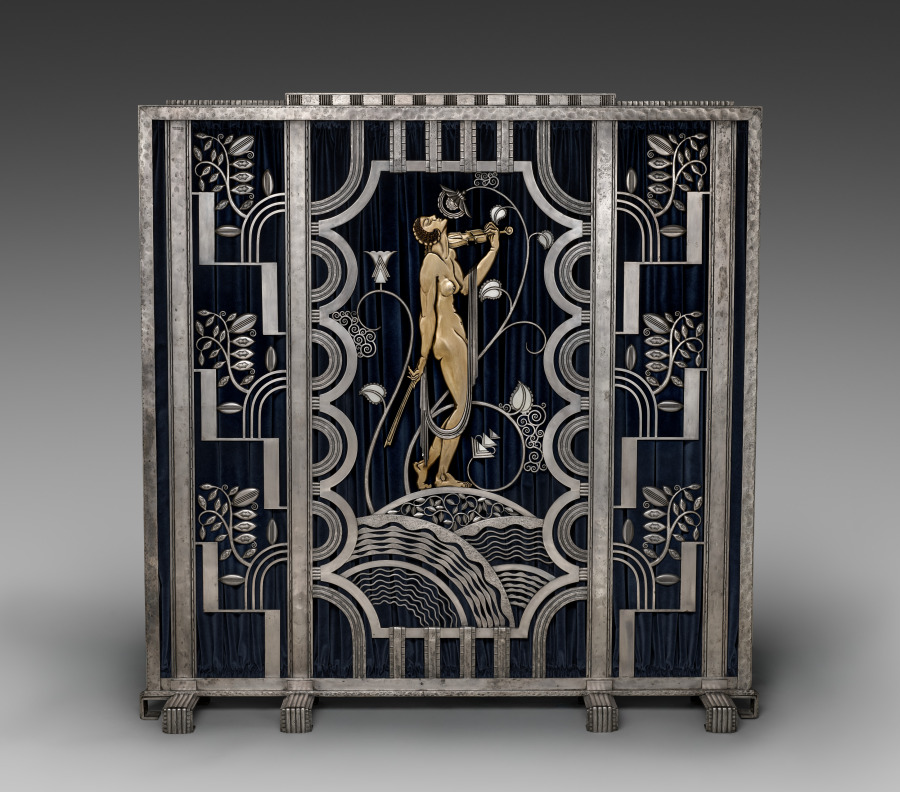
I. The Architectural Premise: From Ritual Vessel to Urban Armature
The Muse with Violin Screen presents a unique translational challenge: how to distill the dualistic power aesthetics of the Cup with Dragon Handles and the Head of a Ruler into a wearable, contemporary silhouette. The former operates through contained dominance—a geometry of restraint where the dragon’s torque is subjugated to the vessel’s cylindrical discipline. The latter operates through frontal monumentality—a planar, symmetrical mask that erases individuality in favor of timeless authority. For the 2026 executive wardrobe, these two principles fuse into a singular architectural thesis: the body as a ceremonial instrument of controlled power. The silhouette must not merely clothe; it must structure presence, converting the wearer’s movement into a ritualized sequence of deliberate, unbroken lines.
1.1 The Cup’s Logic: Vertical Containment and the Sheath
The dragon-handled cup’s essence lies in its interiority—the vessel’s function is to hold, yet its aesthetic power derives from the tension between the rigid outer wall and the latent energy of the creature coiled upon it. Translating this to fabric, the 2026 executive coat adopts a sheath-based construction: a high, closed neckline that mimics the cup’s rim; a torso cut with zero ease from shoulder to hip, echoing the vessel’s cylindrical precision. The sleeve, however, becomes the dragon—not as ornament, but as structural articulation. A single, continuous seam that begins at the acromion and spirals down to the wrist, terminating in a sharp, folded cuff, suggests the creature’s grip without literal representation. This is not decoration; it is load-bearing geometry. The sleeve’s spiral seam allows for a restricted, yet fluid, range of motion—reminiscent of the cup’s handle, which promises grasp but never disrupts the vessel’s profile.
1.2 The Ruler’s Logic: Frontal Planes and the Shield
Conversely, the Head of a Ruler demands a planar frontality. The face is a flat, symmetrical facade, unyielding to time. In garment terms, this manifests as a paneled front—not a draped or wrapped closure, but a precisely engineered seam that runs dead-center from the collar’s base to the hem. This central axis acts as the visual spine, dividing the torso into two mirrored halves. The shoulders are not padded but cut on a strict horizontal, creating a subtle, architectural shelf that references the stone’s squared base. The lapel, if present, is reduced to a micro-notch—a mere 1.5-centimeter interruption in the otherwise uninterrupted plane, echoing the ruler’s tightly sealed lips. The back, however, is where the sculpture’s depth is honored: a single, unbroken panel of fabric that falls from the nape to the calf, with a hidden vent at the center-back to permit stride. This is the monumental reverse, unseen by the observer but felt by the wearer—a private reminder of immutable authority.
II. Structural Poetics: The 2026 Executive Silhouette Defined
The definitive silhouette for this research is Minimalist, but with a specific, severe inflection: the “Ritual Sheath”. It is neither the fluid, body-skimming minimalism of the 1990s nor the aggressive, padded power-shoulder of the 1980s. Instead, it occupies a third space—rigid yet responsive. The key measurements are as follows:
- Shoulder-to-hip ratio: 1:1.05, with a slight, almost imperceptible taper toward the hem, creating a trapezoidal tension that references the cup’s base.
- Armhole depth: Reduced by 2 centimeters from standard tailoring, forcing the sleeve to sit high and tight, mimicking the dragon’s coiled attachment.
- Hem length: Two centimeters below the patella, a deliberate truncation that prevents the garment from becoming a dress, maintaining its status as a power shell rather than a covering.
- Fabric weight: 480 GSM wool-cashmere blend, with a fuller’s finish that compresses the weave into a felt-like density—approximating the stone’s solidity without sacrificing drape.
2.1 The Collar as a Frieze
The collar is the most critical zone. It is not a lapel, not a shawl, but a stand-and-fall construction that rises 4 centimeters at the back of the neck, then folds forward into a sharp, horizontal break. This references the Head of a Ruler’s browline—a continuous, unbroken ridge that separates the face from the skull. In the garment, this ridge is achieved through a fusible interlining of horsehair canvas, stitched with a 12-stitch-per-inch density to ensure the fold never softens. The collar’s front edges meet at the sternum with a single, hidden magnetic closure, invisible to the eye, so the garment appears as a seamless monolith when closed. When open, the collar falls back to reveal the interior—a contrast lining of raw silk in a deep oxblood tone, a subtle, private nod to the bronze’s patina.
2.2 Seam Logic: The Invisible Dragon
All seams are felled and pressed open, then top-stitched with a 0.5-millimeter thread in a matching onyx shade. The goal is to create a surface that reads as cast, not sewn. The only visible seam is the center-front axis, which is deliberately raised—a 3-millimeter ridge created by inserting a thin cord of cotton piping beneath the fabric. This ridge casts a shadow across the chest, echoing the carved line of the ruler’s jaw. The sleeve’s spiral seam is hidden on the underside, visible only when the arm is raised—a fleeting, kinetic revelation of the dragon’s presence, reserved for moments of gesture.
III. Urban Materiality: Onyx as the New Executive Neutral
The color is Onyx—not black, but a compressed, light-absorbing charcoal with a blue undertone. This is a deliberate departure from the standard navy or jet-black of executive suiting. Onyx reads as basalt, as obsidian, as the polished surface of the ruler’s stone head. It does not reflect; it absorbs and redistributes light, creating a matte, almost powdery finish that shifts subtly under urban sodium lighting. The fabric is a double-faced wool, woven in a 2x2 twill with a brushed reverse, so the interior is slightly softer, slightly warmer—a tactile contrast to the exterior’s rigidity.
3.1 Material Behavior in the Urban Context
This onyx wool behaves with architectural memory. It holds a crease for 48 hours, resists moisture through a nano-fiber treatment, and drapes with a deliberate, slow fall—not fluid, but weighted, as if the fabric itself is conscious of its authority. In the urban environment—glass towers, concrete plazas, subterranean transit—the garment’s surface interacts with these materials not as a contrast, but as a counterpoint. Against glass, it is opaque; against concrete, it is dense; against steel, it is silent. The wearer becomes a mobile monument, moving through the city with the same immutable presence as the ruler’s head in its museum hall.
IV. Conclusion: The Silhouette as a Dialectical Resolution
The 2026 executive silhouette, derived from the Muse with Violin Screen and the dual aesthetics of the dragon cup and ruler’s head, is not a trend. It is a philosophical position. It rejects the fluid, performative minimalism of recent seasons in favor of a rigid, ceremonial minimalism that demands the wearer’s posture align with the garment’s geometry. The onyx sheath is a vessel for the body, a shield for the self, and a monument to the wearer’s own authority. It is the dragon’s grip and the ruler’s gaze, rendered in wool and seam. This is the definitive urban silhouette for those who understand that true power is not displayed—it is contained, structured, and worn.