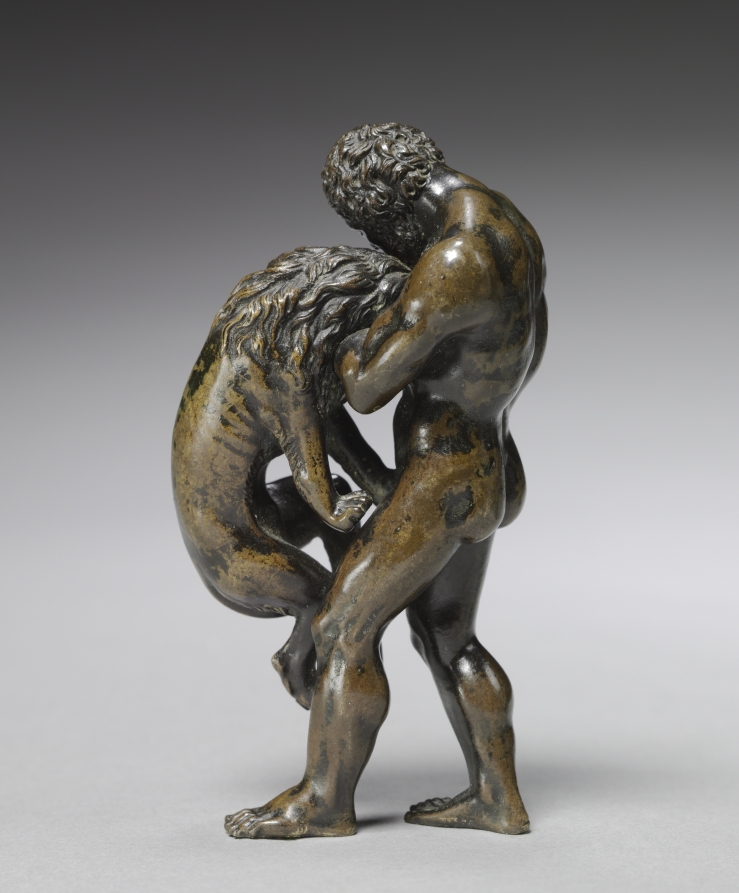
Urban Form: Hercules and the Nemean Lion
Executive Summary: The Dialectics of Vessel and Void
Addison Fashion’s 2026 Urban Silhouette Research extracts a dualistic design thesis from the juxtaposition of the Chinese Jar (Hu) and Jacques-Louis David’s The Death of Socrates. The former embodies a silent, earth-bound fullness; the latter, a theatrical, rationalized emptiness. For the New York executive, this synthesis yields a wardrobe architecture predicated on contained volume and articulated absence. The silhouette is not merely draped or tailored—it is chambered, offering the wearer a mobile vessel for authority, while the color field of Sand grounds the collection in a mutable neutrality that resists the binary of stark white and funereal black. This analysis deconstructs the formal grammar of both artifacts and translates their philosophical tensions into a technical specification for the 2026 executive wardrobe.
I. Form: The Geometry of the Hu and the Scaffold of Socrates
The Jar (Hu) presents a primal formal logic: a globular belly, a constricted neck, and a stable, flared foot. Its silhouette is a study in compressed expansion—the maximum volume achieved with minimal surface articulation. The absence of ornamentation is not a lack, but a deliberate negative capability. The jar’s surface, roughened by time, absorbs light rather than reflecting it, creating a matte, tactile presence. For the executive wardrobe, this translates into a shoulderless, drop-shoulder overcoat with a high, funnel neck—a direct analog to the jar’s neck—and a subtly flared hem that mimics the foot. The garment’s interior volume becomes its functional core: it does not cling to the body but houses it, allowing for layered movement without visual clutter. The fabric, a dense wool-cashmere blend with a brushed, matte finish, replicates the jar’s light-absorbing surface, ensuring the silhouette reads as a solid, monolithic form.
Conversely, David’s composition is a triangulated scaffold. The dying Socrates, his right arm extended toward the hemlock cup and his left index finger raised toward the heavens, creates a diagonal tension that fractures the horizontal plane of the prison cell. The surrounding disciples—each in a distinct posture of grief, anger, or resignation—form a series of secondary vectors that reinforce the central narrative. This is not a passive form; it is an argument made visible through musculature and drapery. The executive translation is a structured, single-breasted jacket with a pronounced, forward-pitched shoulder—not padded to excess, but engineered to create a sharp, architectural line. The lapel is cut with a severe, almost razor-like notch, echoing the painting’s linear precision. The jacket’s waist is suppressed, but not cinched, creating a subtle hourglass that references the classical ideal of the hero’s torso. The key innovation is the asymmetric closure: a hidden placket that shifts the visual axis, mimicking the painting’s off-center focal point. This introduces a controlled dissonance into the otherwise rational silhouette.
I.1. The Neck and the Hem: Terminals of Meaning
The Hu’s neck is a point of constriction and passage. It is the threshold between the vessel’s interior void and the external world. In the wardrobe, this is addressed through a high, stand collar on the overcoat, which functions as a physical and psychological barrier—a modern-day cuirass. The collar is not merely folded; it is constructed with an internal interfacing that allows it to stand away from the nape, creating a shadowed gap. This gap is the “empty” space, the moment of pause before the garment’s volume begins. The hem, conversely, is the point of grounding. The Hu’s foot provides stability; the overcoat’s flared hem, cut with a slight A-line, achieves the same effect, allowing the garment to move as a single, weighted unit rather than flapping around the ankles.
For the jacket, the terminals are the cuffs and the hemline. David’s figures have hands that are either clenched or dramatically open—never neutral. The jacket’s sleeve is cut with a slight, forward curve, terminating in a functional, buttoned cuff that can be tightened to create a clean line or loosened for a more gestural drape. The hemline is cut to sit at the first knuckle of the thumb, a length that provides coverage without sacrificing mobility. This is a deliberate counterpoint to the overcoat’s floor-sweeping volume, establishing a hierarchy of form within the ensemble.
II. Color: Sand as the Synthesis of Clay and Marble
The selected color, Sand, is not a compromise but a philosophical resolution. The Hu’s original clay body is a spectrum of ochres, umbers, and pale buffs—colors that are inherently earthy and non-assertive. David’s painting, despite its dramatic chiaroscuro, is dominated by the warm, honeyed light of the prison, which renders the marble architecture and the figures’ skin in tones of amber and ivory. Sand occupies the precise midpoint: it is neither the raw, unrefined brown of the clay nor the cool, intellectual white of Neoclassical marble. It is a processed neutrality, a color that has been refined but not bleached.
In the 2026 executive wardrobe, Sand functions as a chromatic primer. It allows the silhouette to be the primary carrier of meaning, rather than relying on color contrast. The overcoat in Sand reads as a monolithic block, its volume emphasized by the absence of tonal variation. The jacket, in a slightly deeper Sand—almost a greige—creates a subtle, tonal layering effect when worn with the overcoat. This is not a “colorful” collection; it is a monochromatic study in light absorption and reflection. The matte finish of the wool absorbs ambient light, while the smooth, tightly woven cotton of the shirt—also in Sand—reflects a faint, satiny sheen. This interplay of textures within a single hue creates a visual rhythm that is sophisticated and understated, suitable for the executive who commands attention through presence, not pattern.
II.1. The Semiotics of Sand in Corporate Power
Sand is a non-aggressive power color. Unlike Onyx, which asserts dominance through darkness, or Ivory, which claims purity through lightness, Sand suggests endurance and adaptability. It is the color of the desert, of the unglazed pot, of the stone that has been weathered into shape. For the NYC executive navigating a landscape of glass towers and digital noise, Sand offers a visual respite—a return to a material, tactile reality. It pairs effectively with the collection’s metal accents: brushed brass for the jacket’s hidden snaps and oxidized silver for the overcoat’s minimal, loop-button closure. These metals are not polished to a high shine; they are finished to a dull, satin luster, echoing the patina of age on the Hu’s surface.
III. Technical Specifications for the 2026 Executive Wardrobe
The following are the core construction parameters derived from the research:
1. The Vessel Overcoat (Hu-derived): Fabric—100% wool, 680 GSM, brushed finish. Construction—Raglan sleeve with a high, funnel collar; no shoulder padding; internal waist drawcord (hidden) to adjust volume; hem flared by 4 inches from the knee. Length—mid-calf. Closure—single, hidden horn button at the sternum.
2. The Socratic Jacket (David-derived): Fabric—wool-silk blend, 420 GSM, smooth finish. Construction—Forward-pitched shoulder with 0.5 inch padding; asymmetric, hidden placket; suppressed waist with 1 inch of ease; notch lapel with a 3.5-inch gorge. Length—hipbone. Closure—three, hidden magnetic snaps.
3. The Trousers (Synthesis): Fabric—wool-cotton twill, 320 GSM. Construction—High-rise, pleated front; tapered leg with a 7.5-inch hem; no break. The pleats are functional, allowing for expansion, echoing the Hu’s capacity for volume.
4. The Foundation Layer: A crew-neck, long-sleeve top in Sand-colored silk-cotton jersey. This is the “void” layer—it is meant to be unseen but felt, providing a smooth base for the structured outer layers.
IV. Conclusion: The Wardrobe as a Living Vessel
The 2026 Urban Silhouette Research concludes that the executive wardrobe must function as a dual container: it holds the body with the silent, generous volume of the Hu, while simultaneously articulating the body’s gestures with the rational, dramatic precision of David’s composition. The Sand palette ensures that this dialectic is not expressed through loud contrast, but through subtle shifts in texture, weight, and light. The wearer is not merely dressed; they are housed in a form that has been refined through the lens of two civilizations’ deepest inquiries into life and death. The result is a wardrobe that is both a monument and a tool—a vessel for the executive’s own narrative, ready to be filled with the actions of the day and emptied of the noise of the city. This is not fashion; it is functional philosophy, tailored to the grid.