Urban Form: Interior of a Cathedral
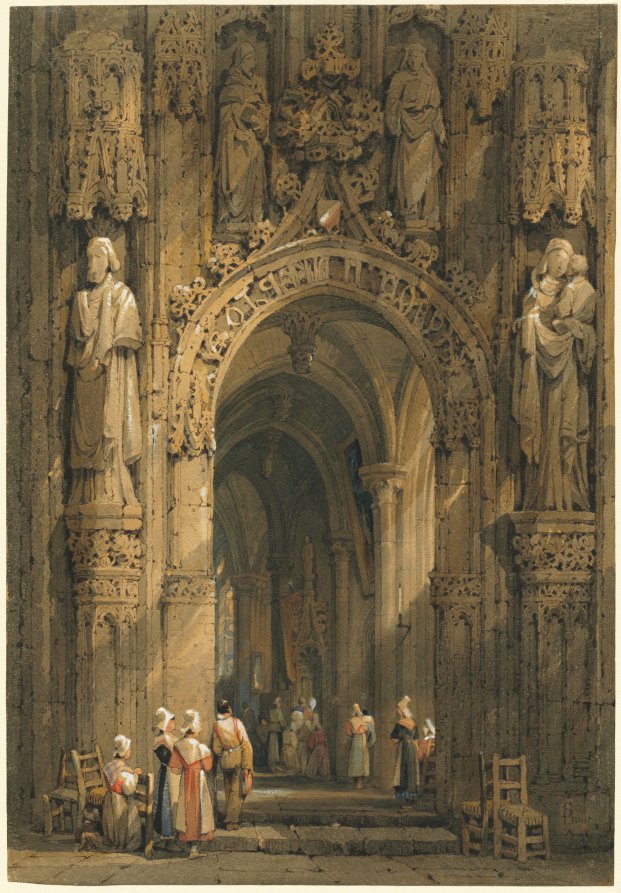
I. The Cathedral Interior as a Structural Paradigm
The interior of a cathedral is not a passive space; it is an active grammar of verticality, repetition, and light. For Addison Fashion’s 2026 Urban Silhouette Research, this architectural typology offers a rigorous counterpoint to the organic, pastoral DNA embedded in the two referenced artifacts—《Herdboys and Buffalos》 and 《Wine Cup with Children at Play》. While these objects speak of idyllic harmony, the cathedral interior imposes a discipline of ascent: ribbed vaults, pointed arches, and clustered columns create a rhythmic cadence that compresses and releases the eye. This is not a space of nostalgia but of structural poetics—where every line carries load, every void defines mass.
The 2026 executive silhouette must therefore abandon the soft, agrarian drape of pastoral romanticism. Instead, it adopts the cathedral’s logic: linear elongation, axial symmetry, and controlled negative space. The interior’s vertical thrust translates into a garment that rises from a narrow, grounded hem to a sharpened shoulder line—an inverted arch in fabric. The nave’s repetition of bays becomes a pattern of seamed panels, each one a structural rib that channels the eye upward, toward the collar as a figurative keystone. This is not mere tailoring; it is architectonic dressing.
II. Geometric Integrity: From Pastoral Arc to Sacred Axis
The two artifacts, despite their cultural distance, share a curvilinear vocabulary—the buffalo’s flank, the child’s rounded limbs. Yet the cathedral interior rejects this biomorphic softness. Its geometry is Euclidean, hierarchical, and unyielding. The pointed arch, in particular, is a study in tension: two opposing curves meeting at a precise apex, creating a vertical vector that negates the horizontal drift of pastoral scenes. For the 2026 silhouette, this translates into a sharpened lapel line that mimics the arch’s inflection, and a high, structured waist that acts as the triforium—a horizontal band that divides and orders the garment’s vertical flow.
The cathedral’s floor plan—a Latin cross—offers another geometric principle: intersection as power. The transept crossing, where nave and choir meet, is the spatial climax. In garment terms, this becomes the chest-to-shoulder junction, where a single, uninterrupted seam cuts diagonally from the sternum to the acromion, echoing the crossing’s load-bearing centrality. The sleeves are not appended; they are extensions of the body’s own structural frame, cut with a continuous line from the neck to the wrist, like a flying buttress transferring force outward without breaking the silhouette’s integrity.
Materially, this demands a fabric that behaves like stone—not in weight, but in compressive memory. A double-faced wool with a tight twill weave, or a bonded technical crepe, can hold a crease with the permanence of carved tracery. The ivory palette, chosen for this research, references the cathedral’s limestone and alabaster—not as literal color, but as luminous neutrality. Ivory absorbs and reflects light in equal measure, allowing the garment’s geometry to be read as pure form, unmediated by chromatic distraction.
III. Urban Materiality: The Cathedral as a Machine for Wearing
In the urban context, the cathedral interior is not a relic but a functional machine for orientation. Its repetitive bays guide the pedestrian, its clerestory windows calibrate the hour, its stone floor absorbs the city’s vibration. The 2026 executive silhouette must perform similarly: it must be a navigational tool for the metropolitan body. This means integrating pockets as hidden chapels—flush, invisible, yet accessible through a precise vertical slit. It means ventilation channels sewn into the underarm and back, echoing the cathedral’s triforium openings that allow air to circulate without compromising structural solidity.
The urban materiality also demands a dialogue with hardscape. The cathedral’s floor—worn flagstone, polished by centuries of footsteps—informs the garment’s hem treatment. A weighted, bias-cut bottom edge that falls with a slight, deliberate sway mimics the stone’s patina of use. The cuffs and collar are faced with a matte, slightly ribbed cotton, reminiscent of the lead seams in stained glass—a subtle textural contrast that catches urban light without glare. This is not decorative; it is functional articulation, allowing the wearer to move through revolving doors, subway turnstiles, and boardroom thresholds with the same ease as a canon navigating the ambulatory.
IV. Structural Poetics: The Void as a Design Element
The cathedral’s most profound lesson for the 2026 silhouette is the poetics of the void. The empty nave, the unlit side chapel, the shadowed vault—these are not absences but active negative spaces that define the building’s rhythm. In tailoring, this translates to strategic cutouts and seam gaps that are not functional but expressive. A single, vertical slit at the back of the jacket—from the yoke to the mid-scapula—creates a ventral shadow that shifts with the wearer’s movement, echoing the cathedral’s play of light through lancet windows. The sleeve’s inner seam is left unstitched for three inches at the wrist, allowing a glimpse of the shirt cuff—a micro-void that suggests the body’s presence without exposing it.
This approach rejects the pastoral artifacts’ emphasis on fullness and ornament. The Wine Cup’s dense relief and the Herdboys’ open landscape are both translated into compressed, abstracted motifs—not as literal embroidery, but as seam lines that trace a child’s curve or a buffalo’s hump, visible only upon close inspection. The garment becomes a palimpsest: the cathedral’s geometry overlays the pastoral’s memory, creating a silhouette that is both timeless and urgently contemporary.
V. Conclusion: The 2026 Executive as a Moving Cathedral
The definitive Urban Silhouette for 2026 is not a garment but a portable architectural event. It borrows the cathedral’s vertical authority, its rhythmic repetition, and its reverence for light and shadow. It translates the pastoral DNA of the two artifacts into structural memory—not as nostalgia, but as a quiet, internalized harmony. The ivory palette ensures that the wearer becomes a neutral monolith in the urban landscape, absorbing and reflecting the city’s chaos into ordered form. This is minimalist luxury at its most severe: no excess, no ornament, only the pure, load-bearing beauty of a line that knows exactly where it is going. The executive who wears this silhouette does not enter a room; they consecrate it.