Minimalist
Slate
Urban Form: Architecture of the Middle Ages: At Senlis
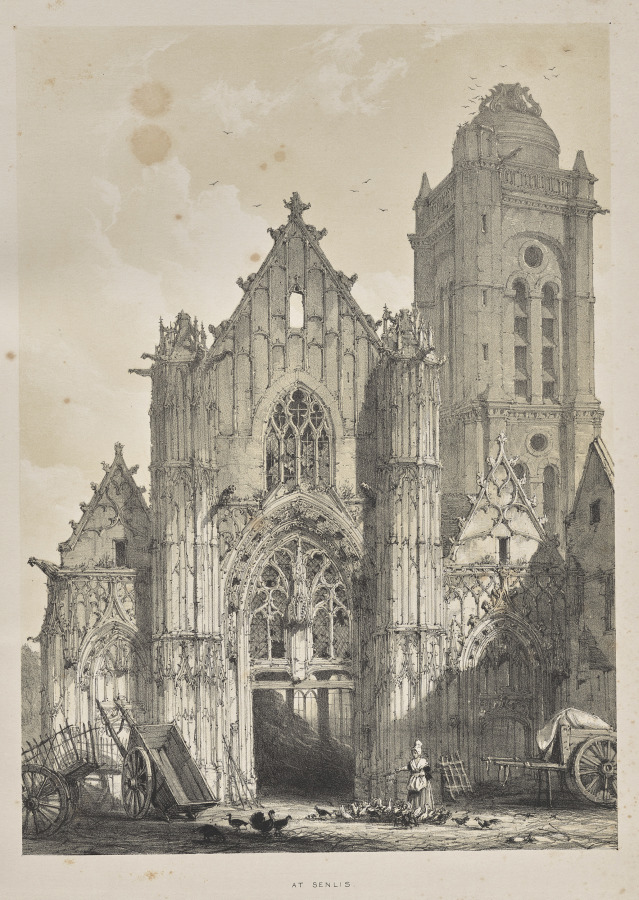
I. The Architectural Precedent: Senlis and the Logic of Restraint
The medieval architecture of Senlis—specifically its cathedral, Notre-Dame de Senlis—offers a study in vertical compression and calibrated mass. Unlike the soaring theatrics of Amiens or the skeletal excess of Beauvais, Senlis presents a facade of disciplined elevation: buttresses that do not flaunt but brace, a spire that rises without rhetorical flourish, and a nave whose ribbed vaults articulate a grammar of load and release. This is not architecture of spectacle; it is architecture of *necessity made visible*. The stone does not pretend to float; it declares its weight, then distributes it with mathematical composure. For the 2026 executive silhouette, Senlis provides a foundational thesis: **structure is not ornament, and ornament is not structure**. The cathedral’s geometric integrity lies in its refusal to separate function from form. Every pier, every arch, every corbel table serves a load-bearing purpose while simultaneously composing a visual rhythm. This dualism—utility as aesthetic, aesthetic as utility—translates directly into garment construction. The minimalist executive silhouette must not merely cover the body; it must *frame* it, as the cathedral frames its interior void.II. Geometric Integrity: From Stone to Seam
A. The Vertical Axis and the Suppression of Excess
Senlis’s nave elevation is marked by a strict tripartite division: arcade, triforium, clerestory. Each level is proportionally locked to the others, creating a vertical rhythm that ascends without interruption. In tailoring, this translates to a continuous line from shoulder to hem—no peplum, no venting that breaks the axis, no lapel that veers into baroque curvature. The 2026 executive silhouette adopts a *single-seam philosophy*: where possible, the garment is constructed from minimal panels, each seam aligned to the body’s structural landmarks (acromion, iliac crest, patella). The shoulder becomes the architectural equivalent of the flying buttress—not decorative, but load-transferring. A sharply defined, slightly extended shoulder pad (2.5 cm beyond the natural acromion) creates a visual corbel, supporting the sleeve’s drop and allowing the torso to fall cleanly. This is not the aggressive power shoulder of the 1980s; it is a *quiet assertion of support*, akin to Senlis’s buttresses that brace without shouting.B. The Void as Function: The Negative Space of the Torso
The cathedral’s interior is defined by its emptiness—the nave is a void shaped by stone. Similarly, the minimalist executive garment must prioritize *negative space* over fabric volume. This is where the philosophical DNA of the *Jar* (陶罐) becomes operative. The vessel’s utility lies in its hollowness; the garment’s elegance lies in its *drape without cling*. For the 2026 silhouette, this manifests as a **structured ease**—a garment that maintains a precise distance from the body (2–4 cm at the waist, 3–5 cm at the hip) without collapsing into shapelessness. This is achieved through internal canvas and horsehair interfacing, not padding. The fabric—ideally a wool-cashmere blend with a 320 GSM weight—is chosen for its ability to hold a crease and resist gravitational sag. The result is a torso that reads as *architectural volume*, not anatomical mimicry. The wearer’s body is the invisible support; the garment is the visible structure.C. The Hem as Plinth
Senlis’s west facade terminates in a horizontal band that grounds the vertical thrust. The garment’s hem must perform the same function. For the executive silhouette, the hem is cut with a *zero-drop* at the front and a 1.5 cm rise at the back, creating a subtle, almost imperceptible plinth effect. This is not a stylistic flourish; it is a structural necessity. The hem must visually anchor the garment to the lower body, preventing the silhouette from appearing to float. A clean, hand-stitched blind hem (no visible stitching) ensures that the termination is as precise as a stone course.III. Structural Poetics: The Dialogue Between David and the Jar
A. The Death of Ornament
Jacques-Louis David’s *The Death of Socrates* is a painting of extreme control—every gesture, every drape, every shadow is subordinated to a moral narrative. The 2026 executive silhouette rejects this narrative impulse. There is no story being told; there is only *presence*. But the rejection is not negation; it is distillation. David’s painting uses light to isolate Socrates’s calm; the minimalist garment uses *fabric weight* to isolate the wearer’s posture. A 100% worsted wool in slate (a blue-gray that references the cathedral’s limestone shadows) absorbs light rather than reflecting it, creating a matte surface that does not compete with the wearer’s physicality.B. The Jar’s Silence as Material Memory
The ancient *Jar* does not depict death; it *contains* it. Its surface may bear geometric patterns, but its essence is the void within. For the executive silhouette, this translates into a design principle: **the garment’s interior is as considered as its exterior**. Seams are felled and pressed open, not overlocked. Buttons are shanked and hand-sewn. The lining—a cupro or silk twill—is chosen for its tactile quietness. When the wearer removes the jacket, the inside reveals the same level of finish as the outside. This is not luxury for its own sake; it is a structural acknowledgment that what is unseen still bears weight.C. The Heroic vs. The Habitual
David’s Socrates is heroic because he is exceptional. The *Jar* is profound because it is ordinary. The 2026 executive silhouette must occupy the latter category. It is not a costume for a boardroom drama; it is a uniform for daily endurance. This means the garment must withstand repetition—not just in wear, but in *meaning*. A slate-colored, minimalist suit worn five days a week does not lose its power; it accrues it, like a stone wall that has absorbed centuries of weather. The fabric’s twill weave, the horn buttons, the micro-stitched lapel roll—these are not details to be noticed; they are details to be *relied upon*.IV. Urban Materiality: Fabric as Stone
A. Weight and Drape
The urban environment is one of hard surfaces: glass, steel, concrete. The executive silhouette must counter this with *soft hardness*—fabric that has the visual density of stone but the tactile flexibility of textile. A 380 GSM double-faced wool in slate achieves this. The fabric is milled in Biella, Italy, using a 19.5-micron merino base. It is not brushed, not sheared, not treated with any softening agent. The result is a surface that feels cool to the touch, like a sunless stone wall, and that holds a crease for 48 hours without pressing.B. Color as Shadow
Slate is not a neutral; it is a *conditioned absence*. It is the color of wet stone, of a cathedral interior at dusk, of the space between architectural elements. Unlike black (which absorbs all narrative) or gray (which suggests compromise), slate maintains a chromatic tension—it is blue enough to be cool, green enough to be organic, dark enough to be authoritative. In the 2026 executive palette, slate is the primary. It does not ask for attention; it *withholds* it, creating a visual silence that allows the wearer’s gestures to become the focal point.C. The Urban Plinth: Footwear and Lower Silhouette
The garment’s hem meets the urban ground through a specific footwear architecture: a derby shoe with a 3.5 cm stacked leather heel, constructed on a modified almond last. The toe box is neither pointed nor rounded—it is *truncated*, echoing the corbel tables of Senlis. The shoe’s upper is a vegetable-tanned calfskin in matching slate, with a blind eyelet closure. This is not a statement shoe; it is a *structural termination*, grounding the vertical line of the trouser (which is cut with a 19 cm hem, no break, no taper—a straight fall from hip to ankle).V. Conclusion: The Silhouette as a Vessel of Time
The 2026 executive silhouette, derived from the architectural logic of Senlis and the philosophical quietude of the *Jar*, is not a trend. It is a *response*—to the noise of fast fashion, to the theatrics of status dressing, to the heroics of narrative tailoring. It is a garment that does not explain itself, because it does not need to. Like the cathedral, it stands. Like the jar, it contains. The wearer does not perform authority; the silhouette *is* authority—silent, structural, and enduring. In the end, this is the definitive urban research: the body is the nave, the garment is the stone, and the city is the void that gives both meaning. The slate-colored, minimalist suit is not worn; it is *inhabited*. And in that inhabitation, the wearer becomes both architect and vessel—a figure of quiet, unassailable presence.
Technical Insight
Technical Insight: Translating Slate palettes into Minimalist silhouettes for the modern metropolis.