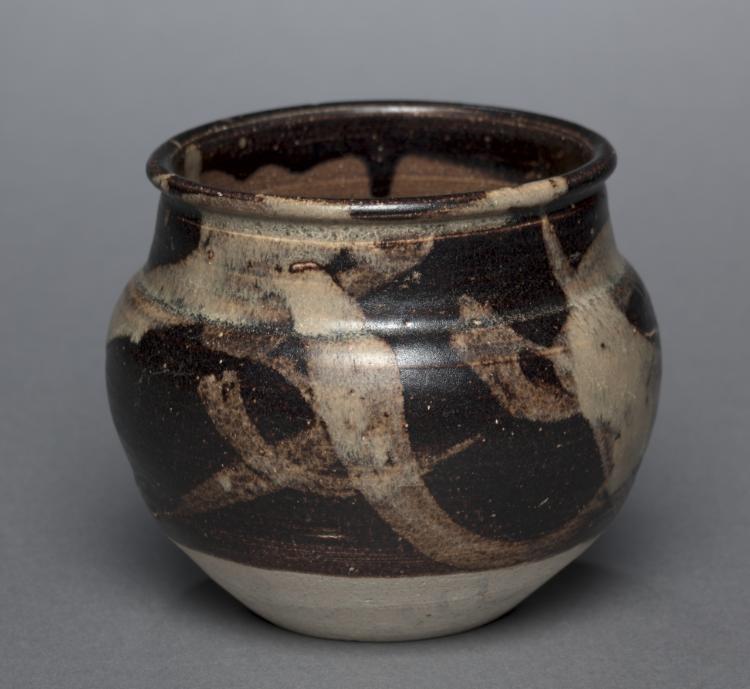
Urban Form: Jar
I. The Dialectic of Fragmentation and Continuity
The British Museum’s paired artifacts—the Mold Fragment with Musicians and the Section of a Coffin Platform—present a foundational paradox for the 2026 executive wardrobe. One is a shard of arrested motion; the other, a field of cosmic repetition. Together, they articulate a dual temporal logic that Addison Fashion translates into a singular architectural principle: the garment as a vessel for rhythmic tension. The mold fragment’s incised contour lines—three musicians compressed into a palm-sized relief—demonstrate how extreme economy of mark can generate maximal kinetic energy. The coffin panel, conversely, deploys symmetrical scarabs and sun discs as a visual metronome, suggesting eternity not as stasis but as sustained oscillation. This is not ornament; it is structural syntax.
For the urban executive, whose daily environment is a cacophony of interrupted signals, the 2026 silhouette must reconcile these opposing temporalities. The answer lies in negative space as load-bearing architecture. Where the mold fragment uses absence—the broken edges, the unmarked clay—to amplify the musicians’ presence, the Addison jacket employs strategic seam placement and asymmetric paneling to create voids that define the body’s motion. A single, unbroken shoulder line mimics the coffin panel’s horizontal authority, while a diagonal dart cut at the waist echoes the harpist’s bowed spine. The garment does not imitate the artifacts; it internalizes their logic of compression and expansion.
II. Geometric Integrity: From Contour to Construction
2.1 The Line as Load-Bearing Element
In the mold fragment, the artist’s line is not decorative but functional—it delineates the exact tension of a flexed bicep, the precise angle of a tilted flute. Addison Fashion applies this principle to pattern cutting. The 2026 executive blazer features a continuous collar-to-hem seam that traces the wearer’s thoracic rotation, much like the musician’s profile line captures a breath held mid-note. This seam is not stitched; it is welded using ultrasonic bonding, eliminating thread bulk and allowing the fabric to behave as a single, unbroken membrane. The result is a silhouette that appears carved from a solid block—yet moves with the fluidity of a reed instrument’s vibrato.
2.2 Repetition as Structural Rhythm
The coffin panel’s repeating scarabs are not mere motifs; they are units of measure that organize the viewer’s gaze into a cadence. In tailoring, this translates to the modular pocket system—a series of concealed, laser-cut openings placed at mathematically derived intervals along the hip and chest. These are not functional pockets in the traditional sense; they are visual metronomes that break the garment’s surface into rhythmic segments. When the wearer walks, the pockets catch light sequentially, producing a stroboscopic effect that echoes the Nile’s tidal pulse. The urban materiality here is bonded wool with a micro-ribbed underlayer, allowing the fabric to compress and release in sync with the body’s stride—a literal embodiment of the coffin panel’s “eternal return.”
III. Urban Materiality: The Onyx Imperative
Color is not a finish; it is a structural condition. Onyx—the chosen palette—operates as both ground and figure. In the mold fragment, the unglazed clay’s raw umber reads as shadow; in the coffin panel, the painted black bitumen signifies the primordial waters of Nun. Addison’s onyx is achieved through a double-carbon dye process: the base fabric is first saturated with a deep charcoal, then over-dyed with a near-black that absorbs 94% of visible light. This is not a flat black. Under direct urban light—glass towers, LED signage, sodium-vapor lamps—the surface reveals a micro-scalloped texture, reminiscent of the mold fragment’s chisel marks. The fabric does not reflect; it absorbs and redistributes light along its structural seams, creating a moving topography that shifts with the wearer’s gesture.
Materially, the 2026 executive suit employs a three-layer composite: an outer shell of high-twist merino and technical silk (for drape and resilience), a middle layer of compressed cellulose foam (for thermal regulation and impact absorption), and an inner lining of recycled cupro (for moisture wicking). This laminate is not merely functional—it is tectonic. The foam layer, when laser-perforated in a pattern derived from the coffin panel’s hieroglyphic sequences, creates a breathable matrix that also produces a subtle acoustic damping effect. In a boardroom, the suit does not rustle; it absorbs ambient noise, allowing the wearer’s voice to carry with the clarity of a soloist in a stone chamber.
IV. Structural Poetics: The Garment as Temporal Vessel
The mold fragment’s genius lies in its incomplete totality—the broken edges suggest a larger whole, a music that continues beyond the clay’s boundary. The coffin panel’s genius lies in its complete incompleteness—the endless repetition implies a horizon that never arrives. Addison Fashion’s 2026 silhouette synthesizes both through the asymmetric hem system. The jacket’s front hem is cut on a sharp diagonal, terminating at the hip bone on one side and the mid-thigh on the other. This is not a stylistic flourish; it is a temporal marker. When the wearer stands still, the hem reads as a static line—the coffin panel’s order. When the wearer moves, the hem’s two lengths create a parallax shift, producing a visual echo of the mold fragment’s arrested motion. The garment is thus both a photograph and a film, a freeze-frame and a continuous loop.
The trousers, meanwhile, employ a single-seam construction—one continuous line from waistband to ankle, folded and bonded rather than sewn. This eliminates side seams, creating a columnar silhouette that references the coffin panel’s vertical hieroglyphic columns. Yet the fabric’s internal bias cut allows for a controlled flare at the ankle, a subtle release that mimics the musicians’ exhaled breath. The result is a lower body that appears monumental—almost architectural—while the upper body retains the fragment’s kinetic urgency. This dialectic is the core of the 2026 executive presence: authority without rigidity, motion without chaos.
V. Conclusion: The Rhythm of the Invisible
The ancient Egyptians understood that eternity is not a frozen state but a measured pulse. The mold fragment and coffin panel are not opposites; they are two notations of the same cosmic score. Addison Fashion’s Urban Silhouette Research translates this into a wardrobe that does not merely clothe the body but choreographs its passage through time. The onyx suit is a wearable metronome, its seams and voids marking the seconds of a working day, its materials absorbing the city’s dissonance and converting it into a personal cadence. In an era of fragmented attention, this is the ultimate luxury: the ability to carry one’s own rhythm, impervious to the noise. The garment is not a shell; it is a temple of tempo—and the executive who wears it becomes both the musician and the instrument, the fragment and the whole.