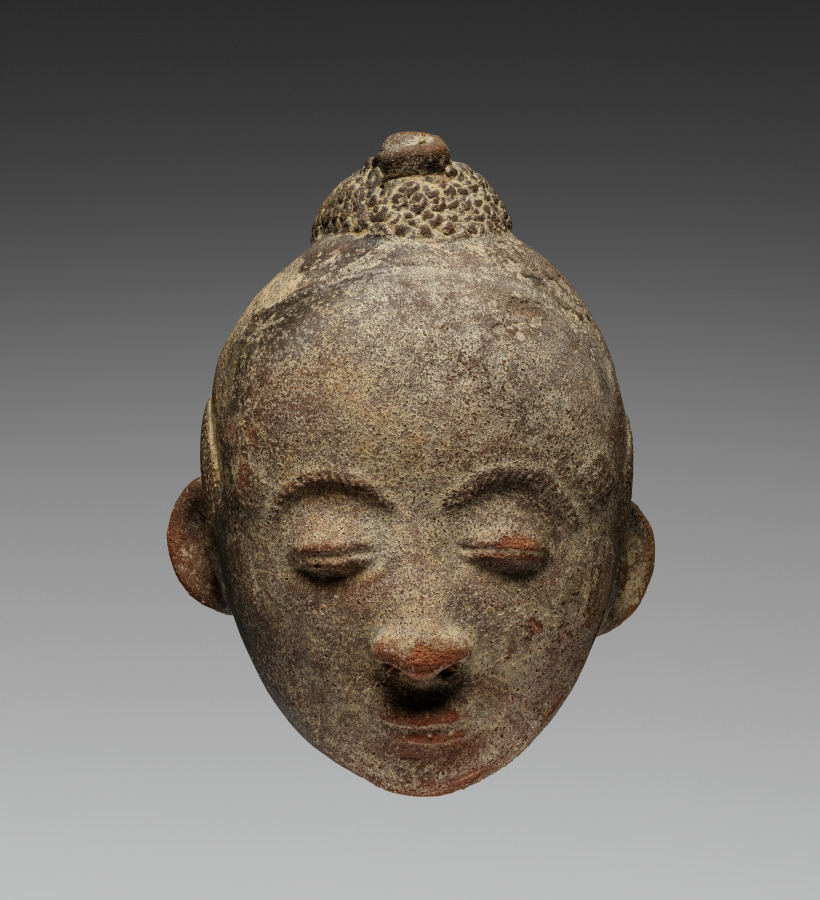
Urban Form: Memorial head (nsodie)
I. The Object as Architectural Precedent
The memorial head (nsodie) from the Akan tradition is not a portrait in the Western sense; it is a compressed monument. Carved in terracotta or cast metal, its volumes are reduced to essential planes—a cylindrical neck, a flattened ovoid cranium, and a brow ridge that reads as a horizontal lintel. Unlike the narrative density of the Senusret Stela or the visceral chaos of Goya’s Disasters of War, the nsodie operates through negative articulation: what is omitted—musculature, expression, idiosyncrasy—becomes the load-bearing element of its aesthetic. This is not a face; it is a facade system.
For the 2026 executive silhouette, this object offers a radical departure from the soft, gestural tailoring that has dominated the past decade. The nsodie’s geometry demands a shoulder line that is not draped but cantilevered. The jacket’s collar must rise like the brow ridge—a single, unbroken seam that visually severs the neck from the torso, creating a zone of stillness. The sleeve head is set forward, mimicking the nsodie’s slight downward tilt, which in garment terms translates to a pitched shoulder that reads as authority without aggression. The torso block is elongated, with a suppressed waist that references the object’s tapered base, yet the hem is cut clean and horizontal, echoing the flat underside of the sculpture. This is not a suit; it is a wearable stele.
II. Structural Poetics: The Logic of Compression
The nsodie’s power lies in its compression of mass. Unlike the Senusret Stela’s grid-like relief, which expands outward to narrate divine order, the memorial head compresses all meaning into a single, dense volume. This is a poetics of interiority—the object does not declare; it withholds. For the executive wardrobe, this translates into a jacket that is unlined in construction but heavily interfaced. The canvas is fused to the shell with a precision that eliminates any possibility of drape or movement. The result is a garment that feels like a shell, not a skin. The fabric—a double-faced wool with a matte, stone-like finish—is chosen for its dead hand: it does not shimmer, does not flow, does not apologize. It sits on the body as if carved.
This compression extends to the trouser. The nsodie’s cylindrical neck suggests a leg line that is straight, columnar, and untapered. The waistband is high and rigid, acting as a structural belt that anchors the entire silhouette. The pleats are not functional; they are incised lines, cut into the fabric as if by a chisel, and pressed so sharply that they read as grooves rather than folds. The hem is weighted with a hidden lead tape, ensuring that the trouser falls with the same gravitational certainty as the sculpture’s base. There is no break at the shoe; the trouser hovers just above the instep, creating a visual gap that mirrors the nsodie’s separation from its pedestal—a moment of suspended gravity.
III. Urban Materiality: Onyx as the New Neutral
In the context of the 2026 urban environment—where glass, steel, and polished concrete dominate—the nsodie’s materiality offers a counterpoint of primordial density. The color Onyx is not merely black; it is a black that absorbs light rather than reflecting it, a black with geological depth. This is achieved through a fabric blend of virgin wool, cashmere, and a micro-portion of metallic fiber that, under direct light, reveals faint striations—like the veining in the stone from which the nsodie is carved. The surface is not smooth; it is sanded to a matte finish, with a subtle tooth that catches the urban grit, making the garment feel lived-in and monumental simultaneously.
The urban materiality extends to the hardware. Buttons are replaced with magnetic closures—invisible, silent, and precise—echoing the nsodie’s seamless transitions between planes. Zippers are hidden beneath plackets, and pockets are cut on the bias to maintain the garment’s uninterrupted surface. The lining is a raw silk in a contrasting graphite tone, visible only when the jacket is opened, revealing an interior architecture that mirrors the object’s hidden core. This is a garment that does not perform for the street; it occupies the street with the same quiet authority as a monument in a plaza.
IV. The Silhouette as Ethical Statement
Returning to the aesthetic dialogue between the Senusret Stela and Goya’s massacre, the nsodie offers a third path: neither divine order nor human chaos, but human order. The stela is aspirational, projecting an eternal stability that is ultimately false; Goya’s canvas is visceral, capturing a truth that is ultimately unbearable. The nsodie, however, is funerary yet composed—it acknowledges mortality without melodrama, power without arrogance. For the 2026 executive, this is the definitive stance. The silhouette does not shout authority through padded shoulders or peak lapels; it asserts through reduction, precision, and silence.
The jacket’s lapel is a notch cut at 75 degrees, a subtle deviation from the standard 90 that creates a barely perceptible forward lean—a nod to the nsodie’s tilted gaze. The back is cut in one continuous panel, with no center seam, allowing the fabric to wrap the torso like a shroud that has been tailored into armor. The sleeves are set with a zero-ease technique, requiring the wearer to adjust their posture to the garment, not the reverse. This is a silhouette that demands a certain physical discipline—a straight spine, a level gaze—not as a performance, but as a habit of being.
V. Conclusion: The Monument in Motion
The memorial head (nsodie) is a static object, yet its geometry contains the blueprint for motion—not the motion of walking or gesticulating, but the motion of presence. It moves through space by refusing to be moved by it. The 2026 executive silhouette, derived from this principle, is a garment that does not follow the body; it frames the body as a fixed point in a fluid urban landscape. In an era of digital distraction and visual noise, this is the ultimate luxury: a suit that functions as a personal monument, carved from onyx-dark wool, engineered with the precision of a sculptor’s chisel, and worn with the quiet gravity of a figure who has already won the argument before speaking.
The stela and the massacre are extremes; the nsodie is the median point—a form that holds both order and rupture within its compressed mass. Addison Fashion’s 2026 collection does not choose between them. It absorbs both, and in doing so, produces a silhouette that is timeless, urban, and utterly unyielding.