Urban Form: Sculptural Element from a Reliquary Ensemble (mbulu ngulu)
Technical Deconstruction: Form, Volume, and the Articulated Silhouette
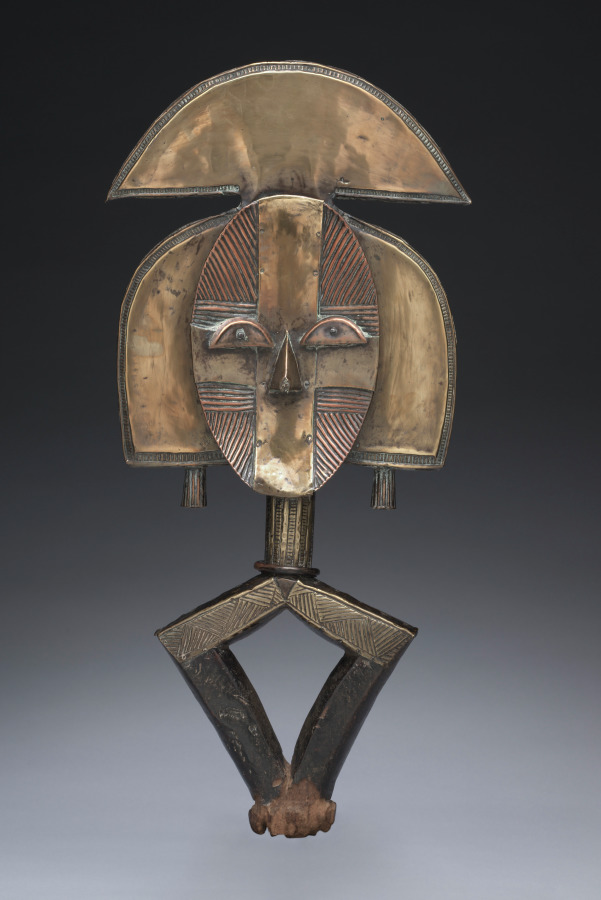
The provided DNA source—a dialogue between the ethereal, negative-space-driven Herdboys and Buffalos and the tactically ornate, symbolically dense Wine Cup with Children at Play—presents a foundational paradox for modern urban aesthetics: the tension between void and substance, between contemplative absence and declarative presence. The mbulu ngulu reliquary figure, with its radically simplified, geometric human form capped by an expansive, planar copper face, serves as the perfect sculptural conduit for this synthesis. Its form is not merely an object but a philosophy of structured absence, a study in controlled exaggeration where the silhouette becomes the primary text.
Architectural Abstraction and the Negative Space Framework
The mbulu ngulu’s most potent formal principle is its reduction of the human torso to a stark, concave rhomboid or open lozenge. This is not a representation of anatomy but an architectural invocation of space. The concave plane functions as a "void" in the Eastern philosophical sense—a "虚室" (empty room) that generates meaning and presence through what it withholds. In silhouette construction, this translates to a deliberate deconstruction of the traditional shoulder-to-hip taper. We propose garments built on a modified A-line or H-frame, where the midsection is not cinched but strategically opened. This can be achieved through several technical interventions: deep, inverted pleats originating from a structured yoke; double-faced wool with internal rigging to maintain a subtle, self-supported distance from the body; or the use of rigid yet lightweight technical felts that hold a geometric form. The result is a silhouette that carries its own atmospheric space, echoing the reliquary’s spiritual containment and the pastoral scroll’s boundless fields within a defined urban frame.
The Planar Face and the Horizon Line: Shoulder as Focal Point
The reliquary’s large, flat, copper-sheet face establishes a dominant horizontal plane, redirecting focus upward and outward. This directly informs a critical shift in tailoring focus for the 2026 executive wardrobe: the re-imagined shoulder and neckline as the new horizon of identity. The exaggerated, planar face finds its sartorial correlate not in volume, but in sharp, uninterrupted linearity. We will move beyond the soft deconstruction of past seasons toward a more authoritative, yet minimalist, shoulder treatment. Think precise, slightly extended shoulder lines achieved through internal haircanvas and featherbone, creating a clean, T-square line from neck to sleeve cap. Necklines will be broad and shallow—wide boat necks or deep, squared scoops—that expose the collarbone and upper thoracic architecture, mirroring the reliquary’s emphasis on the upper plane. This horizontal emphasis creates a silhouette of calm authority, a visual anchor that grounds the volumetric play below.
From Ornament to Articulation: The Western Dialogue
Where the Eastern influence provides the philosophy of void, the Western silver cup contributes the principle of articulated surface and symbolic intent through structure. The cup’s detailed figural relief does not translate to applied decoration, but to strategic articulation of the garment’s form. Seaming becomes the primary decorative and functional element. Seams will be exaggerated, top-stitched with a heavy gauge thread in a tonal Slate, tracing geometric pathways that map the body’s potential movement rather than its actual contour. Darting may be externalized, transformed into decorative tucks that manipulate light and shadow, much like the play of light on the silver cup’s repoussé work. The "play" of the children is abstracted into the play of modular components: detachable wool capes that attach via hidden magnets under the planar shoulder, sleeves with lacing systems allowing for variable volume, representing the fusion of secular vitality with rigorous form.
Application: The 2026 NYC Executive Wardrobe Blueprint
The synthesized formal language—architectural void, planar horizon, and articulated seam—culminates in a wardrobe system engineered for metropolitan rigor and psychological depth. The core palette of Slate is non-negotiable. This complex, cool grey, with its mineral undertones, embodies the copper face of the reliquary, the silver of the cup, and the ink-wash of the scroll. It is neither warm nor cold, but existentially neutral, providing the perfect backdrop for form to speak without chromatic interference.
Key Pieces and Technical Specifications
The Concave Coat: The flagship outerwear piece. A double-faced wool-mohair blend, cut as a single geometric panel for the back, forming a soft, persistent concave curve. Raglan sleeves are set high to preserve the planar shoulder line. Closure is achieved via a single, oversized Slate horn toggle placed off-center, referencing the reliquary’s abstracted feature.
The Planar Tunic Dress: A knee-length dress built on a modified trapeze block. The front and back are cut as near-identical rectangles, with the shape created solely by deep, inverted side pleats released from a yoked shoulder. The neckline is a wide, shallow square, baring the sternum. Sleeves are precisely set-in, ending at a sharp mid-forearm point.
Articulated Trousers: A wide-leg, high-waisted trouser in a heavy-weight Slate crepe. The leg is constructed from two overlapping panels, joined by a vertical seam bisecting the thigh and calf. This seam is functional, allowing the leg to open slightly into a soft blade shape with movement, a direct abstraction of "play" and dynamic vitality.
The Modular Cape-Sleeve Top: A fitted bodice in a technical silk jersey, featuring a wide boat neck. The sleeves are separate architectural objects—long, tapered sleeves or short, planar capes—that attach via a hidden magnetic system under the shoulder yoke, enabling a transformation from ornate (cape) to minimal (sleeve) within the same foundational garment.
This wardrobe is a technical exercise in controlled resonance. It answers the metropolitan demand for severe elegance while embedding a deeper, cross-cultural narrative. It is attire for the executive who operates not just in the physical grid of the city, but in the conceptual space between void and substance, between the contemplative pastoral and the vigorous secular—a walking, sophisticated reliquary for modern thought.