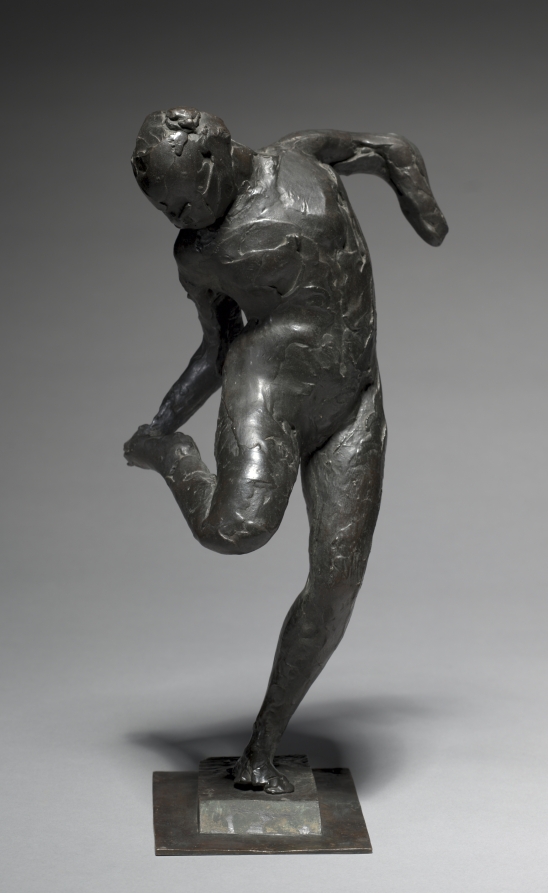
Urban Form: Dancer Looking at the Sole of her Right Foot
I. The Sole as Architectural Ground: Deconstructing the Pose
The subject—a dancer examining the sole of her right foot—presents a radical departure from classical figuration. Unlike the frontal, axial rigidity of the Virgin and Child Enthroned, or the still-life monumentality of de La Tour’s Ewer, this pose is defined by internal torsion and self-referential scrutiny. The dancer’s spine rotates along a vertical axis, while her neck and gaze descend toward the plantar surface—a plane typically hidden, tactile, and utilitarian. This is not a pose of display; it is a pose of inspection. The body folds into itself, creating a closed loop of attention that excludes the viewer. For the 2026 executive silhouette, this translates into garments that prioritize interior architecture over external spectacle.
Geometrically, the pose generates three distinct volumes: the elevated thigh forms a horizontal cantilever; the torso becomes a twisted column; the head and foot create a secondary, smaller triangle within the larger composition. The negative space between the arm and the bent knee is not empty—it is a sculptural void, analogous to the gilded recesses of the medieval throne or the shadowed flank of the brass ewer. In urban materiality, this void is translated into cutaway panels, asymmetric draping, and engineered seam lines that mimic the body’s internal rotation. The silhouette is not static; it is a frozen kinetic event.
II. Structural Poetics: From Gilded Icon to Tactile Minimalism
The medieval Virgin and Child Enthroned achieves its sacred presence through frontality and verticality. The gold leaf annihilates shadow, compressing three-dimensional mass into a two-dimensional icon of light. In contrast, the dancer’s pose rejects frontality entirely. The spine’s rotation creates a dynamic asymmetry that demands a new tailoring logic. For Addison Fashion, this means abandoning the traditional shoulder-to-hem vertical axis in favor of spiral seams that wrap around the torso, echoing the dancer’s twist. The fabric must behave like gilded wood—rigid enough to hold a sculpted form, yet responsive enough to reveal the body’s internal torque.
De La Tour’s Ewer offers a counterpoint: the object’s curved surfaces catch light as if the metal itself were a source of illumination. The dancer’s sole, though flesh, performs a similar function. It is the point of contact—between body and ground, between intention and gravity. In the 2026 executive silhouette, this translates to weighted hems, reinforced ankle zones, and tactile sole-like textures at the garment’s lower extremities. Onyx, as the chosen color, absorbs light rather than reflecting it, creating a visual density that mirrors the ewer’s shadowed body. The materiality is not decorative; it is functional gravity.
III. The Void as Carrier: Reinterpreting the “Empty” as Structural
Both the throne and the ewer operate through a paradox: they are containers—of divinity and of liquid—yet their aesthetic power lies in what they hold within their form. The dancer’s pose externalizes this internal void. The space between her raised foot and her lowered head is a negative volume that defines the positive mass of her body. In tailoring, this principle manifests as strategic negative ease—not tightness, but a deliberate absence of fabric where the body folds. The 2026 executive silhouette employs cutouts at the lumbar curve, open-back constructions, and detachable panels that reveal the body’s own architecture. These voids are not erotic; they are structural disclosures, akin to the exposed joinery of a wooden throne or the polished lip of a metal vessel.
The Virgin and Child’s gold leaf creates a surface that denies time—a permanent, unchanging light. The dancer’s sole, by contrast, is a surface of temporal evidence: calluses, pressure lines, the imprint of prior movement. For urban materiality, this suggests fabrics that record wear—technical wool that develops a subtle sheen at stress points, bonded cotton that creases in predictable, map-like patterns. Onyx, in this context, is not a flat black but a layered darkness, achieved through tonal stitching and matte-and-gloss contrasts that reveal themselves only in motion.
IV. The 2026 Executive Silhouette: A Synthesis of Torsion and Restraint
The definitive Addison silhouette for 2026 is neither tailored nor fluid in the classical sense. It is a hybrid: a tailored shell with fluid inserts, engineered to accommodate the body’s rotational capacity. The jacket’s shoulder seam is shifted 15 degrees backward, mimicking the dancer’s scapular rotation. The trouser’s crotch point is lowered and curved, allowing a seated posture that does not distort the fabric’s line. The coat’s collar is asymmetrical, rising on one side and falling on the other, echoing the head’s tilt toward the foot. Every line is derived from the geometry of self-examination—not the outward gaze of the icon, nor the inward glow of the ewer, but the downward, focused attention of the dancer.
This silhouette is urban in its materiality: onyx-toned, with a surface that shifts between matte and semi-lustrous depending on the light source. It is minimalist in its palette, yet complex in its construction. The garment does not announce itself; it waits to be discovered, much like the sole of a foot that is only revealed when the dancer chooses to look. In a city of constant visual noise, this is a quiet, radical act—a form of sartorial introspection that prioritizes the wearer’s internal experience over external projection.
V. Conclusion: The Sole as Metaphor for Executive Presence
To examine the sole is to examine the foundation. The dancer’s gesture is not one of weakness or fatigue, but of calibrated self-assessment. For the executive, this translates into a wardrobe that is self-aware without being self-conscious—garments that support the body’s mechanics while allowing for moments of pause. The Virgin and Child offers vertical transcendence; the Ewer offers material immanence. The dancer offers neither. She offers the act of looking down, of grounding oneself in the physical reality of one’s own form. The 2026 Addison silhouette is thus not a statement of power, but a statement of presence—a presence that is measured, deliberate, and entirely at ease with its own materiality.