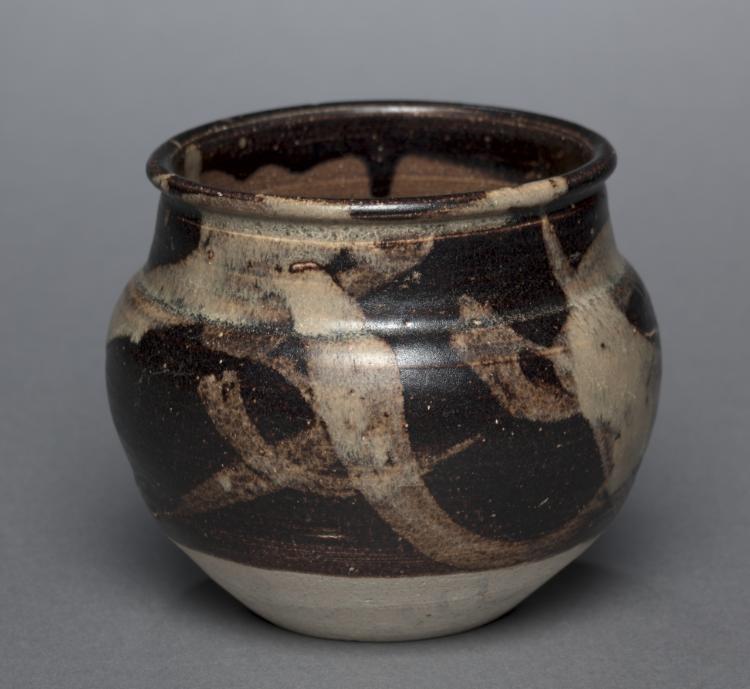
Urban Form: Jar
Structural Poetics: The Dialectic of Fragmentation and Stasis
The subject—a broken ceramic mold bearing musicians, paired with a mortuary zodiac ox—presents an architectural paradox. The mold fragment is an incomplete vessel, its edges raw, its surface scarred by the pressure of ancient thumbs. The ox, conversely, is a closed form, a geometric monolith whose curvature rejects narrative in favor of cosmic permanence. For the 2026 executive silhouette, this dualism translates into a garment that must simultaneously suggest interrupted motion and immutable order. The silhouette cannot be merely tailored; it must be constructed as a tension between these two archaeological states.
The mold’s musicians are compressed into a shallow relief, their gestures truncated by the breakage. This is not a loss of information but a deliberate editing—a poetics of the fragment. In urban dress, this manifests as asymmetric seaming, offset plackets, and panels that terminate before their logical endpoint. A jacket’s hem may drop sharply on one side, echoing the jagged edge of the terracotta, while the opposite side remains clean, referencing the ox’s unbroken contour. The result is a silhouette that reads as deliberately unfinished, yet rigorously controlled. The executive wearer does not wear a garment; they wear a decision about what to reveal and what to sever.
Geometric Integrity: From Terracotta Relief to Urban Armature
The ox’s geometry is reductive: a low-slung head, curved horns, a body that swells like a horizon line. Its symmetry is not static but gravitational—it anchors the viewer’s eye to a central axis. For the 2026 silhouette, this dictates a strong vertical spine, achieved through a continuous center-front seam that runs from collar to hem, unbroken by pockets or darts. The shoulder line must be sharp, almost architectural, like the ridge of a roof, but softened by a slight forward pitch—a nod to the ox’s bowed head. This is not a power shoulder; it is a shoulder of resignation, carrying the weight of cosmic time.
The mold fragment, by contrast, offers a counter-geometry: radial dispersion. The musicians are arranged not in a line but in a cluster, their instruments pointing outward like spokes. In tailoring, this translates to a subtle flare from the waist—not a full skirt, but a controlled A-line that begins at the hip and widens by no more than three centimeters. The effect is one of latent energy, as if the garment is about to release a sound. This is achieved through hidden godets inserted at the side seams, invisible when standing, activated only during movement. The urban executive, walking through a glass atrium, becomes a living relief—a figure whose silhouette shifts between compression and expansion.
Urban Materiality: Slate as a Conductor of Time
The color slate is not a neutral; it is a sedimentary memory. It recalls the fired clay of the mold—its gray-brown undertones—and the patina of aged stone in a necropolis. For fabric, this demands a wool-cashmere blend with a matte finish, woven tightly enough to hold a crease but with a slight tooth, so that light does not slide off but is absorbed and slowly released. The texture must mimic the mold’s porous surface: not smooth, but granular, with a faint irregularity that catches the eye at close range. This is achieved through a double-faced weave, where the inner layer is brushed for warmth and the outer layer is left slightly raw, like unpolished terracotta.
Hardware becomes the zodiac’s metalwork. Buttons are not round but oblong, shaped like the ox’s horns, cast in darkened bronze with a matte finish. Zippers are concealed beneath plackets, their pulls replaced by leather tabs that resemble the straps of an ancient lyre. The lining is a deep charcoal silk, printed with a faint, abstracted star chart—a private reference to the Taurus constellation, visible only when the garment is opened. This is urban materiality as archaeological layering: the outer shell speaks of the present, the inner surface whispers of the tomb.
The Executive Silhouette as a Time Container
The 2026 executive silhouette, derived from this subject, is not about comfort or ease. It is about containment. The mold held music; the ox held the dead. The garment must hold the wearer’s professional identity as a vessel holds a volatile substance—under pressure, yet stable. The jacket’s internal structure uses a fused canvas that extends into the sleeves, creating a rigid frame that does not yield to the body but defines it. The trousers are cut with a high waist and a straight, narrow leg, terminating just above the ankle to reveal a sliver of skin or sock—a deliberate break, like the mold’s fractured edge.
The silhouette’s length is critical. The jacket ends at the mid-hip, not to flatter but to interrupt the vertical line, forcing the eye to pause before continuing downward. This mimics the way the mold’s musicians are truncated by the break—a reminder that all form is provisional. The ox, in contrast, is complete; its silhouette is a closed loop. The garment reconciles these by offering a removable collar piece—a high, mandarin-style stand that can be attached for a funerary formality or detached for a more fragmented, casual stance. This modularity is the urban executive’s answer to ritual: the ability to shift between the celebration of the instant and the acknowledgment of the inevitable.
Conclusion: The Narrow Path Between Heat and Gravity
Addison Fashion’s 2026 Urban Silhouette Research concludes that the executive garment is not a uniform but a philosophical instrument. It must carry the heat of the musician’s fingers—the urgency of a deadline, the pulse of a negotiation—while bearing the gravity of the ox’s stare—the long view, the legacy, the final account. The slate wool is the medium; the asymmetric seams are the syntax; the hidden star chart is the subtext. This is a silhouette for those who understand that every meeting is a fragment, and every career is a zodiac cycle. The wearer does not merely dress; they inscribe themselves into the urban fabric, leaving a mark as lasting as a thumbprint in wet clay, as quiet as a stone ox in a sealed chamber.