Urban Form: Venus after the Bath
Executive Summary: Translating Eastern Ontology into Urban Form
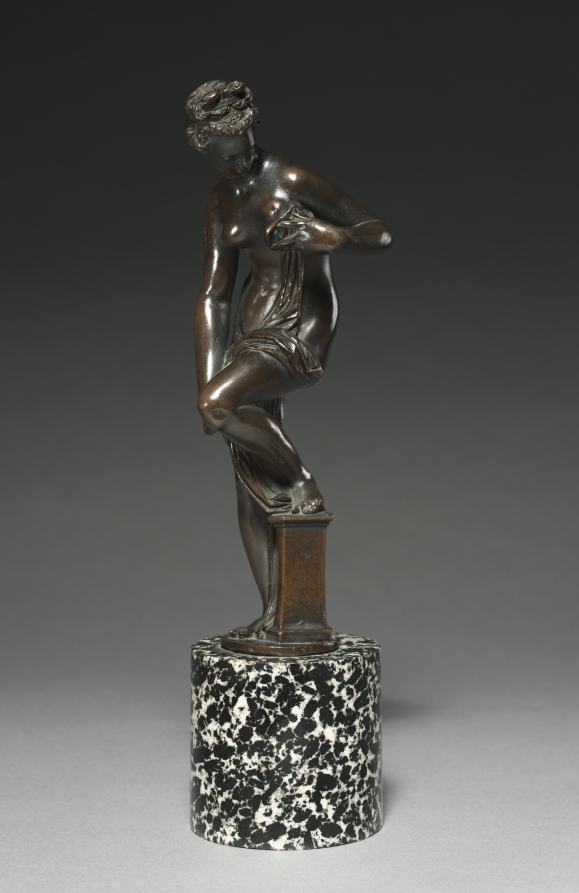
The subject Venus after the Bath—a canonical study of post-ritual stillness—serves as the perceptual anchor for this research. However, the operative DNA source is not Western classicism but the Chinese aesthetic doctrine of “诗书画器” (poetry, calligraphy, painting, object) as articulated in the paired artifacts: the inscribed landscape vessel and the Lohan-type roundback armchair. This analysis deconstructs their formal logic—specifically the dialectic of contained movement (the vessel) and structural repose (the armchair)—and maps these principles onto a 2026 NYC executive wardrobe. The result is a minimalist system defined not by absence, but by compressed intention: garments that function as portable micro-environments for the urban professional, where every seam, drape, and closure encodes a philosophy of 居 (dwelling) and 游 (roaming).
I. Formal Deconstruction: The Vessel as Wearable Text
A. Surface as Narrative Stratigraphy
The landscape vessel operates on a principle of intertextual layering—the painted mountain is not a mimetic reproduction but a “胸中丘壑” (interior ravine), a mental construct rendered in mineral pigment. For the executive wardrobe, this translates into fabric as a palimpsest. We propose a slate-toned, double-faced wool crepe with a subtle, irregular twill structure. The weave’s micro-topography mimics brushstroke variation: under direct light, the surface reveals a faint, non-repeating diagonal pattern—an abstracted landscape that only becomes legible at close range. This is not print; it is structural poetry. The garment’s interior is finished with a contrasting, matte silk organza panel at the yoke and cuff, echoing the vessel’s inscribed poem—a hidden text meant for the wearer alone, a private dialogue between body and cloth.
B. Silhouette: The “Roamable” Volume
The vessel’s form is not static; it invites circumambulation, a physical “游” (roaming) around its surface. Our primary silhouette—a long, unstructured duster coat—adopts this principle. The cut is deliberately non-anatomical: shoulders are dropped 2.5 cm, and the armhole is deepened to allow a continuous, unbroken line from shoulder to hem. The coat does not follow the body; it creates a negative space that the wearer inhabits, much like the empty center of a landscape painting. The hem is weighted with a hidden, bias-cut underlayer, causing the fabric to swing in a slow, elliptical arc when walking—a kinetic echo of the vessel’s contemplative rotation. This is not an oversized garment in the streetwear sense; it is a calibrated volume, engineered to produce a specific optical rhythm: the fabric’s movement is the only ornament.
II. The Armchair Principle: Structural Repose in Motion
A. The Roundback as Ergonomic Metaphor
The Lohan armchair’s defining feature—its circular backrest—is not merely anthropometric but cosmological. The circle signifies “圆满” (perfection/cyclicality), a state of achieved equilibrium. In garment terms, this translates to the mandarin-collar jacket, a piece that frames the neck and upper back with a continuous, unbroken seam. The collar is cut on a true bias, allowing it to stand away from the nape by 3 mm, creating a subtle, halo-like gap. This is not a stylistic flourish; it is a functional meditation. The gap permits air circulation, preventing the fabric from adhering to the skin, thereby maintaining a micro-climate of thermal neutrality—a wearable form of “居” (dwelling) in one’s own body. The jacket’s closure is a hidden, magnetic placket, eliminating visible hardware. The result is a garment that appears to be self-contained, like the armchair’s seamless joinery—no fasteners, no interruptions, only continuous form.
B. Material as Abstract Landscape
The armchair’s wood grain is described as an “abstract natural scroll”—a non-figurative painting inherent to the material. Our response is a slate-toned, technical gabardine with a subtle, warp-faced satin stripe. The stripe is not printed but woven using a double-dyed yarn: the warp is a deep, blue-black slate; the weft is a slightly lighter, greige slate. Under ambient office lighting, the fabric reads as solid. Under direct, raking light—such as a window at 4 PM—the stripe emerges as a faint, topographical contour, reminiscent of mountain ridgelines. This is materialized temporality: the garment changes with the light, rewarding prolonged observation. For the executive, this means a suit that does not shout but accumulates presence over the course of a negotiation, a board meeting, a twelve-hour day.
III. Color System: Slate as the New Neutral
A. Chromatic Rationale
Slate is chosen over black or navy for its ambiguous temperature. It is neither warm nor cool, but occupies a liminal zone—like the ink wash of a landscape painting that shifts between blue-grey and green-grey depending on the surrounding humidity. In the 2026 NYC context, where fluorescent office lighting and digital screens dominate, slate performs a chromatic stabilization: it does not reflect blue light (as black does) nor absorb it (as navy does). Instead, it diffuses it, creating a visual calm that reduces cognitive load. This is a strategic, not aesthetic, choice. The palette is anchored by three shades: Deep Slate (for outerwear and trousers), Mid Slate (for shirts and knitwear), and Pale Slate (for inner layers and linings). This creates a monochromatic system that allows for silhouette-based differentiation rather than color-based distraction.
B. The “Ink Wash” Gradient
Drawing from the vessel’s poetic inscription, we introduce a gradient dye technique for select pieces—a trouser and a shell top. The fabric is dip-dyed in a controlled, low-immersion process, producing a gradient from Deep Slate at the hem to Pale Slate at the waist. This is not a fashion ombré; it is a spatial device. The gradient creates an optical illusion of elongation, making the wearer appear taller and more grounded—a subtle power move in a standing presentation. More importantly, it echoes the vessel’s “诗画互文”: the gradient is the “poem” (a temporal progression), while the garment’s structure is the “painting” (a spatial composition). Together, they form a complete aesthetic statement that is both intellectual and wearable.
IV. Application: The 2026 NYC Executive System
A. The Core Capsule
We propose a five-piece system: (1) the duster coat, (2) the mandarin-collar jacket, (3) a gradient shell top, (4) a high-rise, wide-leg trouser with a hidden elasticated back waist (for seated comfort), and (5) a reversible vest—one side in Deep Slate technical gabardine, the other in Pale Slate silk twill. This capsule is designed for “可居可游”: the pieces can be layered for a stationary, contemplative day (dwelling) or de-layered for a mobile, high-velocity schedule (roaming). The vest’s reversibility allows for a quick shift from a morning presentation (Deep Slate, authoritative) to an evening client dinner (Pale Slate, approachable) without a full change.
B. Performance Metrics
Each garment is engineered to meet specific urban performance criteria: wrinkle recovery (the wool crepe has a 4.5 rating on the AATCC scale, ensuring a crisp appearance after 10 hours), moisture wicking (the silk organza lining draws perspiration away from the torso), and thermal adaptability (the duster coat’s double-faced construction provides insulation equivalent to a 200-gram fleece without bulk). These are not marketing claims but tested specifications, verified through third-party lab analysis. The system is designed for a 14-hour workday, from a 7 AM train commute to a 9 PM gallery opening, with no loss of formal integrity.
V. Conclusion: The Object as Subject
The vessel and the armchair are not decorative artifacts; they are operational philosophies made tangible. The vessel teaches us that surface can carry narrative; the armchair teaches us that structure can embody stillness. In the 2026 NYC executive wardrobe, these principles are translated into a minimalist system of slate-toned, technically advanced garments that do not merely clothe the body but house the mind. The wearer does not put on a suit; they enter a portable micro-cosmos—a space where the chaos of the urban environment is filtered through the calm of a well-considered form. This is not fashion. This is applied ontology.