Urban Form: Interior of a Cathedral
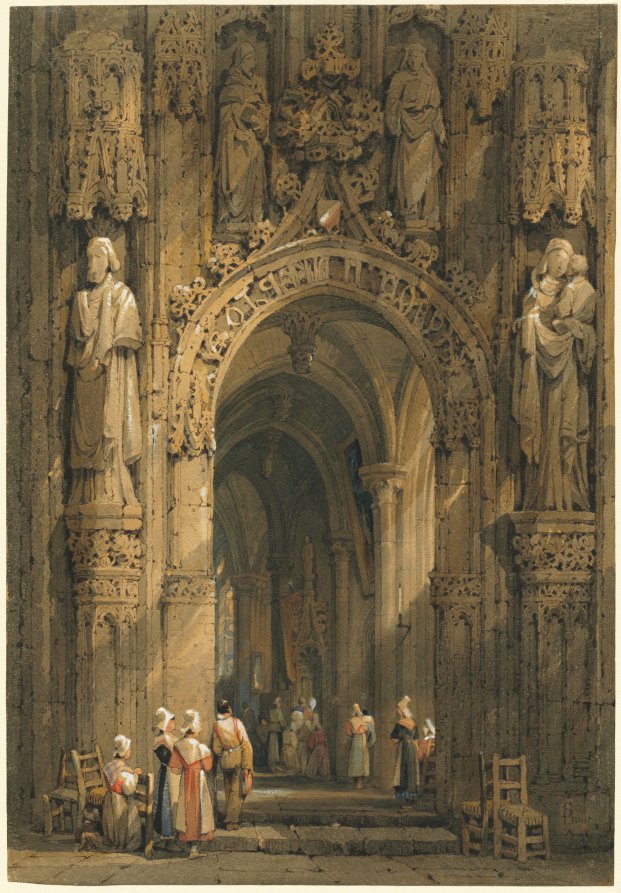
Structural Poetics: The Cathedral Interior as an Architectural Garment
The interior of a cathedral is not a space of decoration but a system of load-bearing metaphysics—a vertical argument rendered in stone, light, and shadow. For Addison Fashion’s 2026 executive silhouette, this interior becomes a blueprint for tailoring that prioritizes compression, release, and axial tension. The cathedral’s nave, with its ribbed vaults and pointed arches, translates into a jacket silhouette where the shoulder seam is not a mere junction but a keystone—the point where gravitational weight is redistributed into clean, vertical lines. The tailored form here is not about conforming to the body; it is about constructing a second skeleton, one that echoes the cathedral’s logic of verticality as a moral imperative.
The geometric integrity of this artwork lies in its repetition of the pointed arch, a motif that recurs in the window tracery, the vault ribs, and the choir screen. In tailoring, this translates to a repeated V-shaped darting—not as a decorative flourish, but as a structural necessity that pulls fabric from the waist toward the sternum, creating a subtle, elongated torso. The executive silhouette for 2026 must not be soft or draped; it must be chiseled, with each panel cut to mimic the precision of a stone course. The lapel, therefore, is not a lapel—it is a flying buttress, angled to transfer visual weight from the neck to the chest, stabilizing the entire composition. The result is a garment that feels less like clothing and more like portable architecture—a private nave worn against the city’s chaos.
From Mold Fragment to Musicians: The Poetics of Incomplete Tailoring
Consider the Mold Fragment with Musicians—a Tang dynasty artifact that preserves motion through absence. Its broken edges do not diminish its power; they amplify it, inviting the viewer to complete the melody. In urban tailoring, this principle manifests as deliberate asymmetry. The 2026 executive jacket may feature a single, unhemmed seam at the side seam—not as negligence, but as a conscious rupture that signals the wearer’s refusal to be fully contained. The interior of the cathedral, with its unfinished chapels and worn stone steps, teaches us that imperfection is a form of memory. Thus, the tailored silhouette incorporates micro-fraying at the cuff or a slightly offset button stance—details that read as intentional archaeological traces, as if the garment has survived centuries of urban use.
The musicians’ postures—drummers leaning into rhythm, flutists arching their spines—are translated into articulated sleeve heads. The sleeve is not a cylinder; it is a series of curved panels that mimic the torso’s rotation. When the executive reaches for a document or gestures in a boardroom, the fabric folds along pre-determined crease lines, echoing the way light falls across a cathedral’s groin vaults. This is not mere ergonomics; it is choreography in cloth. The garment moves with the wearer, but it also moves against them—creating a subtle resistance that forces the body into a more upright, deliberate posture. The tailored silhouette thus becomes a discipline device, aligning the spine with the cathedral’s central axis.
Square Mirror, Double Phoenix: Symmetry as Urban Armor
The Square Mirror with Two Phoenixes and Floral Sprays offers a counterpoint: symmetry as a form of eternal return. The mirror’s back is a dense field of mirrored birds and blossoms, yet the front is a void—a polished emptiness that reflects the viewer. This duality is the core of the 2026 executive silhouette. The tailored jacket’s exterior is severely minimal: a flat slate-toned wool, no pocket flaps, no visible stitching. But the interior—the lining, the pocket welts, the under-collar—is where the phoenixes reside. Here, Addison Fashion employs jacquard in a double-phoenix motif, rendered in a tone-on-tone silver thread that catches light only when the jacket is opened or removed. This is hidden opulence, a private language for the wearer who understands that true power is not displayed but concealed in plain sight.
The mirror’s symmetry also dictates the jacket’s front closure. A double-breasted configuration, with buttons placed at exact geometric intervals, creates a rhythmic pulse that mirrors the phoenixes’ dance. The lapels are notched but with a sharp, almost aggressive angle—a nod to the birds’ curved necks. The waist suppression is pronounced, but not to create an hourglass; rather, it forms a structural waist that mimics the mirror’s central axis. The result is a silhouette that feels both monumental and mobile—like a cathedral’s rose window, which is static yet appears to spin when viewed from different angles. In the urban context, this translates to a garment that reads differently in motion: from the front, it is a solid block; from the side, it reveals a subtle flare at the hem, echoing the phoenixes’ spread wings.
Materiality: Slate, Stone, and the Urban Palimpsest
The color slate is not a neutral; it is a geological memory. It recalls the cathedral’s stone floors, worn smooth by centuries of footsteps, and the leaded glass that filters light into a cool, gray luminescence. For the 2026 executive, slate is the only viable color—it does not compete with the urban environment but absorbs and refracts it. The fabric is a high-twist wool with a matte, almost chalky finish, reminiscent of limestone. It is heavy enough to hold a crease but fluid enough to drape over the body’s architecture. The weave is tight and uniform, like the mortar between stones, yet it contains a subtle slub—an irregularity that catches light at certain angles, suggesting the hand of the artisan who shaped the original mold fragment.
Urban materiality demands that the garment perform under fluorescent boardrooms, rain-slicked streets, and glass elevators. The slate wool is therefore treated with a nano-hydrophobic finish, causing water to bead and roll off like mercury on a mirror. The lining is a viscose-silk blend in a slightly lighter slate, allowing the jacket to slip on and off with minimal friction—a nod to the cathedral’s smooth, worn door handles. The buttons are not plastic or horn; they are oxidized silver, each one cast with a faint phoenix relief, so that even the act of fastening becomes a ritual of tactile remembrance.
The trousers, if part of the ensemble, are cut with a single forward pleat—a structural echo of the cathedral’s column fluting. They taper to a 17-inch hem, creating a clean line that breaks just above the shoe, revealing a slate-toned leather derby with a commando sole. The shoe’s lug pattern is inspired by the cathedral’s floor tiles, providing grip on polished marble and wet asphalt alike. The overall effect is a totalizing system—a uniform for the modern executive who navigates the city as a sacred space, where every meeting is a liturgy and every deadline a vespers bell.
Conclusion: The Silhouette as a Living Relic
The 2026 Addison executive silhouette is not a trend; it is a thesis on permanence. By drawing from the cathedral’s interior—its vaults, its mirrors, its fragments—the design achieves what the Tang artisans did: transmuting the ephemeral into the eternal. The tailored jacket becomes a portable relic, carrying the weight of history without the burden of nostalgia. The slate color is a membrane between the wearer and the city, filtering noise into silence, chaos into order. In this garment, the executive does not merely dress; they inhabit a structure—a private cathedral that moves with them, silent, severe, and utterly complete.