Urban Form: Architecture of the Middle Ages: In St. Remi, Abbeville
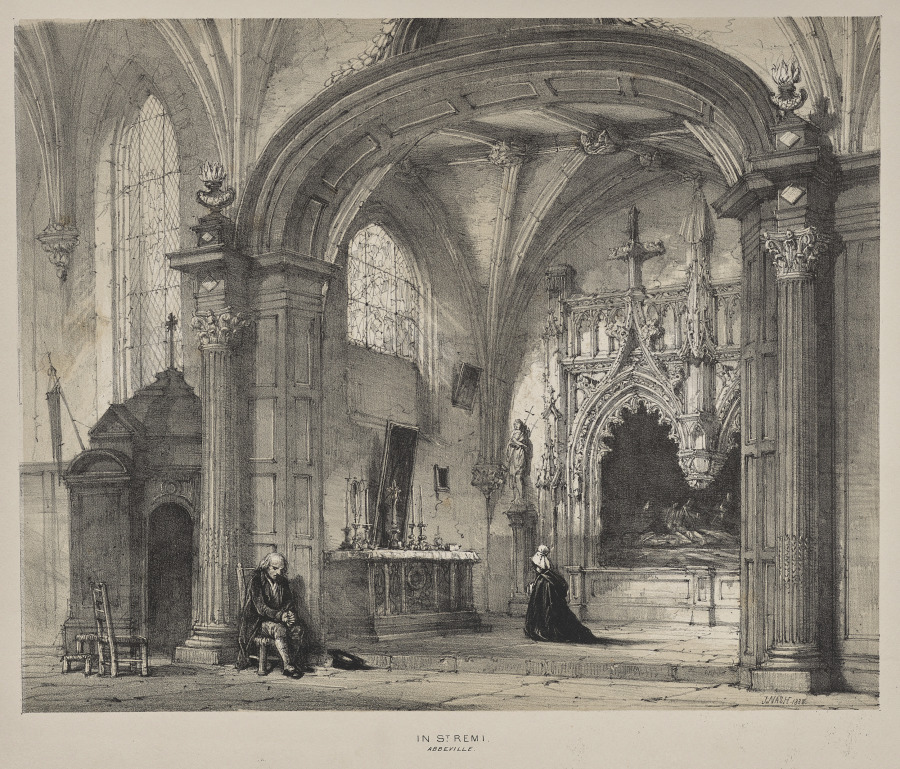
I. The Architectural Premise: St. Remi’s Vertical Imperative
The medieval timber-and-gilt sculpture of the Virgin and Child Enthroned from St. Remi, Abbeville, is not an artifact of devotion alone—it is a treatise on load-bearing form. The Virgin’s seated posture, rendered as a rigid, tower-like mass, establishes a vertical axis that compresses the viewer’s gaze upward, toward a horizon of transcendental order. Her throne is not a piece of furniture; it is a structural metaphor. The folds of her gown, carved in repetitive, parallel ridges, function as buttresses—each crease channeling visual weight downward, anchoring the figure to its base, while the gilded surface denies any gravitational pull by reflecting light as a non-material sheen. This is architecture disguised as iconography.
For the 2026 executive silhouette, this translates into a tailored rigidity that rejects softness as a signifier of authority. The shoulder line must emulate the throne’s armrests—sharp, horizontal, and unyielding. The torso, like the Virgin’s columnar form, should taper minimally, preserving a sense of vertical compression rather than natural waist suppression. The jacket’s length extends to the mid-thigh, echoing the sculpture’s lower register, where the drapery settles into a static, weighted plane. Every seam is a carved line; every dart, a chiseled groove. The result is a silhouette that does not move with the body but disciplines it—a wearable assertion that power is not performed but structurally inherent.
II. The Counterpoint: Georges de La Tour’s Luminous Materiality
Where the St. Remi sculpture imposes a divine exteriority, La Tour’s Ewer (c. 1640) inverts the equation. The brass vessel, illuminated by a single candle, is not a passive object but a self-contained light source. Its convex surface gathers illumination, compresses it into a single, blinding highlight, and then releases it into the surrounding darkness. The handle’s curve and the spout’s arc are not ornamental—they are functional trajectories that guide the eye along a path of tension and release. The painting’s genius lies in its refusal to depict a narrative; instead, it depicts the condition of visibility itself.
In urban materiality, this becomes a lesson in surface treatment. The 2026 executive garment must not rely on pattern or embellishment to assert presence. Instead, it employs fabric as a reflective membrane—a high-density wool with a subtle luster, or a technical silk with a metallic undertone, that catches ambient light in controlled, deliberate bursts. The silhouette’s lapels are cut with a sharp, angular notch, mimicking the ewer’s spout, while the pocket flaps are set at a precise 15-degree angle, echoing the handle’s curvature. These are not decorative gestures; they are optical devices that manipulate how light strikes the body, creating a moving highlight that shifts with the wearer’s stride. The garment becomes a portable chiaroscuro—a study in how darkness and illumination negotiate across a tailored plane.
III. Structural Poetics: The Shared Logic of Containment
Both artworks operate on a paradox: they are containers—the Virgin holds the Christ child; the ewer holds liquid—yet their aesthetic power emerges from what they do not hold. The Virgin’s throne is hollow at its core, a void that supports the sacred body; the ewer’s interior is unseen, its emptiness implied by the solidity of its brass shell. This is the Heideggerian reliability of the tool: the more a vessel fulfills its function, the more its form becomes autonomous, freed from utility to enter the realm of pure presence.
For the tailored silhouette, this translates into a negative-space construction. The jacket’s interior is not a lining but a structural void—a canvas shell that maintains its shape without padding, using a fused interlining that mimics the ewer’s hammered brass. The sleeves are set with a high armhole, creating a clean, uninterrupted line from shoulder to wrist, as if the arm were a liquid poured into a rigid mold. The back panel is cut in a single, unbroken sweep, reminiscent of the Virgin’s frontal rigidity, yet the side seams are angled to allow a subtle, controlled flare—a nod to the ewer’s swelling belly. The result is a garment that feels empty when worn, yet visually full—a paradox that mirrors the sacred and the secular’s shared obsession with the void as the site of meaning.
IV. Urban Materiality: Onyx as the Non-Color of Authority
The chosen palette—Onyx—is not a mere shade but a material philosophy. Onyx is a stone that absorbs light, yet its polished surface emits a faint, internal glow. It is the color of the St. Remi sculpture’s shadowed recesses, where gold leaf fails to reach, and the color of La Tour’s background darkness, against which the ewer’s highlight burns. In urban contexts, onyx signifies silent power: it does not announce itself through brightness but through depth. A tailored suit in onyx reads as a monolith—a moving slab of compressed night, interrupted only by the strategic gleam of a silk tie or a polished metal zipper.
This materiality demands a specific fabrication: a 320-gram wool crepe with a matte finish, woven with a slight technical stretch to preserve the silhouette’s rigidity without sacrificing mobility. The buttons are cut from blackened brass, their surfaces brushed to a low sheen, echoing the ewer’s patina. The stitching is tonal, invisible at a distance, but revealed under direct light as a subtle ridge—a nod to the Virgin’s carved folds. Every element is calibrated to reinforce the garment’s architectonic presence, ensuring that the wearer is not adorned but constructed.
V. Conclusion: The Silhouette as a Dialectical Instrument
The 2026 executive silhouette, derived from the St. Remi Virgin and La Tour’s Ewer, is not a compromise between sacred and secular. It is a synthesis—a tailored form that borrows the Virgin’s vertical authority and the ewer’s luminous self-containment. The garment’s geometry is strict, its surface is reactive, and its core is void. It does not ask to be admired; it demands to be occupied. In this, it fulfills the deepest function of both artworks: to make the invisible visible, not through decoration, but through the disciplined interplay of mass, light, and emptiness. The wearer becomes a living vessel—a container of purpose, whose form is the ultimate proof of presence.