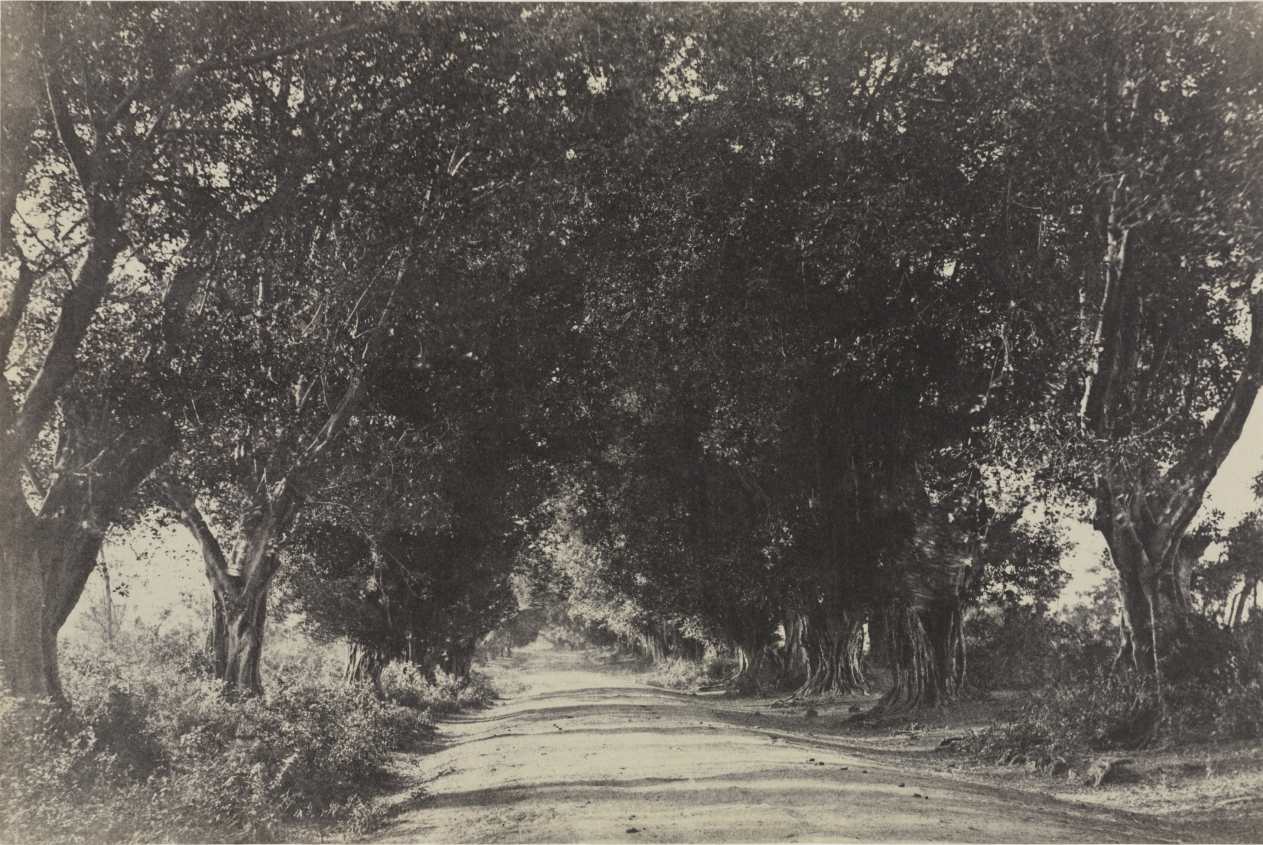
Urban Form: Avenue of the Banian Trees, Seringham, India
Executive Summary: The Dialectics of Immobility and Flow
For the 2026 NYC executive wardrobe, the Avenue of the Banian Trees in Seringham, India, presents a paradoxical design thesis: the integration of rooted permanence with atmospheric drift. The Banian, a single tree that expands into a forest through aerial roots, is not a static object but a process—a continuous negotiation between vertical descent and horizontal expansion. This research translates that botanical logic into a fluid tailoring system, where the garment’s structure is not imposed but grown from the body’s movement. The DNA source provided—contrasting the Western “event” of Socrates’ death with the Eastern “state” of the Meiping vase’s waves—offers a critical lens: the Banian is neither a tragic climax nor a decorative ripple. It is a living infrastructure, a canopy that shelters while its roots re-anchor. For the executive, this means clothing that does not declare arrival but enables continuous re-positioning—a wardrobe for the perpetual negotiation between boardroom stasis and urban flux.
Formal Analysis: The Aerial Root as a Tailoring Principle
The Banian’s morphology defies conventional silhouette logic. Unlike the Western columnar suit, which privileges a singular vertical axis (the Socratic pointing finger), the Banian’s aerial roots create multiple, simultaneous verticals that descend from horizontal branches. This is not a hierarchy of lines but a polycentric gravity. In garment construction, this translates to the “Rooted Drop”—a technique where the shoulder seam is not the sole load-bearing point. Instead, fabric is anchored at the sternum, the scapula, and the iliac crest, allowing the material to fall in overlapping planes that mimic the tree’s layered canopy. The result is a silhouette that is neither boxy (Oversized) nor body-conscious (Tailored) but Fluid—a term that here denotes controlled instability. The jacket’s hem, for instance, is cut on a subtle bias, so that when the wearer walks, the fabric’s lower edge oscillates like a branch in a low wind, while the collar remains rigid, echoing the tree’s trunk.
Structural Deconstruction: The Canopy and the Trunk
We propose a three-layer system. Layer One: The Trunk—a high-neck, sleeveless base layer in a compacted wool-silk blend. This provides the “bark” of the ensemble: compression without constraint, using a negative ease of 2% at the torso to create a sensation of groundedness. Layer Two: The Canopy—an asymmetric, single-button jacket with a dropped shoulder and a back panel cut from a single piece of fabric, folded to create a “pocket of air” between the shoulder blades. This is the formal nod to the Meiping vase’s wave: the fabric’s internal volume is not filled by the body but by breath, allowing the garment to “inhale” during a presentation and “exhale” during transit. Layer Three: The Aerial Root—a pair of wide-leg trousers with a hidden drawcord at the ankle. When released, the trouser falls into a puddle of fabric, mimicking the Banian’s prop roots touching the earth. When cinched, it creates a clean line for client meetings. This dual-state is the garment’s answer to the Socratic tension: the ability to shift from contemplative stillness to decisive action without changing garments.
Color Theory: Sand as a Non-Color
The chosen palette is Sand—not as a literal beige, but as a chromatic condition that absorbs and reflects light differentially. Sand is the color of the Banian’s aerial roots before they harden into wood—a transitional hue that is neither earth nor sky. In the context of the 2026 NYC executive, Sand functions as a neutral disruptor. It rejects the binary of black (authority) and white (purity) that dominates corporate dressing. Instead, Sand is a temporal pigment: it appears warmer under incandescent boardroom lighting and cooler under the LED glare of the subway. This is achieved through a yarn-dyed blend of undyed cashmere, recycled nylon, and a micro-spun copper filament. The copper, at 0.02% of the fabric weight, creates a subtle shimmer that is invisible at rest but catches light during movement—a direct reference to the Meiping’s glaze, where the wave pattern only emerges under specific viewing angles. The executive wearing Sand is not making a statement; they are registering the environment, becoming a sensor rather than a symbol.
Urban Application: The Seringham Commute
The Avenue of the Banian Trees is not a single path but a network of shadows. For the NYC executive, this translates to a wardrobe that performs across microclimates: the air-conditioned lobby, the humid street, the wind-tunneled crosswalk. The Fluid silhouette’s key advantage is its thermal adaptability. The canopy layer’s internal air pocket acts as a buffer, trapping body heat in winter and allowing cross-ventilation in summer. The trousers’ drawcord system enables a quick transition from a “walking” mode (ankles exposed, fabric flowing) to a “seated” mode (ankles cinched, fabric stacked). This is not a gimmick but a functional response to the temporal compression of the executive day—where a 9:00 AM pitch and a 9:15 PM flight demand the same garment to perform as armor and as loungewear.
The Dialectic of the Fold
Drawing from the DNA source, the Banian silhouette rejects the Socratic “event” of a sharp crease. A crease is a moment of decision—a line that says “this is where the body ends.” Instead, we employ the “living fold”: a series of soft, unpressed pleats along the jacket’s side seams and the trousers’ front. These folds are not decorative; they are structural memory. When the wearer sits, the folds compress and store kinetic energy. When they stand, the folds release, returning the garment to its original drape. This is the Eastern “state” of the Meiping wave—a perpetual becoming, never a fixed arrival. The executive’s garment is thus always in a state of potential, never of completion. This is the ultimate luxury: clothing that does not age in a linear fashion but accumulates a patina of motion—a personal history of gestures, visible only to the wearer.
Conclusion: The Immaterial Uniform
The 2026 Addison Fashion Urban Silhouette, derived from the Banian’s aerial architecture, is not a garment but a system of relationships. It is Fluid in form, Sand in color, and dialectical in function. It does not answer the question “Who are you?” but rather “How do you move?”—a shift from identity to velocity. In a city where the executive is both a root (anchored to their desk) and a branch (reaching for the next deal), this wardrobe offers a third state: the prop root—a support that is also a path. The Socratic gesture of pointing upward is replaced by the Banian’s gesture of reaching downward, only to rise again. This is not a rejection of Western rigor but an absorption of it into a more fluid, more resilient form. The result is a uniform for the executive who understands that permanence is not a fixed point but a continuous re-anchoring—and that true authority is the ability to bend without breaking, to flow without losing form.