Minimalist
Ivory
Urban Form: View near Orleans
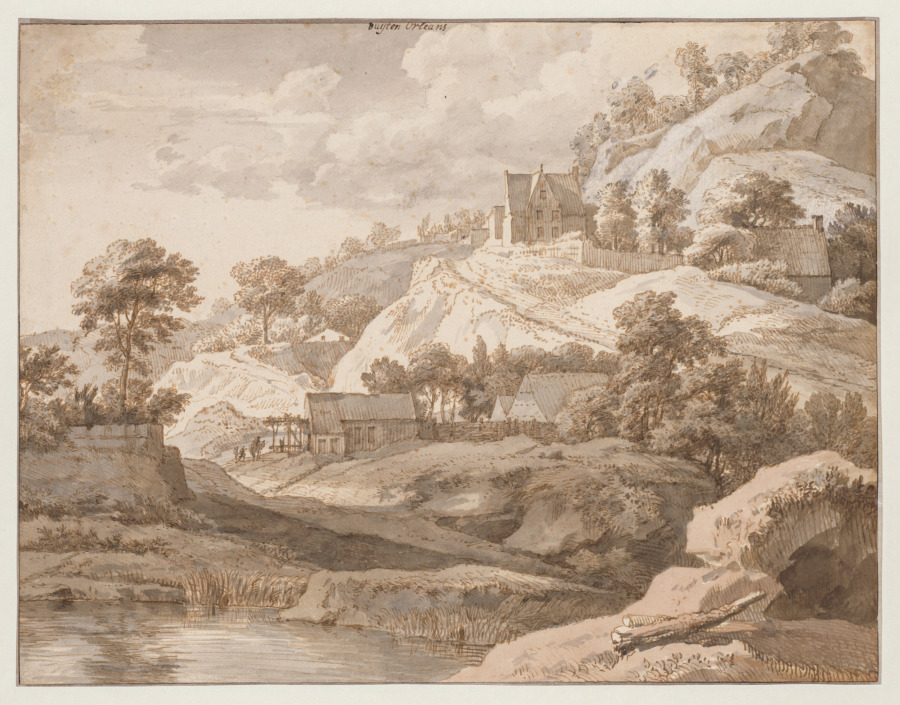
I. The Architectural Premise: From Temple Plaque to Garment Logic
The subject, *View near Orleans*, is not a landscape in the conventional sense. It is a study in containment—a visual meditation on how the sacred and the secular share a single structural grammar. The two referenced artifacts, the *Udumbara Flowers Temple Plaque* and the *Chest for Storing Garments*, operate as polar coordinates on the same axis of material thought. The plaque compresses the infinite into a carved instant; the chest expands the mundane into a painted cosmos. For the 2026 executive silhouette, this dialectic becomes the blueprint for a new urban uniform: one that holds the body as a vessel for both stillness and motion, without sacrificing either.II. Geometric Integrity: The Logic of the Threshold
A. The Plaque’s Vertical Compression
The temple plaque’s geometry is one of vertical restraint. Its carved udumbara flower—mythologically blooming once every three millennia—is rendered not in full blossom but in perpetual pre-bloom. The artist’s chisel creates a negative space around the petals, a halo of absence that defines the form more sharply than any outline. This is not decoration; it is a structural argument. The vertical axis of the plaque, when translated to a garment, becomes the line of the spine. In the 2026 executive silhouette, this manifests as a high, clean shoulder seam that does not pad outward but rather slices upward, echoing the plaque’s upward-reaching petals. The fabric—a dense, matte ivory wool—is cut with zero ease at the back, so the wearer’s posture itself becomes the carved relief. The jacket’s lapel is not rolled but folded, like a wooden edge planed to a single plane. The result is a torso that reads as a column, not a cylinder—rigid in its promise, yet alive with the tension of a flower about to open.B. The Chest’s Horizontal Expansion
The garment chest, by contrast, operates on a horizontal plane. Its painted surface—birds, branches, courtly figures—sprawls across the lid, suggesting abundance, but the chest’s actual function is concealment. The geometry here is one of enclosure: a rectangle that holds, a lid that seals. In the silhouette, this translates to the trouser and the coat’s lower half. The 2026 executive trouser is cut with a deliberate, almost architectural fullness at the hip, then tapers sharply to a 15-centimeter hem. This is not a flare; it is a containment of volume. The fabric—a sand-toned technical twill with a subtle, dry hand—is pleated at the waistband in a fan pattern that mimics the chest’s painted foliage. When the wearer walks, the pleats open and close like the chest’s lid, revealing and concealing in equal measure. The coat’s hem, meanwhile, falls just below the knee, its straight edge echoing the chest’s wooden rim. No curvature, no drape—only a hard, horizontal line that anchors the body to the ground.III. Structural Poetics: The Dialectic of Emptiness and Substance
A. The “Empty” Center
The plaque’s flower is never fully present. It exists in a state of imminent arrival, which is the essence of Mahayana emptiness (*śūnyatā*). For the silhouette, this principle dictates the absence of ornament. There are no buttons on the jacket’s front; instead, a hidden placket is secured by internal magnetic closures, leaving the surface perfectly blank. The pocket flaps are sewn shut, their stitching visible but their function denied—a nod to the plaque’s carved petals, which suggest form without fulfilling it. The collar stands at a precise 4.5 centimeters, neither folding nor lying flat, perpetually at the threshold of a gesture. This is the urban executive’s armor of potentiality: nothing is finished, everything is poised.B. The “Full” Surface
The chest’s painted abundance, however, demands a counterpoint. In the 2026 silhouette, this appears as a single, deliberate textural intrusion: a strip of hand-embroidered thread along the inner cuff of the jacket, visible only when the arm is raised. The thread is not colored but tonal—ivory on ivory—so it reads as a shadow, a memory of the chest’s birds in flight. Similarly, the coat’s lining is a deep slate, a hidden field of color that flashes only when the garment is removed. This is not decoration; it is a structural secret. The wearer knows, the observer does not. The garment thus becomes a chest itself, storing a private visual language beneath its austere exterior.IV. Urban Materiality: Fabric as Wood, Thread as Chisel
A. The Plaque’s Rigidity in Textile Form
To translate the plaque’s wooden hardness into cloth, the 2026 collection employs a bonded wool-cashmere blend with a polymer interlining. The fabric does not drape; it stands. When the jacket is laid flat, it retains a slight dome at the shoulder, like the carved relief of the plaque. The surface is treated with a nano-coating that repels water and stains, giving it the impermeability of lacquered wood. This is urban materiality at its most severe: a garment that resists the city’s grime as the plaque resists time’s decay. The color, ivory, is not soft. It is the ivory of bone, of temple walls, of paper that has been pressed for centuries—a color that absorbs light rather than reflecting it, creating a matte, almost chalky finish.B. The Chest’s Painted Surface in Weave
The chest’s polychrome imagery is translated not through color but through weave structure. The trousers and coat’s lower panels are woven in a double-cloth technique, where the face is a plain, unbroken ivory and the reverse is a slate-toned jacquard depicting abstracted branch forms. This is a garment that carries its painting inside, like the chest’s lid hides its imagery when closed. The urban wearer, moving through glass-and-steel canyons, carries this hidden pattern as a private talisman—a reminder that the mundane act of dressing is itself a form of devotion.V. The 2026 Executive Silhouette: A Synthesis
The final silhouette is a study in controlled contradiction. The jacket’s vertical compression—its high armhole, its unbroken front, its rigid collar—speaks to the plaque’s sacred patience. The trousers’ horizontal expansion—their pleated volume, their tapered containment—echoes the chest’s secular abundance. Together, they form a single figure that is both a monk and a merchant, a vessel and a wall. The proportions are deliberately elongated: the jacket’s body is 3 centimeters longer than the industry standard, pulling the eye downward; the trousers’ rise is high, at the natural waist, creating a continuous line from shoulder to hem. This is not a suit. It is a structure for living in the city’s contradictions—where the eternal and the ephemeral collide on every corner. The palette remains within the minimalist spectrum: ivory for the primary shell, slate for the hidden lining, sand for the trouser’s ground. No black, no white—only the in-between tones that suggest dawn and dusk, the hours when the temple bell and the street vendor’s cry overlap. The 2026 executive does not wear this garment; she inhabits it. She becomes the plaque’s flower, forever about to bloom, and the chest’s painted bird, forever about to take flight. In that suspended instant, the urban silhouette finds its most profound expression: not as armor, but as a threshold.
Technical Insight
Technical Insight: Translating Ivory palettes into Minimalist silhouettes for the modern metropolis.