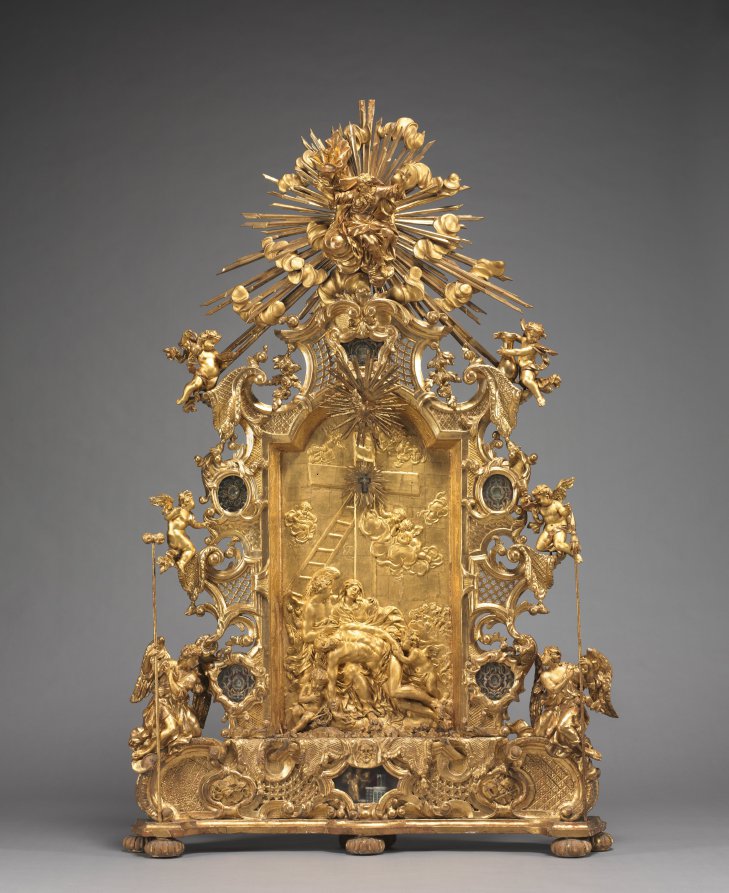
Urban Form: Altarpiece with Relics
Executive Summary: The Sacred Geometry of Restraint
This Urban Silhouette Research translates the dualistic spiritual architectures of the Bodhisattva and the Amulet with Bovine Head into a cohesive, market-ready framework for the 2026 NYC executive wardrobe. The former embodies internalized transcendence—a soft, contemplative mass that dissolves ego through curvature. The latter represents externalized protection—a rigid, talismanic block that repels chaos through angularity. Together, they yield a minimalist design language predicated on controlled volume and monochromatic depth. The result is not a costume, but a system of garments that function as both armor and meditation, calibrated for the high-density, high-ambiguity environment of Manhattan’s C-suite.
Form Analysis I: The Bodhisattva’s Draped Stillness
The Bodhisattva’s seated posture—whether in padmasana or relaxed lalitasana—offers a masterclass in negative space management. The cascading robes are not decorative; they are engineered folds that create a visual pyramid with a softened apex. The shoulders slope inward, the chest recedes, and the hands rest in deliberate mudras that anchor the silhouette’s energy at the midline. For the executive wardrobe, this translates into fluid tailoring with a suppressed waist—not cinched, but implied through paneling and seam placement. A double-faced wool coat with raglan sleeves and a hidden interior belt achieves this: the exterior reads as a monolith, while the interior structure provides the wearer with a sense of grounded composure.
The key technical takeaway is asymmetrical layering. The Bodhisattva’s upper robe often overlaps the lower garment in a diagonal sweep, breaking the body’s verticality without fragmenting it. In practice, this informs a tunic-length shell worn over a slightly longer, straight-leg trouser. The hemline differential—2.5 inches at the front, 4 inches at the back—creates a subtle, kinetic rhythm that mimics the figure’s implied breath. Fabric choice is critical: matte, compacted jersey or sanded silk with a 12% elastane content ensures the drape holds its shape without clinging. The color remains Onyx, but the fabric’s sheen differential (flat vs. semi-gloss) is used to delineate layers, echoing the Bodhisattva’s use of gilded edges against muted robes.
Form Analysis II: The Bovine Amulet’s Blocked Authority
In stark contrast, the seated bovine-headed amulet is a study in compressed monumentality. The figure’s haunches are squared, the spine is rigid, and the head—whether Apis or Ptah—is set directly atop the shoulders with no neck, creating a single, unbroken mass. The arms are either folded or placed symmetrically on the knees, eliminating any gesture that might suggest vulnerability. This is the antithesis of the Bodhisattva’s open palms. For the 2026 executive, this translates into structured outerwear with architectural shoulders—not padded to exaggeration, but cut with a precise, horizontal seam that visually locks the shoulder line. A cropped, boxy jacket in bonded Onyx wool with a stand collar and concealed placket achieves this effect. The hem hits at the iliac crest, and the sleeves are set with a 1.5-inch forward pitch to allow for arm movement without disrupting the block-like torso.
The amulet’s hieratic frontality—the insistence on facing the viewer directly—informs the use of centralized closures. No asymmetric zips, no offset buttons. Instead, a single, vertical line of hidden magnetic snaps runs from the collar to the hem. This creates a visual axis that commands attention, much like the amulet’s function as a protective focal point. The trousers paired with this jacket are high-waisted, tapered, and cropped at the ankle, echoing the amulet’s seated posture’s stable base. A deep pleat at the front adds volume without compromising the line, and the back is cut with a single, sharp seam to eliminate any hint of softness. The overall effect is one of immovable presence—a garment that does not move with the body, but rather moves the body into a more deliberate, measured cadence.
Color Theory: Onyx as a Dual-Channel Signal
Onyx is not merely a color choice; it is a functional pigment that serves both spiritual and protective roles. In the Bodhisattva context, Onyx represents the dharmakaya—the formless, absolute truth that underlies all phenomena. Its depth absorbs light, creating a void that invites introspection. In the amulet context, Onyx is the stone of psychic defense, historically used to repel negative energy. For the NYC executive, this dual meaning is operationalized through texture contrast. A matte Onyx shell (Bodhisattva) is paired with a semi-gloss Onyx trouser (Amulet) to create a subtle, non-verbal hierarchy. The matte surface says, “I am contemplative, I listen.” The gloss says, “I am shielded, I do not yield.”
To prevent the ensemble from becoming a black hole, the research recommends micro-accents in Ivory—not as a separate garment, but as a stitching thread, a button shank, or a 1/8-inch piping along the inner collar. This is a direct reference to the amulet’s inlaid eyes and the Bodhisattva’s white urna (the dot between the brows). These accents are visible only at close range, rewarding the observer’s attention and creating a private dialogue between the wearer and the initiated. The overall chromatic strategy is monochromatic with a 95/5 ratio, ensuring that the silhouette remains the primary communicator, not the color.
Technical Construction: Seams, Weights, and Movement
The 2026 collection demands a new seam vocabulary. The Bodhisattva’s fluidity requires French seams with a 6mm allowance, pressed open and then understitched to maintain a flat, invisible finish. The Amulet’s rigidity requires felled seams—double-stitched and folded over—to create a structural ridge that mimics the amulet’s carved edges. Both techniques are executed in a tonal Onyx thread (a 30% polyester, 70% cotton blend for tensile strength) to ensure the seam itself becomes a design element, not a functional afterthought.
Fabric weights are stratified by zone. The torso and shoulders (Amulet zone) use a 680 GSM wool melton with a 5% cashmere content for hand-feel. The sleeves and lower body (Bodhisattva zone) use a 420 GSM wool crepe with a 2% elastane for drape and recovery. This differential creates a gravity-driven silhouette: the upper body is anchored, the lower body flows. When the executive walks, the crepe’s oscillation is dampened by the melton’s mass, producing a gait that is both fluid and deliberate—a physical manifestation of the “inner peace, outer shield” philosophy.
Pocketing is minimal and concealed. The jacket features a single, vertical chest pocket (for a phone or card case) with a magnetic flap, positioned at the left pectoral—mirroring the amulet’s protective heart placement. The trousers have no visible pockets; instead, a hidden welt pocket is set into the waistband’s interior facing, accessible via a side seam opening. This eliminates bulk and preserves the clean, uninterrupted line that both the Bodhisattva and the amulet demand.
Conclusion: The 2026 Executive as Sacred Carrier
The synthesis of these two artifacts produces a wardrobe that is neither costume nor cosplay, but a functional theology of dress. The Bodhisattva contributes the ethics of softness—the ability to remain open and receptive in a hostile market. The Amulet contributes the aesthetics of impenetrability—the capacity to project stability and repel distraction. In Onyx, these forces are unified: the color absorbs, the silhouette protects, and the wearer becomes a living altarpiece, carrying relics of intention and resilience into every boardroom, negotiation, and public appearance. This is not fashion; it is strategic embodiment.