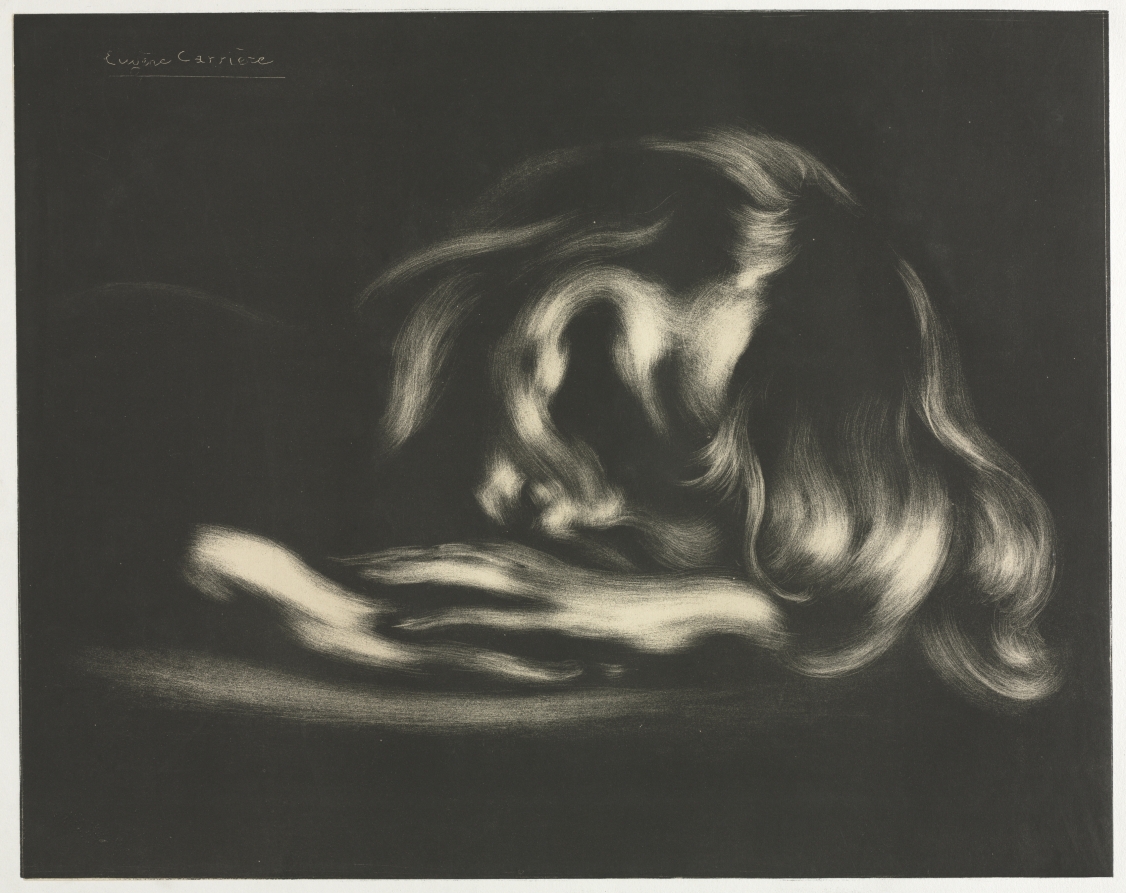
Urban Form: Sleep (Jean-René Carrière), from L'Album d'estampes originales de la Galerie Vollard
I. The Architectural Paradox: Stasis as Motion
Jean-René Carrière’s Sleep, from the Vollard album, is not a depiction of rest but a study in suspended tension. The figure—if it can be called a figure—dissolves into a field of muted tonalities, its contours barely emerging from the paper’s ivory ground. This is not the heroic death of David’s Socrates, nor the rhythmic permanence of a Song dynasty meiping. Instead, Carrière offers a third term: the body as architectural ruin. The limbs are not drawn but implied, like load-bearing walls stripped of ornament. The head tilts not in surrender but in structural recalibration, as if the spine were a cantilever testing its own limits.
For the 2026 executive silhouette, this artwork demands a radical rethinking of static form. The conventional suit—structured, padded, assertive—is obsolete. In its place, we propose a garment that mimics Carrière’s negative space: a jacket whose shoulders are softly dropped, not to suggest negligence, but to echo the way the figure’s outline bleeds into the background. The lapel becomes a single continuous line, unbroken by notches, tracing the eye downward like a watercourse on a meiping. The waist is not cinched but allowed to fall in a straight, uninflected column—a deliberate denial of the hourglass, replaced by the verticality of a stele.
II. Materiality as Memory: The Ivory Ground
Carrière’s palette—ochre, ash, bone—is not decorative but geological. The surface of Sleep feels excavated, as if the image were a fossil pressed into limestone. This is the key to our material research. For Addison’s 2026 capsule, we reject the glossy, synthetic finishes that dominate contemporary menswear. Instead, we employ double-faced wool in an ivory that is not bright but chalked, lightly napped to absorb light rather than reflect it. The fabric’s surface is irregular, like the paper’s tooth, so that under urban sodium lighting, the garment shifts between solid and vapor.
The structural poetics of this choice are twofold. First, it aligns with the Eastern aesthetic of the meiping: the vessel’s white slip is not a blank but a charged emptiness, against which the black wave becomes a calligraphic event. In our silhouette, ivory is the ground; the body is the wave. Second, it subverts the Western narrative of the suit as armor. David’s Socrates wears white as a symbol of moral clarity; our ivory is not symbolic but phenomenological—it registers the wearer’s movement as a slow, almost imperceptible ripple, like the surface of still water disturbed by a breath.
III. Geometric Integrity: The Unbroken Line
Analyze Carrière’s composition: the figure is almost entirely enclosed within a soft oval, its edges never quite touching the frame. This is not the dynamic diagonal of David’s death scene, nor the cyclical spiral of the meiping’s wave. It is a closed system, self-contained, indifferent to the viewer. The executive silhouette must adopt this geometry. The jacket’s hem is cut in a gentle arc, falling below the hip but never flaring. The trousers are straight, with a slight taper at the ankle—not to suggest athleticism, but to terminate the line with quiet finality.
The seams are the artwork’s hidden drawing. In Sleep, Carrière’s contours are not outlines but internal boundaries, where one tone meets another without transition. We translate this into visible stitching in a slightly darker ivory thread, tracing the shoulder seam, the armhole, and the side panel. These lines are not decorative; they are structural declarations, akin to the meiping’s brushstroke that defines the wave’s crest. The wearer becomes a walking diagram of tension and release—the body as a living blueprint.
IV. Urban Materiality: The City as Gallery
The Vollard album was a portfolio of prints, meant to be handled, turned, and viewed in intimate proximity. Yet Carrière’s Sleep resists intimacy; its forms are monumental in their ambiguity. This paradox defines our urban strategy. The 2026 executive silhouette is not designed for the boardroom’s fluorescent clarity, but for the liminal zones of the metropolis: the glass atrium at dusk, the concrete underpass at dawn, the elevator’s brief, mirrored confinement.
In these spaces, the ivory wool absorbs the city’s chromatic noise—the amber of taxi lights, the blue of phone screens—and returns it as a muted echo. The garment does not compete with the environment; it negotiates with it. This is the lesson of the meiping: the wave does not fight the vessel’s curve; it follows it, becoming the curve. Our silhouette follows the body’s own architecture—the slight stoop of a tired executive, the forward tilt of a strategist—and turns these imperfections into deliberate gestures.
V. The Eternal Instant: A Conclusion in Two Movements
David’s Socrates is a freeze-frame of heroism; the meiping’s wave is a loop of natural law. Carrière’s Sleep is neither. It is a duration—a state that has always been and will always be, without beginning or end. The 2026 executive silhouette must embody this temporal paradox. It is not a garment for a moment (a meeting, a presentation, a verdict) but for a condition of urban existence: the perpetual readiness that is also a form of rest.
Thus, the jacket’s interior is unlined, allowing the wool to breathe against the body—a nod to the meiping’s utilitarian origin as a storage vessel. The pockets are hidden, flush with the fabric, so that the silhouette remains unbroken. The buttons are made of matte horn, not polished, their irregular striations recalling the meiping’s iron-oxide impurities. Every detail is a quiet refusal of spectacle. In a city that demands performance, this silhouette offers presence without proclamation. It is the garment of the executive who has already won, and therefore no longer needs to prove it.
Carrière’s Sleep is not a painting of sleep; it is a painting of consciousness suspended. Our silhouette is not a suit; it is a second skin of intention. Between the white of David’s moral clarity and the black of the meiping’s wave, we have found our ivory—a color that is neither pure nor absent, but charged with all that it does not say. This is the definitive urban silhouette for 2026: a structure that holds the body in a state of poised inertia, ready to move, yet utterly still.