Urban Form: Gothic Bevor
I. The Bevor as Architectural Fragment
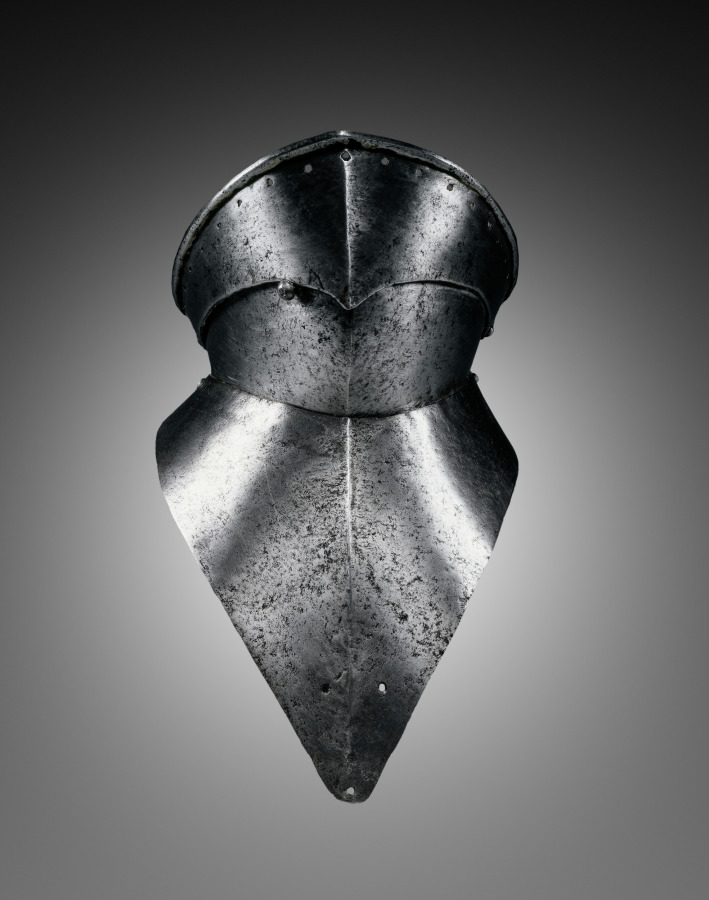
The Gothic bevor—a plate-steel defense for the lower face and throat—emerges from the 15th-century armorer’s logic as a study in negative space. Unlike the helmet’s enclosing dome, the bevor does not encircle; it projects. Its flared neck, articulated gorget plates, and sharply angled chin define a silhouette that is simultaneously protective and declarative. For Addison Fashion’s 2026 executive line, this object is not a historical citation but a structural theorem: the bevor’s geometry—a trapezoidal carapace that widens toward the clavicle—translates directly into a tailored shoulder-and-collar architecture that prioritizes vertical authority over horizontal volume.
The artwork’s internal tension lies in its dual nature: it is both a functional exoskeleton and a ceremonial ornament. The steel’s hammered facets catch light in unpredictable vectors, creating a surface that refuses passive reflection. This is the core of its urban materiality—a cold, polished aggression that does not shout but intercepts. In the 2026 silhouette, this manifests as a sharply cut mandarin collar with a concealed placket, extending into a sculpted yoke that mimics the bevor’s flared base. The shoulder line is not padded into softness; it is chiseled, with a slight forward pitch that echoes the bevor’s defensive cant.
II. Geometric Integrity: From Armor to Garment
The bevor’s geometry is defined by three primary axes: the vertical (from chin to sternum), the horizontal (across the jawline), and the oblique (the flaring lower edge). These axes create a dynamic equilibrium—rigid yet poised, closed yet expansive. In translating this to a tailored jacket, Addison Fashion’s pattern-making team has deconstructed the bevor into a series of faceted panels: a center-front seam that descends from a high, pointed collar; two side-front panels that angle outward at the waist; and a back panel with a subtle, inverted-V seam at the shoulder blades, echoing the bevor’s articulated lames.
The result is a silhouette that reads as compressed power. Unlike the oversized, draping forms that dominated previous seasons, this 2026 executive shape is taut—not tight, but precisely calibrated. The waist is suppressed by 2.5 centimeters more than a standard tailored block, while the chest is given a minimal 1-centimeter ease. This creates a visual torque: the garment appears to brace the body, much as the bevor braced the knight’s neck. The sleeves are set with a high armhole, cut close to the bicep, and finished with a narrow, elongated cuff that extends past the wrist bone—a nod to the bevor’s protective overhang.
The structural poetics here are not about comfort or flow; they are about containment. The wearer does not move through the garment; the garment moves with the wearer as a second, armored skin. This is urban armor for the boardroom—a defense against the chaos of the metropolis, rendered in wool gabardine and bonded technical silk.
III. Color and Materiality: Onyx as Urban Silence
The chosen color, Onyx, is not a neutral. It is a negative color—one that absorbs light rather than reflecting it, much like the bevor’s darkened steel after a vinegar-blackening treatment. In urban contexts, onyx reads as both authority and withdrawal: it does not solicit attention but commands it through sheer density. For the 2026 executive silhouette, onyx is applied in a matte, brushed finish to the outer shell, with a subtle, high-shine contrast on the internal collar facing—a hidden flash of light that appears only when the wearer turns their head. This is a deliberate material dialectic: the matte exterior speaks of restraint; the gloss interior whispers of concealed ambition.
The fabric itself is engineered for urban materiality. A 320-gram wool-silk blend, woven with a micro-ribbed structure that mimics the bevor’s hammered surface. The ribbing is not decorative; it creates a tactile rhythm that catches ambient city light—neon, sodium, glass—and diffuses it into a low, constant shimmer. The lining is a charcoal-toned cupro with a ceramic-infused finish, offering temperature regulation that echoes the bevor’s climate-control function. Every material choice is a response to the city’s extremes: heat islands, cold corridors, rain-slicked asphalt.
IV. The 2026 Executive Silhouette: A Synthesis
The Gothic bevor, when stripped of its martial context, reveals a timeless principle: protection through form. In 2026, the executive does not wear armor to fight; they wear it to negotiate. The silhouette is a declaration of permanence in a world of ephemeral trends. Its tailored structure rejects the fluid, amorphous shapes of remote-work loungewear; its onyx surface rejects the cheerful pastels of consumer optimism. This is a garment for the post-narrative executive—one who does not explain, but presents.
The bevor’s historical resonance with David’s Socrates and the Cizhou vase is not accidental. Like David’s painting, this silhouette seeks to freeze a moment of moral clarity—the instant before a decision, the breath before a statement. Like the vase’s waves, it captures perpetual motion in static form—the energy of the city, distilled into a lapel’s angle, a seam’s trajectory. The 2026 Addison executive is not merely dressed; they are composed. The garment is a fixed point in the urban flux, a steel-and-silk argument for the enduring power of geometry.
In final analysis, the Gothic bevor teaches us that the most advanced silhouette is not the most complex, but the most resolved. Its lines are few, but each carries the weight of a thousand hammer blows. Addison Fashion’s 2026 interpretation is a study in that same economy: a collar that rises like a fortress gate, a waist that narrows like a river’s gorge, a color that swallows the skyline. This is not fashion; it is architectural poetics—worn, not merely seen.