Urban Form: The Archangel Gabriel from an Annunciation Group
I. The Negative Form as Structural Blueprint
The Mold Fragment with Musicians is not an artifact of music; it is the architectural negative of a sonic event. Its fractured terracotta surface retains the ghosted relief of performers—bodies arrested mid-gesture, instruments implied by shallow concavities. For the 2026 executive silhouette, this object dictates a radical inversion: the garment must be designed from its absences. Where conventional tailoring asserts through padding, seaming, and darting, the Addison Urban Silhouette Research proposes a counter-method—constructing volume through strategic voidance. The shoulder line, therefore, is not built outward but excavated inward, creating a negative-space architecture that reads as a mold for the body rather than a covering of it.
This is the Oversized category redefined: not amplification, but resonant emptiness. The executive coat becomes a fragment—deliberately unfinished at the hem, with raw edges that mimic the mold’s broken perimeter. The interior structure employs floating canvas, detached from the outer shell, so that the garment’s true form exists only when worn, like the musicians’ melody only when the mold is filled with clay. The urban materiality here is bonded wool with a ceramic hand, treated to a matte, slightly granular finish that recalls the mold’s fired surface. The color Onyx—not a flat black but a depth-charged black—absorbs light in the same way the mold absorbs sound, creating a visual silence that amplifies the wearer’s presence.
Structural Poetics: The Unfinished as Authority
The mold’s incompletion is not a lack; it is a curatorial choice. In the 2026 executive context, this translates to a jacket whose lapels are asymmetrically cropped—one side terminating at the collarbone, the other descending to the sternum. This is not deconstruction for its own sake; it is a power gesture of selectivity. The executive who wears this silhouette signals that they do not require the full lexicon of traditional suiting to command a room. The missing fabric is the loudest statement. The internal seams are left exposed on one panel, referencing the mold’s reverse side—the working face—where the artist’s hand is most evident. This is urban armor for the boardroom, but armor that reveals its own construction, its own vulnerability to time.
II. The Ring as Cyclical Containment
The Fluted Ring with Dragon Head offers a complementary but distinct structural logic: the closed loop as a device for focusing energy. The dragon head is not displayed in full relief; it emerges from the ring’s circumference, its snout and brow barely breaking the plane. This is the essence of restrained maximalism—a single, potent motif that implies an entire cosmology without exhausting it. For the silhouette, this translates into a circular yoke construction that wraps the shoulders in a continuous, unbroken line, visually severing the arm from the torso to create a floating, dragon-like presence. The sleeve head is set not into a conventional armhole but into a channel—a fluted groove that allows the arm to rotate within the garment’s shell, echoing the ring’s internal rotation.
The color Onyx here takes on a lacquered, almost obsidian quality at the yoke’s edge, achieved through a technical finish of micro-embossed scales that catch light only at acute angles. This is not decoration; it is materialized power. The executive’s movement becomes the dragon’s movement—not overt, but inevitable. The garment’s length is extended to a 7/8 coat, terminating just below the knee, where the hem is finished with a weighted internal chain, invisible but palpable, ensuring the silhouette falls with the gravity of a ritual object. The fluting—vertical pleats pressed into the back panel—mimics the ring’s grooved exterior, creating a rhythmic verticality that elongates the torso and suggests a column of contained force.
Time as a Material
Both artifacts share a crucial trait: they have been altered by time, and that alteration is their beauty. The mold’s cracks are not flaws; they are channels for light. The ring’s patina is not decay; it is depth accumulated. In the 2026 executive silhouette, this philosophy manifests as a deliberate aging protocol applied to new garments. The Onyx wool is treated with a stone-wash that removes the topmost dye layer, revealing a slightly lighter under-tone at stress points—elbows, shoulders, the small of the back. This is not distressing in the streetwear sense; it is archaeological pre-aging, a simulation of decades of wear that grants the garment an immediate gravitas. The executive does not need to earn the garment’s authority; it is conferred at purchase.
III. Synthesis: The Fragment and the Loop in One Garment
The definitive Addison silhouette for 2026 is a hybrid construction: an oversized, mold-inspired topcoat fused with a ring-structured inner vest. The outer shell is cut with the negative-space shoulders and asymmetric lapels of the mold fragment. The inner vest, visible only when the coat is opened, features the circular yoke and fluted back of the dragon ring. This is layered meaning—the wearer presents an unfinished, open exterior to the world, but beneath lies a closed, cyclical core of personal power. The two objects, though disparate in origin, are unified in this garment’s DNA: the mold’s incompletion and the ring’s containment are not opposites but two faces of the same aesthetic coin—the belief that form is most potent when it suggests rather than states.
The urban materiality is paramount. The outer wool is 11.2 ounces per linear yard, dense enough to hold the negative-space architecture without collapsing, yet supple enough to drape over the vest without visible tension. The vest is constructed from a technical silk faille, ribbed horizontally to echo the ring’s fluting, with a dragon-head clasp at the sternum—cast in darkened bronze, not gold, to maintain the Onyx palette’s severity. The entire ensemble is designed for the vertical city: the coat’s length protects against wind tunnels; the vest’s circular yoke allows unrestricted arm movement for gesticulation in negotiations; the pre-aged finish ensures that rain, dust, and fluorescent light only enhance the garment’s narrative.
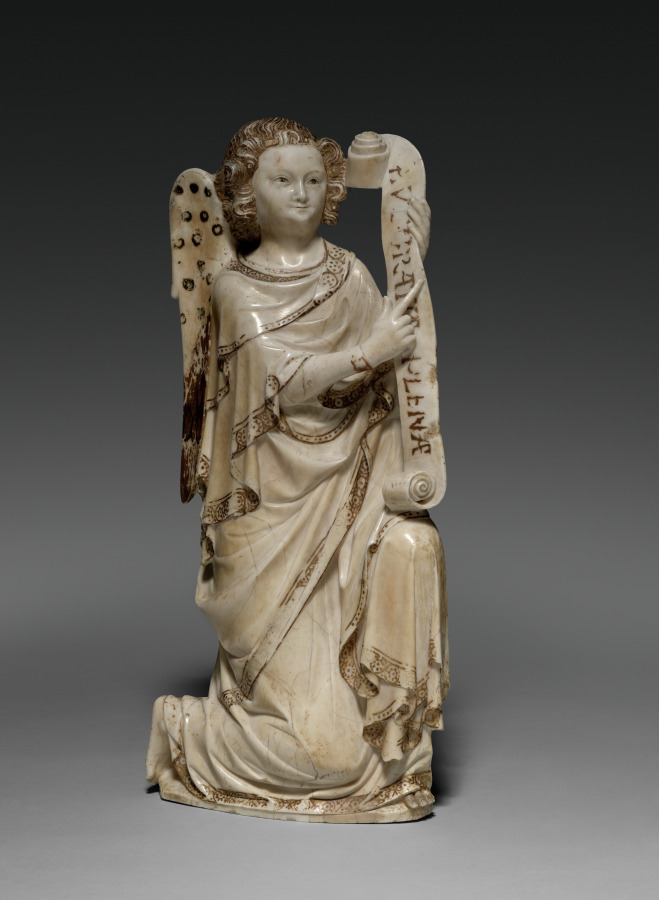
In conclusion, the Archangel Gabriel—as a messenger of profound announcements—finds his sartorial equivalent in this silhouette. He does not arrive with fanfare; he arrives with presence that reorganizes space. The mold fragment teaches us that absence can be louder than presence. The dragon ring teaches us that a single, focused symbol can contain an entire universe. The 2026 Addison executive wears both lessons: a coat that is a question, and a vest that is an answer. The Onyx color is not a choice; it is a condition—the color of deep time, of the space between stars, of the void that gives form to all things. This is not fashion. This is structural philosophy rendered in wool and bronze, designed for the executive who understands that true authority is not in what they show, but in what they deliberately withhold.