Urban Form: The Apotheosis of Romulus: Design for a Ceiling
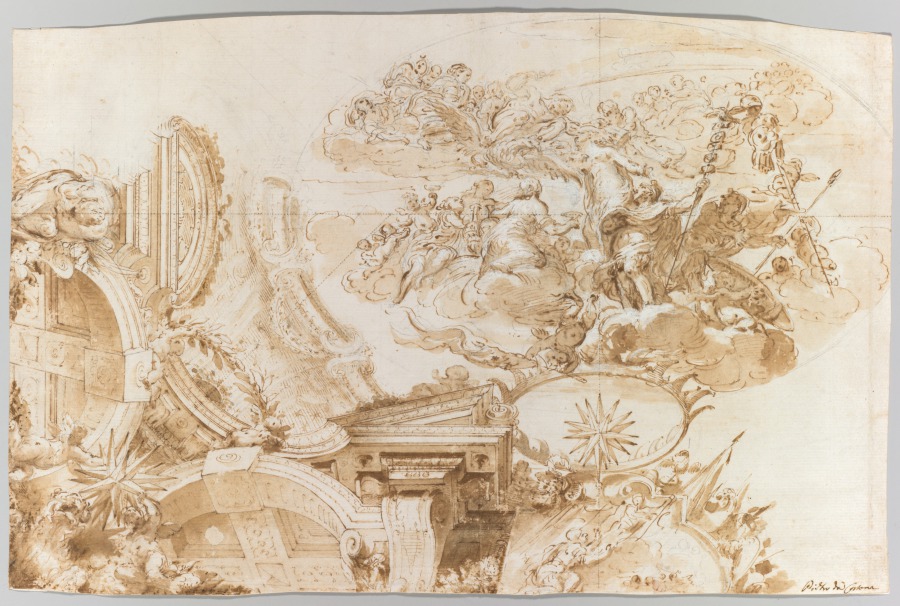
Geometric Integrity and the Apotheosis of Romulus: A Structural Reading
The ceiling painting titled The Apotheosis of Romulus presents a paradox central to contemporary executive dressing: the illusion of ascension rendered through rigorous, horizontal containment. For Addison Fashion’s 2026 Urban Silhouette Research, this artwork functions not as a decorative antecedent but as a blueprint for volumetric discipline. Its composition—a swirling vortex of figures, clouds, and architectural fragments—is anchored by an unseen but palpable grid. The eye is drawn upward, yet the painting’s internal logic insists on a centrifugal pull back to a central axis. This dual motion—expansion and restraint—defines the new executive silhouette: a garment that suggests flight while remaining tethered to the body’s structural truth.
Romulus, the founder of Rome, is depicted at the moment of his deification. The ceiling’s geometry does not celebrate chaos; it organizes transcendence. Every floating limb, every billowing drape, every foreshortened angel adheres to a perspectival scaffold that mimics the architectural coffers surrounding the fresco. For the 2026 silhouette, this translates into a deliberate suppression of natural body curves in favor of engineered lines. The shoulder becomes a cornice—sharp, unyielding, projecting authority. The torso is a frieze, compressed into a clean, uninterrupted column. The waist, if articulated at all, is a hyphen rather than a cinch, suggesting a pause in the vertical narrative rather than an admission of organic softness.
Structural Poetics: From Fresco to Fabric
The painting’s chiaroscuro—the dramatic play of divine light against mortal shadow—finds its sartorial equivalent in the manipulation of fabric weight and opacity. In the 2026 executive wardrobe, this is not achieved through print or embellishment but through material stratification. A double-faced wool crepe in ivory, for instance, mimics the fresco’s plaster luminosity: matte on the exterior, with a subtle, almost imperceptible sheen when the wearer moves. The garment’s internal structure—fused canvases, taped seams, and precision-cut linings—replicates the painting’s hidden armature. Just as the ceiling’s figures are supported by an invisible system of iron rods and wooden beams, the Addison jacket is supported by a skeletal architecture of horsehair canvas and boning at the side seams. The result is a silhouette that appears to float over the body, yet never loses contact with its foundational geometry.
The apotheosis motif—the moment of elevation—is translated into the silhouette’s back construction. A tailored coat or jacket in this collection will feature a bi-swing back or a pleated yoke that releases volume only at the shoulder blades, echoing the painting’s upward surge of drapery. When the wearer reaches forward, the fabric opens like a cloud parting; when at rest, it closes into a seamless plane. This is kinetic minimalism: the garment’s true form is revealed only in motion, much as the ceiling’s full composition is only legible when the viewer tilts their head back and walks the room’s perimeter. The executive silhouette is thus not static but choreographed, designed for the decisive gestures of negotiation, presentation, and command.
Urban Materiality: The City as Canvas
Romulus’s apotheosis occurs above the Roman Forum—a site of political, legal, and commercial life. The painting’s materiality, however, is not marble or bronze but pigment on plaster, a surface that ages, cracks, and absorbs the city’s humidity. For Addison, this suggests a material palette that embraces urban patina rather than sterile perfection. The 2026 collection will employ technical fabrics that mimic this aged quality: a bonded cotton-nylon twill with a slight, irregular slub; a wool-silk blend with a dry, chalky hand; a coated linen that develops a subtle craquelure under stress. These are not “performance” fabrics in the athletic sense but architectural textiles that record the wearer’s environment—the press of a subway strap, the brush of a marble lobby wall, the crease from a long flight.
Color, per the specification, is Ivory—not as a blank canvas but as a loaded neutrality. In the painting, ivory appears in the clouds that cradle Romulus, in the togas of the senators below, and in the marble of the temple pediments. It is a color of both divine radiance and civic authority. For the executive silhouette, ivory is deployed in monochromatic layering: an ivory double-faced coat over an ivory silk-wool turtleneck over ivory wide-leg trousers in a slightly lighter or darker tone. The effect is not flat but tonal, creating a vertical rhythm that elongates the figure—a secular apotheosis achieved through proportion rather than pictorial illusion. The color’s inherent luminosity is controlled through surface texture: a matte jersey for the base layer, a satin-backed crepe for the blouse, a felted wool for the outer shell. Light is absorbed, reflected, and diffused across the body, mimicking the fresco’s uneven plaster ground.
The 2026 Executive Silhouette: A Definitive Code
Drawing from the painting’s centralized composition, the Addison silhouette rejects asymmetrical draping, deconstruction, or any gesture that disturbs the body’s vertical axis. The shoulders are squared but not padded—achieved through a sleeve head that is set slightly forward, creating a subtle, architectural overhang. The lapel is a notch with a sharp, almost aggressive peak, referencing the painting’s triangular groupings of figures. The jacket’s length is hip-skimming, never cropped, never elongated beyond the crotch point—a nod to the painting’s horizon line, which sits at the viewer’s eye level, grounding the celestial scene in human perspective. Trousers are straight-legged with a single, forward crease, falling to a break at the shoe, where they pool slightly—a concession to the urban environment’s need for movement, yet disciplined enough to maintain a clean line.
Dresses and coats follow the same logic. A sheath dress in ivory wool-cashmere is cut with no darts at the bust, relying instead on the fabric’s own body and a series of internal seams that trace the ribcage like the painting’s architectural ribs. A coat, in a heavier ivory melton, is cocoon-shaped but with a suppressed back, creating a volume that reads as deliberate mass rather than accidental bulk. The silhouette’s final element is the absence of ornament. No buttons are visible; closures are hidden beneath plackets or achieved through interior hooks. Pockets are jetted and bound, invisible until used. This is not austerity but purity of intention—every line, every seam, every gram of fabric is justified by the painting’s lesson: that transcendence is not an escape from structure but its ultimate expression.
In conclusion, The Apotheosis of Romulus offers the 2026 executive silhouette a paradigm of controlled ascension. It teaches that the body in power does not need to shout; it can whisper through precision. The Addison interpretation is a garment that stands as a monument to the wearer’s own potential for elevation—not through theatrical excess, but through the quiet, relentless logic of geometry. The ceiling’s figures rise because the architecture below them is sound. So too does the executive rise, wrapped in ivory, cut on the bias of history, and seamed with the future’s unyielding line.