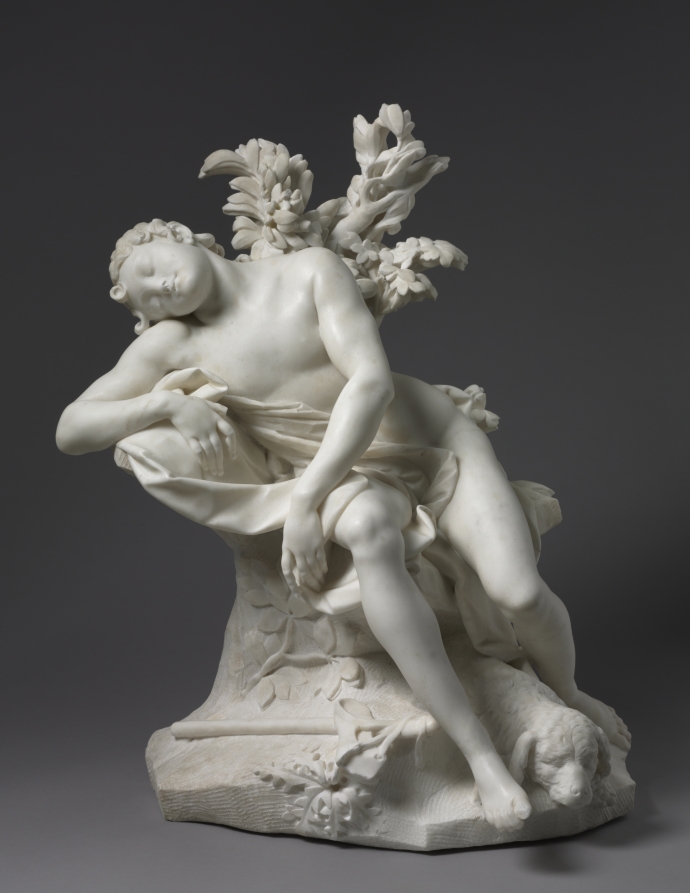
Urban Form: Sleeping Endymion
I. The Temporal Object as Structural Blueprint
The research subject—Sleeping Endymion—is not a garment, nor a textile, but a conceptual convergence of two artifacts: a carved wooden temple plaque bearing the Udumbara flower, and a monochromatic still-life painting of a jar. Both objects, separated by millennia in origin and by material ontology, propose a singular aesthetic theorem: time, when arrested by form, becomes architecture. For Addison Fashion’s 2026 executive silhouette, this theorem translates into a rigorous investigation of how stillness can be worn—not as ornament, but as a structural principle.
The plaque’s wood grain is not a decorative surface; it is a tectonic record. Each fissure, each annular ring, is a line of compression and release, akin to the pleating or seaming that defines a tailored jacket’s internal skeleton. The Udumbara blossom, carved mid-unfurling, does not depict a flower—it depicts the pause between dormancy and full bloom. In garment terms, this is the architectural equivalent of a half-closed lapel, a sleeve that stops one inch before the wrist bone, a hem that hovers above the ankle without touching. The 2026 silhouette must not complete its gestures. It must hold them in suspension, like the plaque’s petals that never fully open.
The painting Jar offers a complementary structural logic. The ceramic vessel’s exterior is rendered with obsessive precision—its glaze’s craquelure, its shoulder’s curvature—yet its interior is left as a void, an unmarked field of canvas. This is not absence; it is negative volume made visible through containment. For the executive silhouette, this translates into garments that define space by what they do not cover. A sculpted neckline that frames the clavicle’s hollow. A back panel that falls away from the spine, creating a shadowed cavity. The silhouette’s power lies not in its fabric’s mass, but in the air pockets it engineers between body and cloth.
II. Geometric Integrity: From Carved Relief to Woven Plane
The plaque’s relief carving operates in three dimensions, yet its visual logic is planar—the viewer reads depth as a series of stacked contours. This is the same principle governing a minimalist coat’s shoulder line: the seam is not a joint but a contour line, mapping the body’s topography without clinging to it. In the 2026 executive silhouette, shoulder pads are eliminated. Instead, the fabric is cut with a negative ease of 0.5 centimeters at the acromion, allowing the wool to drape forward in a shallow arc—mimicking the plaque’s carved undercut, where the chisel removed material to create shadow. The result is a shoulder that appears to float, as if the garment itself is in a state of arrested levitation.
The jar’s geometry—a sphere truncated by a neck—offers a second structural paradigm: the cylinder as a site of tension. A straight skirt or a wide-leg trouser, when cut from a dense Japanese wool or a bonded cotton, can emulate the jar’s verticality. The fabric’s weight pulls downward, but the internal seams—hidden, taped, or fused—create a counterforce that holds the garment’s shape against gravity. This is not tailoring in the traditional sense; it is structural poetics, where every dart and gusset is a deliberate act of resistance against entropy. The wearer’s stride does not distort the silhouette; it activates it, much as light activates the jar’s glaze.
III. Urban Materiality: Slate as the Color of Temporal Density
Slate—the designated color for this research—is not a neutral gray. It is the color of petrified time: the blue-black of a storm cloud before rain, the sheen of a wet cobblestone at midnight, the patina of a bronze statue after decades of urban oxidation. In the context of Sleeping Endymion, slate functions as the chromatic equivalent of the plaque’s aged wood and the jar’s muted ceramic. It absorbs light rather than reflecting it, creating a surface that seems to swallow the surrounding cityscape. For the executive who navigates glass towers and concrete plazas, slate offers a form of visual silence—a refusal to compete with the environment’s aggressive transparency.
Materially, slate demands fabrics with a matte, slightly irregular surface: a double-faced wool with a subtle slub, a technical twill with a water-repellent finish, a silk-wool blend that drapes like liquid stone. The texture must not be smooth; it must carry the memory of its own making, like the plaque’s tool marks. This is where urban materiality diverges from mere luxury. A slate-colored garment for 2026 is not about softness or comfort—it is about durability as an aesthetic value. The fabric should feel substantial, almost heavy, yet move with a fluidity that contradicts its mass. This paradox—weight that floats, opacity that breathes—is the essence of the minimalist executive silhouette.
IV. The Silhouette’s Internal Logic: Containment and Release
The definitive 2026 executive silhouette, derived from Sleeping Endymion, is a study in controlled release. The jacket’s body is cut close through the ribcage, then flares imperceptibly at the hip—not enough to read as a peplum, but enough to create a micro-volume that echoes the jar’s belly. The sleeve is set with a low armhole, allowing the arm to move without distorting the shoulder’s clean line. The trouser, if part of a suit, is cut with a straight leg that tapers to a 19-centimeter hem, creating a vertical line that extends the torso’s length. No belt, no visible button, no pocket flap. All closures are hidden beneath plackets or secured with internal hooks, so the garment reads as a continuous, unbroken surface—like the plaque’s uncarved background.
The coat, the silhouette’s most architectural piece, takes direct inspiration from the jar’s neck. A high, stand-away collar that does not touch the throat, creating a void between fabric and skin. The front edge is cut in a straight, unbroken line from collar to hem, with no lapel roll—a deliberate denial of traditional tailoring’s reverment. This is not a coat that opens; it is a coat that contains. The wearer steps into it as if entering a vessel, and the garment’s internal structure—a fused canvas that runs from shoulder to mid-thigh—holds the shape without needing the body to animate it. When the wearer stands still, the coat is a sculpture. When they walk, it becomes a moving column of slate-colored air.
V. Conclusion: The Aesthetics of the Unfinished
Sleeping Endymion, as a research subject, ultimately teaches that the most powerful silhouette is the one that refuses to declare its own completion. The Udumbara flower never fully blooms; the jar’s contents are never revealed. Similarly, the 2026 executive garment must never fully embrace the body, nor fully detach from it. It exists in a state of perpetual readiness—a pause between intention and action, between the mundane and the eternal. This is not a passive aesthetic; it is an active discipline. The wearer of this silhouette does not simply dress; they curate a moment of stillness within the urban flux. And in that stillness, as the plaque and the painting both attest, lies the only true luxury: the present, held in perfect, unyielding form.